Under drone fire, exiled Kurds wait to confront Iranian regime
Key Takeaways
- Exiled Iranian Kurds face drone fire while waiting to confront the Iranian regime
- Shaho Bloori, 53, has two sisters in Iran and 18 relatives killed by the regime
- One of Bloori's brothers, a protest singer, was executed at age 21
Personal loss and motive
Shaho Bloori, 53, is an exiled Iranian Kurd who trains a new generation of Peshmerga in a tented camp in northern Iraq and says he hears the call of home from both the living and the dead.
“- Published Like many exiled Iranian Kurds, Shaho Bloori, 53, hears the call of home from both the living and the dead”
Two of his sisters remain in Iran, and 18 of his relatives lie buried there, including one of his brothers, a protest singer executed at the age of 21 whom Bloori says is "forever young".
He says the Islamic Revolution Guard Corps hanged his brother, riddled his body with bullets, and then heaped more suffering on his mother by threatening her when she washed his son, which he recounts had "16 bullet holes".
Bloori says he wants justice not revenge if the regime falls, declaring: "Even if someone is guilty of hanging my brother, I don't want them to be executed. We need freedom, not another regime like the Islamic regime."
He says if fighters based in Iraq do cross into western Iran his first mission will be to honour those who are gone by visiting graves and telling the dead: "I remember you always, and I cry for you."
Camp life and threats
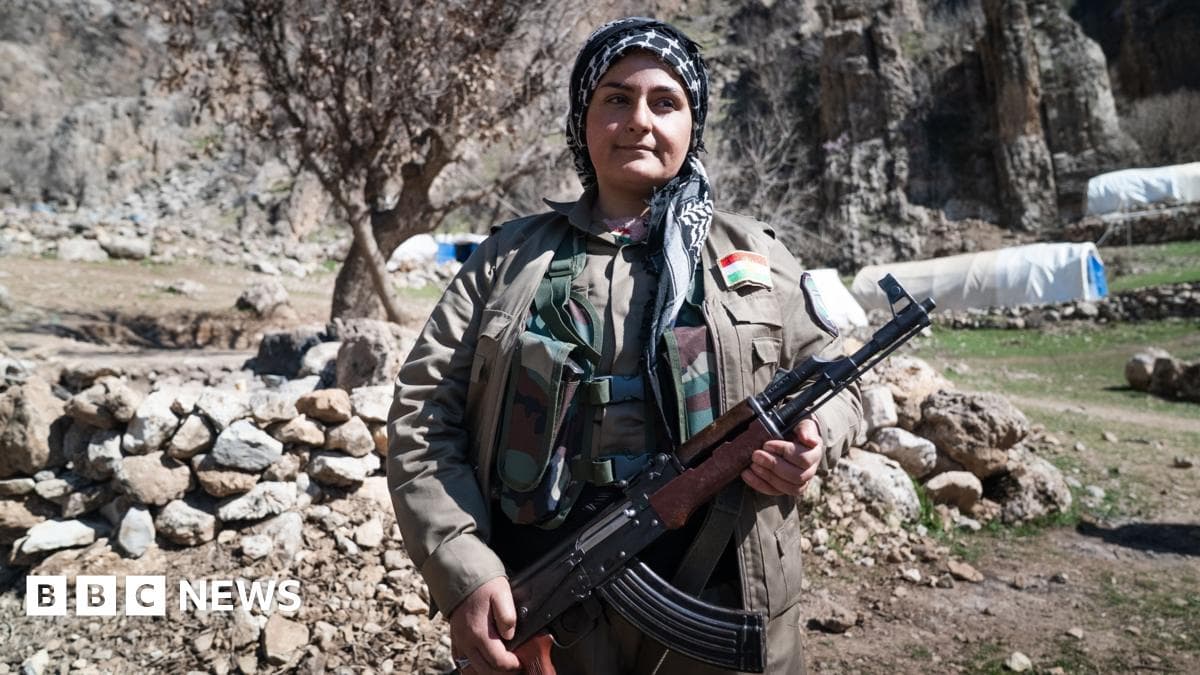
We met Bloori in a camp ringed by mountain peaks that is home to dozens of Peshmerga and where two Peshmerga stood guard behind him as he spoke.
The commander, white-haired and softly spoken, belongs to a small dissident group called Komala of the Toilers of Kurdistan, which is part of a recently formed alliance of Iranian Kurdish organisations opposed to the regime.
Days before the visit there were two drone strikes about a kilometre away that caused injuries but no deaths, and the camp uses drone detection equipment and low-tech sentries as early warnings.
Around two dozen fighters lined up to greet the BBC team, chanting and raising Kalashnikovs while the slogan "Woman, life, freedom" echoed through the mountains; more Peshmerga stood sentry on hilltops and a lone fighter scanned the horizon with his dog by his side.
The authorities in the autonomous region, who are Iraqi Kurds, want to stay out of the war next door and have sought to keep Iranian Kurdish fighters away from the cameras.
Politics and expectations
A senior Komala official, Amjad Hossein Panahi, visited the fighters with his wife and said he has been waiting to see the fall of the regime since its birth 47 years ago, but stressed that air strikes alone "are not enough".
“- Published Like many exiled Iranian Kurds, Shaho Bloori, 53, hears the call of home from both the living and the dead”
Panahi told the BBC that bombing is weakening the regime but ground forces must intervene and "the Kurds can play an important role in this," and he first wants to see a no-fly zone imposed by the US.
He said he does not trust US President Donald Trump, adding "I feel he may decide to stop the war," but insisted "whether or not Trump stops the war, the Islamic Republic is in its final days. It will be brought down, by him or by [Israeli Prime Minister Benjamin] Netanyahu, or by the people."
The report also notes that the Kurds are stateless and spread mainly across four countries—Iraq, Iran, Syria and Turkey—and that rising oil prices, which hurt Americans and others at the petrol pumps, raise questions about how long the US will remain involved.
Immediate danger and risks
During the visit Panahi received a call reporting an attack on a Komala camp in the city of Sulaymaniyah, near the border with Iran, and he warned the gathered fighters that "drones and ballistic missiles are coming" which prompted immediate dispersal.
The BBC team and the Peshmerga scattered to seek cover, and although the skies remained clear at that moment the fighters were left in position in the mountains as they have been for decades.
The article cautions that if Iranian Kurdish fighters enter the war it could be very costly for them and could threaten the fragile stability of Iraq.
Additional reporting for this story was provided by Wietske Burema, Matthew Goddard and Bishar Shareef.
More on Iran
Oil Prices Climb as Iran Proposes Reopening Strait of Hormuz With U.S. Nuclear Talks Deferred
13 sources compared

Sir Christian Turner Says U.S. Only Special Relationship Is Probably Israel
14 sources compared
U.S. Intelligence Agencies Assess How Iran Would Respond If Trump Declares Victory
13 sources compared
Trump Administration Rejects Iran Proposal To End War, Reopen Strait of Hormuz Without Nuclear Program
11 sources compared