Ukraine War05 January, 20263 min read
United States Backs Security Guarantees for Ukraine at Paris Summit
United States endorsed security guarantees committing support if Russia attacks Ukraine again. United Kingdom and France pledged to deploy troops and establish military hubs after a ceasefire.

25 outlets told this the same way.
Outlets did split on Russian Attack Kills At Least 33 On Two Buses In Kramatorsk →
Ukraine postwar security talks
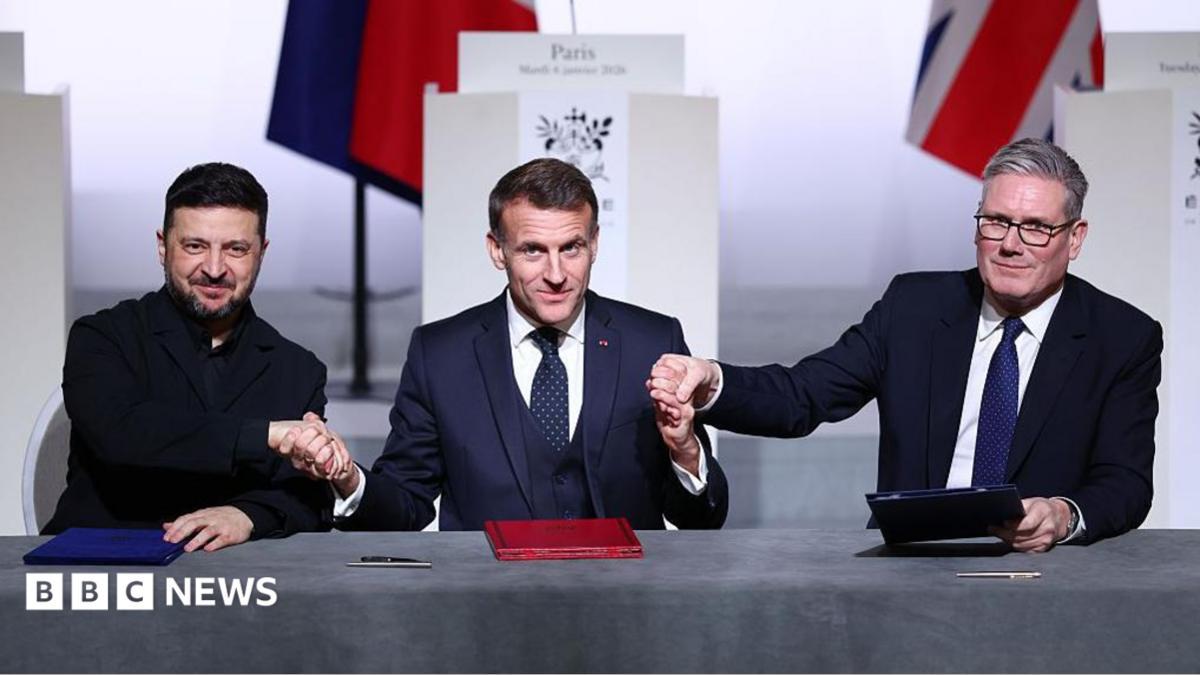
Leaders from a 35-country 'coalition of the willing' met in Paris on 6 January to craft post-war security guarantees for Ukraine. For the first time, the United States signalled formal backing for broad guarantees that would take effect if a credible ceasefire is reached. Multiple outlets report U.S. envoys Steve Witkoff and Jared Kushner attended the talks alongside senior military representatives.
“At a Paris summit of a ‘coalition of the willing’ of mainly European countries, the United States for the first time formally backed broad security guarantees for Ukraine that leaders said would include binding commitments to come to Kyiv's aid if Russia attacks again.”
Coalition leaders said the package would include commitments to come to Kyiv's aid if Russia attacks again. French President Emmanuel Macron described the declaration as 'legally and politically binding.'
Ukrainian President Volodymyr Zelensky travelled to Paris to join the talks. The summit is presented across sources as a major step toward building a multinational framework for Ukraine's security after hostilities pause, although the exact legal form and timing remain to be finalised.
Ceasefire monitoring and support
Sources converge on the key operational elements under discussion: a multinational monitoring and verification mechanism, U.S. support short of combat troop deployments, and commitments by France and the UK to deploy forces after a ceasefire. Reporting describes a U.S.-led truce monitoring cell in Paris and technology-centred verification — drones, sensors and satellites — rather than U.S. combat troops.
Several outlets say the U.S. would provide intelligence, logistics and a backstop for a European-led peacekeeping or security force. France and Britain announced readiness to deploy personnel and create military hubs in Ukraine after hostilities pause.

Ukraine security guarantees
Ukrainian leaders and summit participants described the moves as deterrence and rebuilding measures but said many details remain unresolved. President Zelensky welcomed the guarantees as a strong signal of support. Coalition leaders said territorial issues, monitoring details, financing and legal arrangements still need work.
“Ukrainian president Volodymyr Zelenskyy called the agreements a serious, concrete signal of support but said details — including monitoring, military support and financing — still need to be worked out.”
Reports also emphasized Moscow’s continued rejection of foreign troops on Ukrainian soil and the political difficulty of persuading Russia to accept such guarantees. That stance leaves the proposals conditional and subject to complex negotiations.
US role in coalition
Coverage varies on the precise role Washington will play. U.S. envoys and officials were present and are quoted as supporting strong deterrence. Outlets note the formal US endorsement in coalition language was softened from earlier drafts.
They say American participation would likely prioritise intelligence, logistics and a monitoring role rather than front-line combat. US envoys were described as signalling President Trump's backing, with Witkoff saying the president 'strongly stands behind security protocols'. Some reports stress that language about using US capabilities to support a multinational force was removed from the final coalition statement.
Paris summit follow-up
Despite the summit’s momentum, reporting emphasises practical and political hurdles ahead, including persuading Moscow to accept guarantees, finalising legal and territorial arrangements, and deciding which partners will place forces on Ukrainian soil. Outlets report divergent national stances, with some pledging deployments while others rule them out or limit them to neighbouring NATO territory.
“Allies’ stances diverged: the UK and France said they would send troops, Italy and Poland ruled out deployments, and Germany said any deployment would be limited to a NATO member bordering Ukraine.”
Several outlets note that operational plans, including troop numbers, basing, and whether forces would operate in western Ukraine for training rather than at the front, remain provisional or contentious. In short, the Paris summit created a framework and a political signal, but the move from intent to binding operational commitments is unfinished and contested.