Full Analysis Summary
US Skips UN Human Rights Review
The United States boycotted its Universal Periodic Review (UPR) at the UN Human Rights Council.
It became only the second country after Israel to skip this mandatory human rights assessment.
The US delegation did not appear in Geneva even though all 193 UN member states are expected to undergo review every four to five years.
Coverage consistently notes the unprecedented nature of the move but frames it differently.
Some emphasize the breach of UN norms, while others focus on the political backdrop.
The decision had been signaled in advance, with the absence announced months earlier.
It drew swift criticism at the session itself.
Coverage Differences
tone
TRT World (West Asian) emphasizes institutional gravity and system-level consequences, reporting accusations that the US was "undermining the UN system," while Al Jazeera (West Asian) frames the act as skipping a "mandatory" review. The Killeen Daily Herald (Other) centers the political context in Washington, tying the empty seats in Geneva to prior withdrawals from UN bodies under President Donald Trump.
narrative
Al Jazeera (West Asian) underscores the formal scope of the UPR applying to "all 193 UN member states," whereas TRT World (West Asian) highlights the nonattendance and its rarity after Israel, and The Killeen Daily Herald (Other) stresses the immediate visual of empty seats and linkage to US domestic policy decisions.
US Withdrawal and Reactions
Criticism was immediate and multifaceted.
Countries such as China and Cuba accused Washington of disrespecting the process.
Rights groups and even some US officials expressed alarm.
At the same time, the US State Department defended the move.
It pushed back on criticism from certain Human Rights Council members and invoked the country’s identity as a founding UN member and defender of individual liberties.
Both West Asian outlets and local reporting note the lead-up.
Washington had already signaled in August that it would not attend.
Coverage Differences
narrative
TRT World (West Asian) and Al Jazeera (West Asian) foreground international backlash—especially from China and Cuba—portraying the boycott as "disrespecting" the process, while The Killeen Daily Herald (Other) elevates domestic civil society and officials in Geneva who called the decision "disappointing" and "harmful" to global human rights progress.
missed information
Only Al Jazeera (West Asian) reports the US Department of State’s defense in notable detail, while TRT World (West Asian) and The Killeen Daily Herald (Other) do not include Washington’s stated rationale beyond noting the boycott and reactions.
timeline
Both TRT World (West Asian) and Al Jazeera (West Asian) specify the August announcement of nonattendance, a detail The Killeen Daily Herald (Other) emphasizes less while focusing on the September scene in Geneva.
US Boycott of UN Review
Several outlets highlight that the US is following Israel’s lead by becoming only the second country to boycott the Universal Periodic Review (UPR).
The reasons for the boycott differ according to sources: local US reports link it to domestic political directives related to perceived bias against Israel at the UN.
In contrast, West Asian sources emphasize a breach of UN review norms and avoid attributing a political motive.
One report also points out that despite tensions, the US participated in the 2020 UPR, making this boycott a significant departure from recent practice.
Coverage Differences
narrative
Al Jazeera (West Asian) and TRT World (West Asian) both stress the sequence—"second country, after Israel"—without ascribing a motive, whereas The Killeen Daily Herald (Other) links the boycott to a February order rooted in perceived anti-Israel bias at the UN.
missed information
Only The Killeen Daily Herald (Other) notes prior US participation—despite earlier withdrawals—by stating the US still joined the 2020 UPR, a detail not included in the West Asian outlets cited.
Overview of UPR Process
The UPR’s structure and scope are highlighted across coverage.
It is a process that applies to all 193 member states on a four-to-five-year cycle.
According to one report, the review would have examined LGBTQ rights, immigrant rights, and the death penalty.
Another outlet stresses the UPR’s role as a key mechanism for assessing and recommending improvements to human rights records.
Institutional fallout followed quickly.
The UN Human Rights Council moved to address the non-cooperation and set a new date for the US review.
Coverage Differences
missed information
Al Jazeera (West Asian) uniquely details issue areas under review—"LGBTQ rights, immigrant rights, and the death penalty"—while TRT World (West Asian) and The Killeen Daily Herald (Other) do not list specific topic areas.
narrative
TRT World (West Asian) foregrounds institutional response—rescheduling to late 2026 and urging renewed cooperation—while The Killeen Daily Herald (Other) emphasizes the UPR’s mandatory character and cadence, and Al Jazeera (West Asian) emphasizes the universal scope of the process.
US Non-Participation in UN Council
Procedurally, the timeline is clear yet framed differently.
Washington announced in August it would not attend.
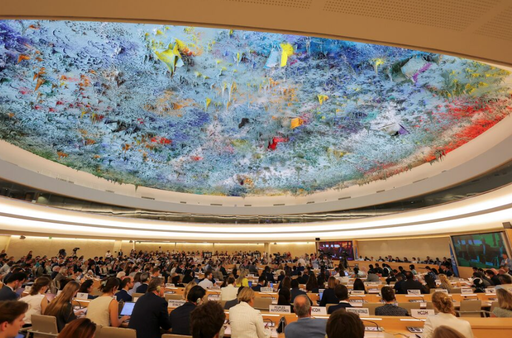
By September, the US seats in Geneva were visibly empty.
The Human Rights Council later adopted a decision to address the non-cooperation.
The Council called on the US to resume participation and pushed the review to late 2026 with a possibility of an earlier slot.
Reactions ranged from charges of disrespecting UN oversight to defenses anchored in US identity and principles.
Coverage Differences
timeline
TRT World (West Asian) and Al Jazeera (West Asian) both state the August announcement of nonattendance, while The Killeen Daily Herald (Other) spotlights the September imagery of empty seats in Geneva.
institutional response vs. optics
TRT World (West Asian) details the Human Rights Council’s formal response—addressing non-cooperation and rescheduling—whereas The Killeen Daily Herald (Other) centers the optics and political backdrop; Al Jazeera (West Asian) balances procedure with noting the State Department’s defense.