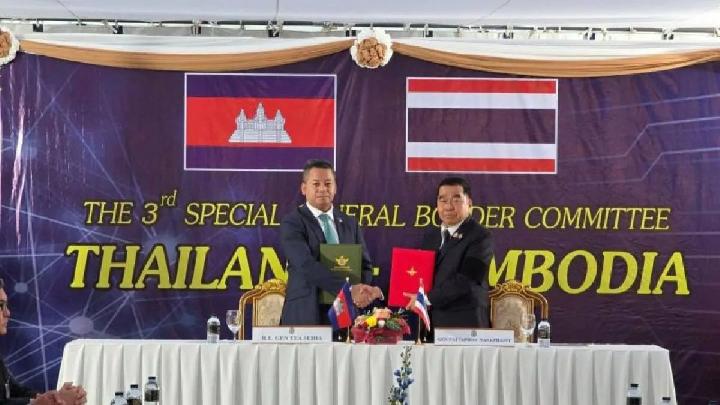
Full Analysis Summary
U.S. $45M stabilization pledge
The United States has pledged $45 million to support stabilization after the Thailand–Cambodia ceasefire.
Assistant Secretary of State Michael George DeSombre announced the package during a virtual briefing on Jan. 9, 2026 and in Phnom Penh.
The funding breakdown cited across reports is $15 million for border stabilization and aid to displaced persons, $10 million for demining and unexploded ordnance clearance, and $20 million for programs to combat fraud, drug trafficking and related threats.
Tempo.co English reports the pledge and the identical breakdown and notes DeSombre’s announcement and role in monitoring the ceasefire.
Cambodianess likewise lists the $45 million package with the same components and emphasizes community recovery and restoring normalcy.
Al Jazeera places the pledge in a broader U.S. engagement context, noting Washington’s interest in strengthening ties with Cambodia and earlier U.S. actions on foreign aid tied to narrow U.S. interests.
Coverage Differences
Tone and emphasis
Tempo.co English (Western Alternative) presents the pledge in diplomatic and operational terms, focusing on the announcement, the funding breakdown, and DeSombre’s monitoring role; Cambodianess (Other) reports the same numbers but emphasizes community recovery, civilian safety and restoring normalcy; Al Jazeera (West Asian) situates the pledge within wider U.S. strategic aims, noting efforts to limit Chinese influence and earlier U.S. decisions on aid. Tempo frames the pledge as diplomatic support and monitoring, Cambodianess frames it as recovery assistance and institutional cooperation, and Al Jazeera frames it as part of U.S. strategic interests and past aid decisions.
U.S. aid after clashes
The pledge comes after a period of heavy fighting and a Dec. 27 ceasefire that halted recent clashes.
Al Jazeera reports the truce ended 20 days of fighting that killed at least 101 people and displaced more than half a million on both sides.
Tempo.co English places the pledge in the aftermath of months of renewed fighting that escalated in July with artillery and air strikes, producing civilian casualties and displacements.
Cambodianess notes the funding aims to help displaced people and restore normalcy but warns that landmine incidents and the slow activation of monitoring mechanisms remain obstacles to lasting peace.
Together, the sources describe a volatile security context with large civilian impacts and substantial displacement that the U.S. package aims to address.
Coverage Differences
Detail emphasis and casualty reporting
Al Jazeera (West Asian) provides specific casualty and displacement figures tied directly to the Dec. 27 ceasefire and the 20 days of fighting, giving a sense of scale; Tempo.co English (Western Alternative) emphasizes a longer timeline with renewed fighting since July and references artillery and air strikes as escalation points; Cambodianess (Other) focuses less on exact casualty figures and more on how the funding will assist displaced communities and on ongoing obstacles such as landmines and monitoring delays.
U.S. diplomatic engagement
Reports differ in describing U.S. diplomatic engagement.
Tempo.co English quotes DeSombre saying he welcomed the Dec. 27 truce and Thailand’s release of 18 captured Cambodian soldiers as steps toward restoring trust.
Tempo.co also reports the U.S. will keep monitoring the ceasefire and sees opportunities to deepen cooperation.
Cambodianess says the U.S. is working with ASEAN and Malaysia to help implement the Kuala Lumpur Peace Accords and stands ready to support border demarcation if requested, while stressing that demarcation is a bilateral matter.
Al Jazeera notes U.S. strategic aims to strengthen ties with Cambodia to limit Chinese influence and reports that President Trump claimed credit for resolving the dispute even as his administration cut or froze some foreign aid, including de-mining assistance, a nuance that complicates a simple portrayal of uninterrupted U.S. assistance.
Coverage Differences
Narrative on U.S. role and scope
Tempo.co English (Western Alternative) frames the U.S. as an on-the-ground monitor and partner seeking to deepen cooperation; Cambodianess (Other) emphasizes multilateral coordination with ASEAN and Malaysia and a willingness to support demarcation if requested while noting bilateral limits; Al Jazeera (West Asian) introduces a geopolitical interpretation, reporting that President Trump has "claimed credit" and highlighting past U.S. aid cuts or freezes which could suggest mixed U.S. policy signals rather than a purely stabilizing role.
Demining funding and risks
Tempo.co English, Cambodianess, and Al Jazeera flag implementation risks despite the pledge.
Tempo.co English and Cambodianess include demining in the $10 million funding package and list unexploded ordnance clearance as an explicit line item.
Cambodianess and Al Jazeera underscore remaining obstacles such as landmine incidents, slow activation of monitoring mechanisms, renewed violence, and contested border areas that Phnom Penh says require Thai withdrawal.
This creates ambiguity because Tempo and Cambodianess frame demining funds as forward-looking stabilization while Al Jazeera reports that the U.S. previously cut or froze some foreign aid, including demining assistance to Cambodia.
That discrepancy raises questions about continuity and the political framing of U.S. assistance.
Coverage Differences
Apparent tension between current pledge and past aid actions
Tempo.co English (Western Alternative) and Cambodianess (Other) explicitly list $10 million for demining as part of the new package and frame it as remediation for landmine risks; Al Jazeera (West Asian) reports that the U.S. administration "cut or froze some foreign aid (including de‑mining assistance to Cambodia)," which may appear to contradict or complicate the narrative of steady U.S. support and suggests mixed policy signals.