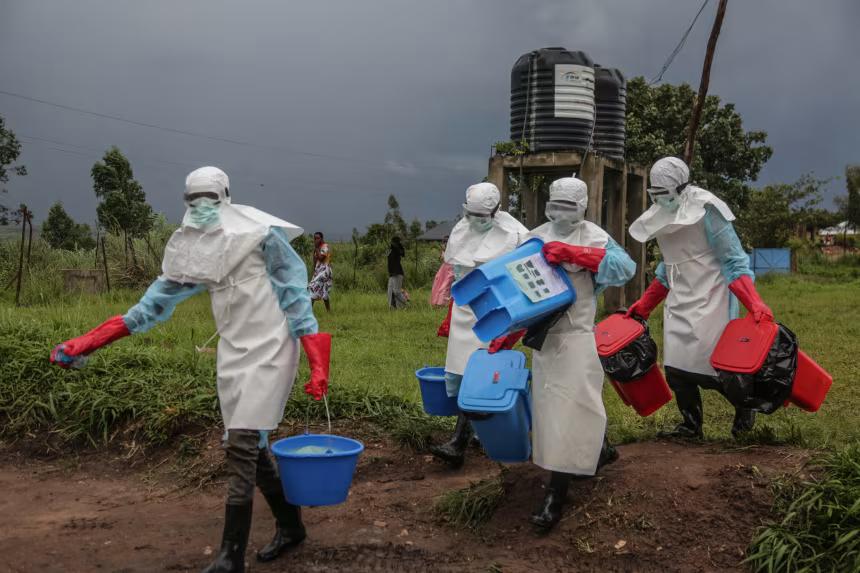
U.S. And Uganda Border Moves Amid Congo Ebola Outbreak Draw WHO Criticism
Key Takeaways
- Outbreak remains centered in eastern Democratic Republic of Congo.
- Reportedly escalating with rising cases and deaths according to health authorities.
- Misinformation and doubts about the outbreak circulate, including claims it's fabricated.
Border closures and Ebola
As public health workers in the Democratic Republic of Congo work to rein in a growing outbreak of a rare Ebola virus, the U.S. and Uganda have taken steps that a U.S. Centers for Disease Control and Prevention-linked tally describes as occurring while Congo has reported more than 1,000 suspected and confirmed cases and more than 250 deaths.
“Hélène Akilimali says she’s taking every precaution against contracting Ebola, including always wearing a face mask in public”
On May 27, Uganda closed its border with Congo with only a narrow set of exceptions, and the next day the United States announced plans to send exposed Americans from affected countries to a quarantine facility in Kenya, a country with no Ebola cases.
The Conversation says the WHO warned that such moves “have no basis in science,” arguing that border closures and travel restrictions can push movement to informal crossings that are not monitored.
The Conversation also frames the Uganda-Congo border as a practical challenge because it is “several hundred miles long” and crossed by numerous footpaths beyond formal border posts, which many people use daily to visit family.
Misinformation and local strain
In eastern Democratic Republic of Congo, cocoa seller Hélène Akilimali said she is taking precautions including always wearing a face mask in public, but she told a journalist on the ground for CNN that customers may or may not wear masks and that “You’re not going to chase them away.”
Élie Ilunga, a resident of Bunia, said “The disease is definitely here,” while also describing how misinformation and lax attitudes have complicated the response as people see deaths.

The Egypt Independent reports that the World Health Organization Director-General Tedros Adhanom Ghebreyesus said that “more than 900 suspected cases have been identified so far, including 101 confirmed cases,” and it adds that WHO earlier said at least 177 deaths are now thought to be linked to the Ebola outbreak in DRC.
It also describes tensions in Ituri on Thursday, when relatives of a young man who died of Ebola tried to take his body “by force” from the Rwampara Hospital, and protesters caused a blaze that burned down two hospital tents.
What response needs next
The Egypt Independent says WHO raised the risk level to “very high” in DRC and “high” on the regional level, while warning epidemic risk remains low on a global level and that case numbers are expected to keep increasing given the time the virus circulated before detection.
“Democracy Dies in Darkness By Rael Ombuor , Rachel Chason and Lauren Weber NAIROBI — As a deadly outbreak of Ebola spreads through the eastern Democratic Republic of Congo, one conspiracy theory is that nonprofit workers brought the disease to get more money”
It reports that the strain driving the outbreak has “no approved vaccine or treatment,” and that the area is in a conflict zone with an estimated two million people displaced, while eastern DRC has historically underfunded healthcare infrastructure.
Greg Ramm, DRC country director for Save the Children, told CNN that “We are in a game of catch-up. There are not enough health resources,” and said the teams are working with local authorities to deliver basic supplies like disinfectant and chlorine to clinics.
The Conversation adds that the WHO declared the current Ebola outbreak a public health emergency of international concern on May 17 and explicitly warned against border closures and travel restrictions, saying they can compromise local economies and negatively affect response operations from a security and logistics perspective.
More on Technology and Science

USDA Detects Possible New World Screwworm In South Texas, Sends Sample To Iowa Lab
18 sources compared

Suno Raises $400 Million Series D At $5.4 Billion Valuation, Despite Copyright Lawsuits
11 sources compared
Amazon Rolls Out AI-Generated Product Images in Shopping Search Bar
16 sources compared

Microsoft Build 2026 Makes Windows Agent-Native With MXC and Surface RTX Spark Dev Box
22 sources compared