Syria07 November, 20252 min read
US and UN Remove Sanctions on Syrian President Ahmad Al-Sharaa Ahead of Trump Meeting
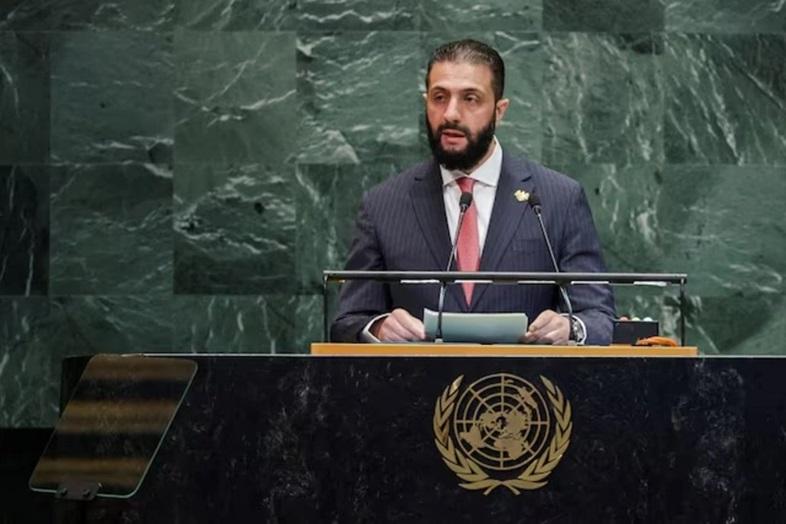
UN Security Council voted 14-0 with one abstention to remove sanctions on Ahmed al-Sharaa. The US Treasury Department delisted al-Sharaa and Interior Minister Anas Khattab from terrorist sanctions.

60 outlets told this the same way.
Outlets did split on France Suspends Police Stun Grenades at High School Protests After 15-Year-Old Loses Hand →
Syria Sanctions Removal Update
The United Nations Security Council removed Syrian President Ahmed al‑Sharaa and Interior Minister Anas Hasan Khattab from the ISIL/Al‑Qaida sanctions list in a US‑drafted resolution. The resolution was supported by 14 members, with China abstaining from the vote. At the same time, the United States delisted both men from its Specially Designated Global Terrorist restrictions.
“The UN Security Council has lifted sanctions on Syria's interim President Ahmed al-Sharaa... supported by 14 of the 15 UNSC members (with China abstaining)...”
Several media outlets described this step as signaling a “new era” for Syria. This development comes just ahead of al‑Sharaa’s scheduled visit to the White House on November 10, which some reports called a historic first.
Coverage varies on whether the lifted measures were largely symbolic or substantive, and on the exact language of the vote. However, most accounts agree that the decision paves the way for eased diplomatic and economic engagement with Washington and other countries.
Ahmed al-Sharaa and HTS Overview
Reporting diverges on Ahmed al‑Sharaa’s trajectory and on Hayat Tahrir al‑Sham (HTS). Multiple outlets note he led the HTS‑backed coalition that ousted Bashar al‑Assad in December 2024 and later distanced the group from al‑Qaeda. Some sources assert HTS was delisted by Western governments.
Others stress HTS remains under UN sanctions. One account states al‑Sharaa was formerly designated under the name Muhammad al‑Jawlani, an identification most reports do not make. Several sources add that al‑Sharaa addressed the UN General Assembly, underscoring his emerging international legitimacy.

Global Reactions to Syria Delisting
Reactions split along geopolitical lines. The US framed the delisting as a political signal of a “new era” and a “chance at greatness” for Syria. UK and European moves paralleled the shift.
“The resolution... signaling recognition of a new political era... precedes al-Sharaa's upcoming visit to the White House...”
Pakistan and Türkiye publicly welcomed the decision. China abstained and criticized the US‑driven process as serving Washington’s interests amid ongoing terrorist threats.
Some coverage also highlights pledged reconstruction funds and a US push to roll back domestic sanctions law known as the Caesar Act. Skepticism persists in parts of the US Congress regarding these efforts.
Syrian President's White House Visit
The White House visit is presented as historically unprecedented, though even here accounts differ. Enab Baladi describes it as the first-ever visit by a Syrian president to the White House, while DW characterizes it as the first such visit since Syrian independence in 1946. Coverage outlines an agenda spanning reconstruction, counterterrorism, and possible Syrian entry into the US-led coalition against ISIS.
Several reports also note prior Trump-Sharaa encounters and Trump’s personal praise for the Syrian leader. Some outlets add that Sharaa has appeared on major international stages such as UNGA and COP30, underscoring the rapid normalization push.

Syria Delisting and Diplomacy
Looking ahead, several outlets connect delisting to broader reintegration, including possible Syrian participation in the US-led anti-ISIS coalition. Emerging regional diplomacy and even prospects for Syria-Israel normalization are also linked to this process. Others emphasize unresolved risks and limits, noting that arms-related restrictions remain in place.
“The UK has lifted sanctions... The visit aims to encourage Syria’s cooperation with the US-led coalition against Islamic State. Meanwhile, the US is reportedly negotiating with Damascus to expand its military presence in Syria...”
China warns about foreign terrorist fighters, and some reports point to possible US-Syria security arrangements under discussion. At the same time, the UN resolution underlines sovereignty and responsibilities on counterterrorism, human rights, and narcotics. This signals that international acceptance is tied to governance benchmarks as well as real-world security conditions.
