Syria07 November, 20253 min read
US and UN Remove Syrian President Al-Sharaa from Terror Sanctions Ahead of White House Meeting
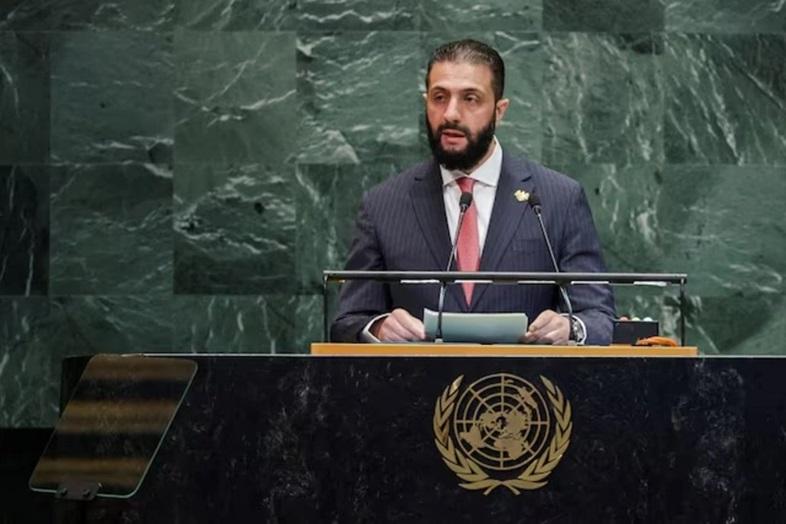
UN Security Council removed sanctions on Syrian President Ahmed al-Sharaa and Interior Minister Anas Khattab. United States officially delisted al-Sharaa from its Specially Designated Global Terrorist sanctions list.

56 outlets told this the same way.
Outlets did split on France Suspends Police Stun Grenades at High School Protests After 15-Year-Old Loses Hand →
UN and US Sanctions Update
Multiple outlets report that the United States and the UN Security Council moved to remove Syrian President Ahmed al‑Sharaa and Interior Minister Anas Khattab from terrorism‑related sanctions lists ahead of al‑Sharaa’s planned White House meeting with President Donald Trump. Western mainstream coverage says the UN measure lifted sanctions tied to past links to al‑Qaeda, with China abstaining, and frames the visit as the first by a Syrian president since 1946. West Asian and African outlets likewise say a US‑drafted resolution passed, delisting both officials from UN lists.
“The UN Security Council has lifted sanctions on Syria's interim President Ahmed al-Sharaa and Interior Minister Anas Khattab...”
Al Jazeera adds that Washington also struck them from the US Treasury’s Specially Designated Global Terrorist list. However, a Western alternative source notes the US initially proposed a UN resolution and that the voting timeline was unclear, underscoring some procedural ambiguity across reports.
International Reactions to Syria Policy Shift
Several outlets describe the move as part of a broader policy reset intended to create space for Syria’s reconstruction and a political transition, even as key actors stress conditions. Asian coverage calls it a strategic recalibration recognizing “constructive engagement.” West Asian and Asian sources quote US officials calling it a political signal of a “new era.”
The EU is reported to be aligning its posture, having lifted economic sanctions earlier while maintaining security restrictions. Pakistan publicly backed the UN decision. China, however, abstained and criticized the resolution as serving US interests and raised concerns about terrorism and foreign fighters—signaling that consensus on the policy shift is limited.

Background on al-Sharaa and HTS
Reporting on al-Sharaa’s background diverges in emphasis. Several outlets say he was once a sanctioned rebel leader tied to al-Qaeda and HTS, carried a US bounty, and later led forces that ousted Bashar al-Assad. A West Asian source uniquely claims al-Sharaa had been designated under the name Muhammad al-Jawlani.
“Once a sanctioned Islamist rebel leader with a $10 million U.S. bounty, al-Sharaa has undergone a remarkable transformation over the past year, evolving from militant leader to head of state after his forces toppled Bashar al-Assad’s regime.”
Asian sources note HTS severed ties with al-Qaeda in 2016 and that UN monitors reported no active HTS–al-Qaeda links this year. West Asian and West Asian/Other outlets conflict on whether HTS remains under UN sanctions or was delisted, reflecting real disagreement about the group’s current designation and status.
Sanctions and Policy Responses
Policies and mechanisms are portrayed differently across various outlets. Some sources emphasize US executive and legislative actions, such as an executive order ending Syria sanctions and congressional efforts to repeal 2019 measures. Other reports focus on allied alignment in response to these policies.
West Asian coverage highlights a June executive order to end sanctions and notes delisting under EO 13224. Western Alternative sources describe the EU’s lifting of economic sanctions while maintaining security restrictions.

Several Western and Asian sources report that the UK and other countries aligned their positions following the UN decision. Some outlets downplay the practical impact of these measures, describing prior UN restrictions as largely symbolic or waived for travel purposes.
Syria's Future Cooperation Plans
Looking ahead, outlets anticipate an agenda centered on counterterrorism cooperation, potential coalition alignment, reconstruction, and Syria’s reintegration. Some reports suggest more far-reaching regional shifts may occur. Other and Asian sources say al-Sharaa will discuss reconstruction and counterterrorism at the White House and may formalize Syria’s entry into the US-led coalition against ISIS.
“During the visit, President al-Sharaa is expected to sign Syria’s accession to the U.S.-led Global Coalition to Defeat the Islamic State.”
An Asian outlet uniquely reports US–Damascus talks on expanding the US military footprint tied to Israel arrangements. A West Asian outlet notes direct Syria–Israel negotiations after Assad’s fall. Asian coverage also stresses that analysts view sanctions relief as a test rather than full normalization.
