
U.S. Bombs Iran as Israel Continues Airstrikes Across Iran and Lebanon
Regional escalation after U.S. strikes
The conflict sharply escalated within a week after the United States began bombing Iran, broadening into a multi-state confrontation across the Middle East as more countries carried out strikes and air defenses were mobilized.
“Gift this articleShare to FacebookPrint article Article printing is available to subscribers only Print in a simple, ad-free format Subscribe Comments: SaveZen Reading Zen reading is available to subscribers only Ad-free and in a comfortable reading format Subscribe”
NPR summarized the situation as "A week after the U.S. began bombing Iran, the conflict has broadened, with more Middle Eastern countries carrying out strikes."

The Tennessean framed it similarly: "Less than a week after the United States and Israel began military strikes on Iran, the conflict has rapidly widened to involve many Middle Eastern states and some European militaries."
Both outlets report continuing Israeli operations, with NPR noting that "Israel continued airstrikes in Iran and Lebanon overnight."
Widespread Persian Gulf strikes
The geographic scope has been wide and kinetic: hundreds of missiles and drones were launched and intercepted across the Persian Gulf region, attacks reached multiple U.S. and allied bases, and naval and air assets were targeted.
The Tennessean reports "Hundreds of missiles and drones have been launched and intercepted across more than half a dozen countries in the Persian Gulf region," noting a U.S. submarine sank an Iranian navy ship on March 4 and NATO air defenses intercepted an Iranian missile headed for Turkey.

NPR also highlighted the spreading strikes, observing that "more Middle Eastern countries [are] carrying out strikes" as Israel maintained air operations in Iran and Lebanon.
Casualty count discrepancies
Reported casualties underscore a stark human toll and vary across reports.
“Mapping countries involved in the U”
NPR cited figures of more than 1,300 dead in Iran (Iran’s Red Crescent), roughly 300 dead in Lebanon (local health officials), and six U.S. troops killed.
The Tennessean reported more than 1,200 Iranians, 10 Israelis and six U.S. troops killed, and said Lebanon was heavily hit with ministry reports of over 75 killed and about 500 wounded after Israeli strikes responding to Hezbollah rocket fire.
NPR and The Tennessean provide overlapping but contradictory counts, showing broad regional casualties and variation in reporting between outlets.
Cross-border conflict incidents
The conflict has produced several discrete, high-profile incidents that illustrate its intensity and cross-border impact.
The Tennessean details specific attacks and hits on allied facilities, saying "Six American soldiers were killed March 1 in an unmanned aircraft attack on Port Shuaiba, Kuwait."
The Tennessean reported that Iran struck the U.K. air base at Akrotiri (Cyprus) on March 2, prompting Britain, France and Greece to deploy air-defense assets to the island.
The Tennessean also noted Azerbaijan’s Nakhchivan airport was hit by Iranian drones, injuring four people.
NPR provided on-the-ground color, reporting that its correspondent Carrie Kahn "reported from a bomb shelter in Tel Aviv as sirens sounded," underscoring the civilian impact and sense of threat in neighboring states.
Responses to Iran operations
U.S. and Israeli officials defend operations as aimed at halting Iran’s capabilities, while critics dispute that rationale and many countries have moved defensive assets or issued advisories.
“Latest updates on the U”
The Tennessean reports that Washington and Jerusalem say the campaign aims to halt Iran’s nuclear and ballistic missile programs, but critics — including many Democrats — dispute that justification.
The Tennessean says several European countries have moved military assets, including air defenses, ships and helicopters, to help protect allies.
NPR highlighted diplomatic tone and rhetoric, noting that Iran’s president apologized for attacks on Gulf states but did not commit to stopping all strikes, and that President Trump posted about that apology, calling Iran 'the losers of the Middle East.'
The Tennessean cited a U.S. State Department advisory urging Americans to leave 14 Middle Eastern countries because of safety risks.
Key Takeaways
- United States began bombing Iran; Israel conducted airstrikes across Iran and in Lebanon
- Conflict expanded regionally, with multiple Middle Eastern countries launching strikes
- Hostilities escalated within a week after U.S. and Israel launched military strikes on Iran
More on Iran-Israel
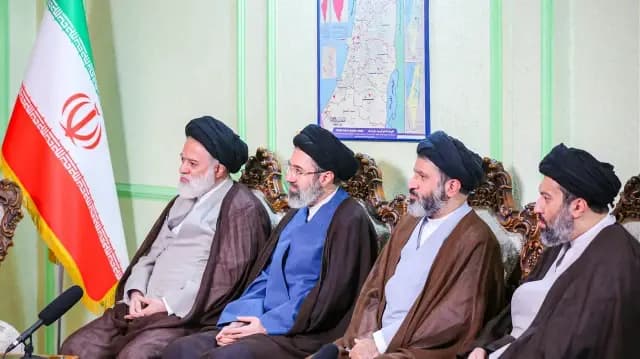
Iran Names Mojtaba Khamenei Supreme Leader After US-Israel Strike Killed Ali Khamenei
41 sources compared

Israel Bombs Tehran Oil Depots, Blankets Capital With Toxic Black Smoke and Oil Rain
11 sources compared

U.S. and Israel Kill Iran's Supreme Leader, Trigger Regional War
49 sources compared

Iran Kills Seventh U.S. Service Member After Attack on Saudi Military Base
16 sources compared