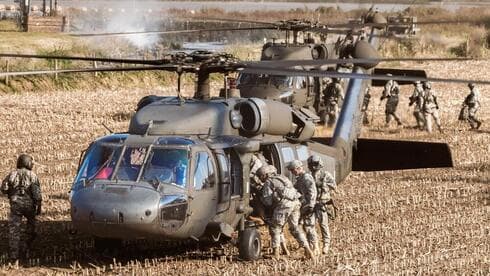
Pentagon to deploy thousands of 82nd Airborne soldiers to Middle East amid Iran talks
Key Takeaways
- Pentagon plans to deploy thousands of 82nd Airborne Division troops to the Middle East.
- Deployment is tied to ongoing U.S.-Iran diplomacy and talks to end the war.
- The move signals a broader regional buildup, with estimates ranging from 1,000 to 3,000.
Troop Deployment Details
The Pentagon is preparing to deploy thousands of elite U.S. Army soldiers from the 82nd Airborne Division to the Middle East, escalating military presence even as President Donald Trump claims diplomatic efforts are underway with Iran to end the war.
“Your choices will have effect within our Website”
Two anonymous familiar sources told Reuters that between 3,000 and 4,000 soldiers from the Fort Bragg-based division are expected to be deployed, with The Wall Street Journal confirming around 3,000 troops will be sent to support Operation Epic Fury.

Meanwhile, Associated Press sources report at least 1,000 troops will be deployed, creating a discrepancy in reported troop numbers.
The 82nd Airborne Division functions as the Army's premier rapid-response force, capable of deploying anywhere in the world within 18-24 hours, specializing in parachute assaults into hostile or contested territory to secure airfields and establish operational footholds.
Diplomatic Ambiguity
The deployment occurs amid conflicting signals about diplomatic negotiations, with Trump announcing talks while Iranian officials deny any direct dialogue.
President Trump stated that the US and Iran have reached 15 points of agreement in conversations to end the conflict, claiming Iran would "very much" like to make a deal, but Iranian sources denied these assertions.

However, an Iranian source later told CNN that there was "outreach" between the two countries and Iran was willing to listen to "sustainable" proposals.
The diplomatic uncertainty comes as the conflict enters its fourth week, having roiled global markets and resulted in significant casualties across the region.
Strategic Escalation
The military buildup represents a significant escalation in the U.S.-Iran conflict, with the deployment coming alongside additional naval forces and raising the probability of American military personnel entering Iranian territory.
“At least 1,000 US troops from 82nd Airborne set to deploy to Mideast, AP sources say At least 1,000 US troops from 82nd Airborne set to deploy to Mideast, AP sources say WASHINGTON (AP) — The U”
The Pentagon has already dispatched thousands of Marines aboard the USS Boxer amphibious assault ship and accompanying warships to the region, with Newsweek reporting that roughly 2,500 additional Marines and 2,500 sailors were deployed to the Middle East.
This substantial troop increase follows the destruction of more than 9,000 military targets inside Iran since U.S. and Israeli military operations began on February 28, yet Iran has continued drone and ballistic missile attacks throughout the week.
The broader deployment creates a complex strategic situation as Trump maintains all military options remain available.
Military Planning Options
Military officials have confirmed that while no final decision has been made to commit ground forces to Iran itself, the deployment would give President Trump greater flexibility in military planning.
Options under serious consideration include reopening the strategically vital Strait of Hormuz by force, seizing strategic islands such as Kharg Island which handles 90% of Iran's oil exports, or securing Iran's stockpile of highly enriched uranium.

One scenario involves Marines leading an initial assault on Kharg Island, with combat engineers repairing the damaged airstrip to allow cargo aircraft to bring in supplies and reinforcements, followed by the 82nd Airborne's 3,000-strong brigade augmenting and eventually relieving the Marines.
This planning reflects growing concerns in Washington about the trajectory of the conflict and the need to maintain readiness for various military contingencies.
Iran's Defiant Response
Iran has responded to the U.S. military buildup with defiance, signaling its readiness for confrontation after decades of preparation for asymmetric warfare against the technologically superior US military.
Senior Iranian military figure Admiral Ahmadian, acting as spokesperson for Supreme Leader Mojtaba Khamenei, declared that Iran has spent "over two decades" preparing for asymmetric warfare and delivered an ominous two-word message: "Come closer."

Admiral Ahmadian stated: "For years, we've been awaiting the Americans' entry into the designated points, and for over two decades, we've been training with the asymmetric warfare strategy for this very moment."
This defiant response underscores the high-stakes nature of the military escalation as both sides simultaneously engage in diplomatic posturing while preparing for potential ground combat operations.
Diplomatic Efforts
International diplomatic efforts continue alongside the military buildup, with Pakistan offering to host formal peace talks between Washington and Tehran.
Pakistani Prime Minister Shehbaz Sharif wrote on X that Pakistan is ready to "facilitate meaningful and conclusive talks" to end the Iran war, with three Pakistani officials, one Egyptian official and a Gulf diplomat confirming the U.S. had agreed in principle to join talks in Pakistan.
The Trump administration has reportedly offered a 15-point ceasefire plan to Iran, according to a person briefed on the contours of the plan, which includes a proposed month-long ceasefire, the dismantlement of Iran's nuclear program, an end to Iranian support for proxy militant groups, and the reopening of the Strait of Hormuz.
Despite these diplomatic efforts, the continued military expansion suggests a complex and potentially contradictory strategy by the Trump administration.
More on USA

USC Cancels California Gubernatorial Debate Amid Backlash Over Candidate Criteria
37 sources compared

President Donald Trump Voted by Mail in Florida Special Election
18 sources compared

Democrat Emily Gregory Flips Florida House District 87 Including Mar-a-Lago
61 sources compared

Delta suspends special congressional services for members of Congress amid shutdown
25 sources compared