
US destroys Iranian base threatening Hormuz oil shipments
Key Takeaways
- US dropped 5,000-pound deep penetrator bombs on Iranian missile sites near Strait of Hormuz.
- GBU-72 bunker-busting bombs deployed; first combat use reported.
- CENTCOM confirmed operation via a post on X.
US Hormuz Strike
The United States has conducted a major airstrike on Iranian missile positions along the strategically vital Strait of Hormuz.
“The US Central Command announced that it had dropped 5,000-pound (about 2,268-kilogram) deep penetrator bombs on Iranian missile sites near the Strait”
US Central Command announced that American forces struck hardened missile facilities using multiple 5,000-pound 'deep penetrator munitions.'

This action is part of the operation known as Epic Fury, launched jointly by the United States and Israel on February 28.
Operation Epic Fury has targeted over 1,000 Iranian sites within the first 24 hours, with more than 5,000 targets struck by March 16.
The strikes come amid heightened tensions after Iran moved to shut down the narrow waterway through which roughly one-fifth of the world's oil supply passes.
This has triggered disruptions in maritime traffic and a spike in global energy prices.
Buster Bombs Deployed
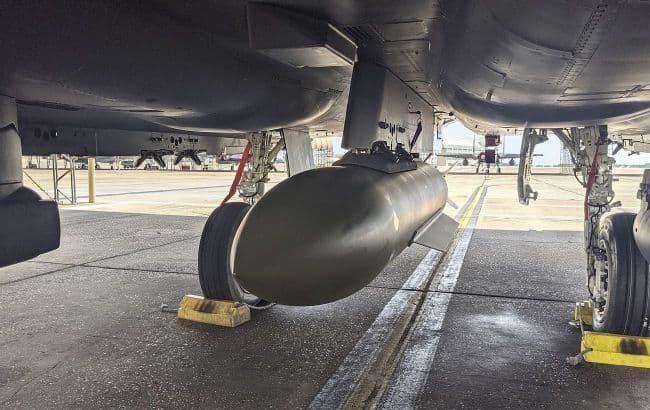
The US employed GBU-72/B bombs, also referred to as the Advanced 5K Penetrator, in these strikes.
These are precision-guided weapons weighing 2,300 kilograms equipped with GPS/INS guidance systems.
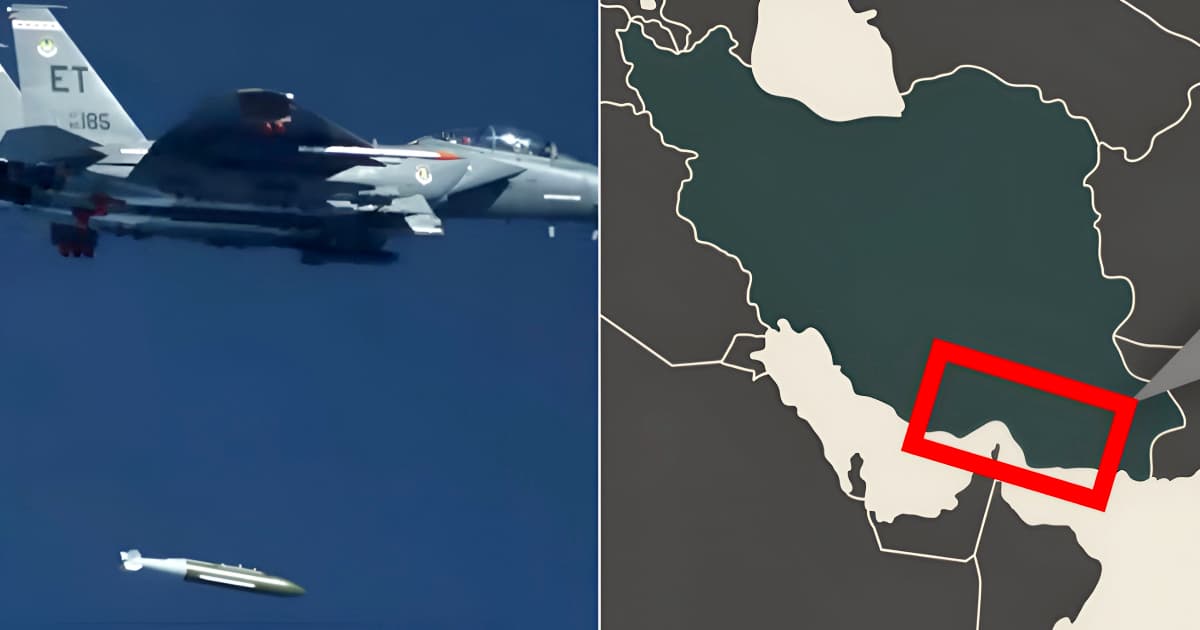
They are specifically designed to demolish bunkers and deeply buried targets.
The munitions fill a niche capability between standard 2,000-pound bombs and 30,000-pound Massive Ordnance Penetrator.
According to an Air Force Times report, each bomb costs an estimated $288,000.
The GBU-72 was developed to overcome hardened, deeply buried target challenges.
Lethality is expected to be substantially higher compared to similar legacy weapons like the GBU-28.
Iranian Missile Arsenal
Iran has positioned various missile systems including the Noor (a derivative of the Chinese C-802 with a range of up to 300 kilometers).
“Email advertisement [](https://www”
The Khalij Fars ballistic anti-ship missile has similar range and a 450-kilogram warhead.
Tehran also possesses the Nasir and Ghadir subsonic missiles with ranges of up to 90 and 300 kilometers respectively.
Tehran also possesses the Hormuz-1 and Hormuz-2 ballistic missile systems capable of striking targets at distances up to 300 kilometers.
These installations are central to Tehran's strategy of deterring or disrupting shipping in the region.
They are traditionally deployed in underground shelters that require specialized bunker-busting munitions to destroy.
The Iranian positions hit in the strike are part of a broader network of surface-to-surface and anti-ship missile systems along the Hormuz coastline.
Oil Market Impact
The strikes come amid Iran's partial blockade of the Strait of Hormuz.
This has reduced maritime traffic from 153 transits daily to between just 4 and 13.
Brent crude oil prices have soared above $120 per barrel as a result.
This strategic waterway is one of the world's most critical oil chokepoints.
Iranian drones and missiles have damaged at least 8 to 11 merchant vessels since March 2.
The US has responded by eliminating 16 Iranian minelayer vessels in the region on March 10.
The US also bombed Kharg Island, which handles 90% of Iran's crude oil exports on March 14.
Iranian Parliament Speaker Mohammad Baqer Qalibaf stated 'The Strait of Hormuz situation won't return to its pre-war status.'
Global Response
President Donald Trump has declared that the United States 'requires no assistance' following NATO's refusal to join joint escort missions.
“It is believed that B-1Bs based at the British airbase in Fairford were involved in the operation”
Trump lamented that the US is not receiving support 'despite the fact that we helped' NATO 'so much.'

He described the rejection of his calls as a 'very foolish mistake.'
Trump has stated his unwillingness to halt the attacks on Iranian targets.
Over 20 nations have issued a joint statement condemning Iran's de facto closure of the Hormuz Strait.
Indian Prime Minister Narendra Modi has spoken with the Iranian president to condemn attacks on critical infrastructure.
Modemphasized that 'shipping lanes must stay open'.
The international community's response highlights the critical importance of the waterway to global energy security.
More on Iran

Iran Attacks Dimona and Arad with Ballistic Missiles, Broadens War With Israel
49 sources compared
Israel and U.S. Strike Natanz Nuclear Facility Again; Iran Blames Attack
69 sources compared

Iran Fires Long-range Missiles, Strikes Near Israeli Nuclear Site
104 sources compared
Trump Defends Iran War by Citing Pearl Harbor
12 sources compared