Gaza Genocide14 January, 20262 min read
US Launches Phase Two Of Gaza Ceasefire Plan To Dismantle Hamas And Install Internationally Supervised Palestinian Governing Committee
This article is an automated aggregation of coverage from news outlets. Our editorials offer in-depth analysis curated by the NewsCord team.
United States launches Phase Two emphasizing full demilitarization, technocratic governance, and Gaza reconstruction. A 15-member National Committee (NCAG) will administer Gaza under international oversight.
43 outlets told this the same way.
New York Post was read line by line by the Watchdog: 7.6. See the score →
Phase Two Gaza Plan
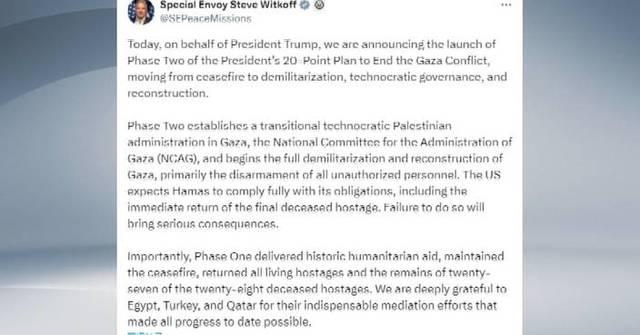
The United States announced the launch of Phase Two of a 20-point Gaza plan that shifts the process from maintaining a ceasefire to full demilitarisation, technocratic governance and large-scale reconstruction.
“Phase two aims to end Hamas’s 18-year rule, begin disarmament of armed groups (starting with Hamas), install a 15-member Palestinian technocratic committee to run daily affairs, and launch reconstruction the UN estimates will cost over $50 billion.”
U.S. Special Envoy Steve Witkoff framed the new stage as establishing a transitional technocratic Palestinian administration, the National Committee for the Administration of Gaza (NCAG), to run Gaza's daily affairs.

A U.S.-led Board of Peace, reportedly to be chaired by former President Donald Trump, would provide oversight of the NCAG.
Former U.N. envoy Nickolay Mladenov is named as on-the-ground representative and Ali Shaath is reported to head the committee.
The U.S. warned Hamas that failure to comply, including not returning the final deceased hostage, would bring serious consequences.
Phase Two implementation gaps
Phase Two is explicitly tied to demilitarisation and reconstruction but faces severe practical gaps. The UN estimates reconstruction will exceed $50 billion, yet little funding has been pledged. There is no clear, agreed mechanism to disarm Hamas or to deploy a credible international peacekeeping force.
The roles, mandate and financing of any transitional committee remain contested. Analysts and regional reporting warn these implementation gaps could derail the plan. They point to undefined timelines for NCAG establishment and uncertainty about who will provide troops or funds for reconstruction.

Gaza governance and disarmament
Hamas and Palestinian factions have signalled limited cooperation on governance but rejected unconditional disarmament. Reporting says Hamas agreed to cede authority to an independent technocratic committee while insisting that full disarmament must await a broader political settlement or the creation of a Palestinian state. Gaza's leaders have offered weapon "freezes" or storage and decommissioning options rather than immediate surrender.
“Hamas has agreed to cede governance to an independent committee but refuses full disarmament without progress toward a Palestinian state, offering only a possible 'freeze' of weapons.”
Mediators report Hamas returned all living hostages and all but one deceased body, identified as Ran Gvili. The return of the final remains is a central U.S. and Israeli condition for further steps.
Humanitarian impact in Gaza
On the ground, reporting documents an extreme humanitarian toll and ongoing Israeli military operations described by many outlets and rights experts in the strongest terms. Gaza health authorities cited by multiple outlets report more than 71,400 Palestinians killed since October 2023, and some sources say the U.N. and rights experts have described Israel's campaign as genocide. Journalists and analysts say Phase One's gains were undermined by ongoing Israeli air strikes that continued to kill Palestinians after the truce, and that aid flows - despite reported increases - have not met needs, leaving most Gazans dependent on humanitarian assistance.
Implementation and political constraints
Implementation depends on international buy-in, which remains uncertain. Some countries have expressed interest in contributing to an international security force, but many refuse to undertake forcible disarmament and few governments have committed reconstruction funds. Regional mediators Egypt, Turkey and Qatar have publicly backed the technocratic committee and helped negotiate the stage.
“An international security force is being formed — with Indonesia and Morocco pledging troops — but many countries refuse to take on the task of forcibly disarming Hamas...”
The United States is pressing for compliance and links progress to the return of the final deceased hostage. Israel’s political leadership remains a constraint: Prime Minister Benjamin Netanyahu opposes PA rule in Gaza and insists on security guarantees and recovery of the final body before broader concessions.
