Iran · 01 May, 2026 · 5 min read
U.S. Navy Awards Domino Data Lab Nearly $100 Million to Detect Iranian Mines in Strait of Hormuz
Navy awarded a $100 million contract to Domino Data Lab to develop the AMMO program. AMMO aims to accelerate machine-learning for faster, more accurate mine detection.
How the story is framed: operational military development vs. market/de-escalation lens.
7 of 8 outlets skipped it: crypto Briefing links the development to prediction-market positioning (invasion likelihood decreasing; traffic normalization increasing)..
10outlets compared
Same story, two versions
tap a side to read it in full
Crypto Briefing
“Market pricing suggests that the likelihood of the US invading Iran is decreasing, potentially due to enhanced mine detection capabilities.”Read the original ↗
Jordan News
“This move comes as U.S. President Donald Trump has emphasized the priority of securing the strategic waterway, whose potential closure poses a major threat to the global economy.”Read the original ↗
One outlet treats the contract primarily as a signal for broader geopolitical and market outcomes (de-escalation), while others emphasize the direct operational aim—mine detection/removal and securing the chokepoint—shaping how readers interpret the same underlying event.
AI Mine-Counter Deal
The United States Navy has awarded a contract worth nearly $100 million to Domino Data Lab to accelerate the detection and removal of naval mines in the Strait of Hormuz, according to Reuters.
“The United States Navy has awarded a contract worth nearly $100 million to Domino Data Lab”
The contract is described as shifting mine-detection tasks from traditional vessels to AI-powered autonomous underwater vehicles, with the goal of enabling faster and more efficient operations.

Reuters quotes Domino Data Lab operations director Thomas Robinson saying the system reduces the time required to train submersible units to identify new types of mines from six months to just a few days.
Reuters also reports Robinson highlighted that systems trained in other regions—such as detecting Russian mines in the Baltic Sea—can be rapidly adapted and deployed in the Strait of Hormuz to identify Iranian mines.
Reuters adds that Robinson said the Navy could be ready within a week instead of a year thanks to Domino’s technology.
The same Reuters report frames the move as tied to U.S. President Donald Trump’s emphasis on securing the strategic waterway, whose potential closure poses a major threat to the global economy.
A separate report also ties the deal to the AMMO program, describing it as “Accelerated Machine Learning for Maritime Operations” and stating it aims to speed up and improve the accuracy of detecting underwater threats.
AMMO and Faster Adaptation
Multiple reports connect the Domino contract to Project AMMO, with the program name spelled out as “Accelerated Machine Learning for Maritime Operations.”
In the Reuters-based descriptions, the technology is presented as enabling faster adaptation of mine-detection models, including by training unmanned systems to recognize new types of mines much faster.
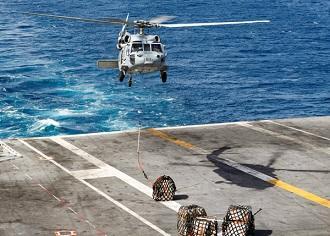
One account says updating AI models for underwater drones could take up to six months previously, but “now the process has been cut to just a few days.”
Another Reuters-based report says the Navy is strengthening its use of artificial intelligence to identify and neutralize naval mines in the Strait of Hormuz, and that traditional operations “could take months.”
The same Reuters-linked reporting emphasizes that the system aggregates data from sensors including sonar and visual systems, and that it enables real-time analysis of model performance and rapid adjustments to how the systems operate.
In the Reuters account, Robinson is quoted describing the speed advantage as a readiness shift, saying the Navy could be ready within a week instead of a year.
A separate Reuters-based narrative in StratNews Global similarly describes the contract as up to $99.7 million and says the software can teach underwater drones to identify new types of mines in a matter of days.
Trump, Ceasefire, and Pressure
The reports place the AI mine-detection push within a broader U.S.-Iran confrontation over the Strait of Hormuz, describing the strait as a key chokepoint for global oil shipments.
“U.S. President Donald Trump has emphasized the priority of securing the strategic waterway”
Reuters-based coverage says the move comes as U.S. President Donald Trump emphasized the priority of securing the strategic waterway, whose potential closure poses a major threat to the global economy.
StratNews Global adds that Trump said the Navy is already working to clear Iranian mines from the strait and warns that any disruption could impact the world economy.
MyIndMakers similarly states that Trump stated the Navy is already working to remove Iranian mines from the strait, and it describes the route as crucial for global oil transport.
That same report says clearing underwater explosives remains a slow and risky process that could take months even with a fragile ceasefire between the U.S. and Iran after weeks of conflict.
Al-Jazeera Net frames the urgency as time pressure, saying traditional mine sweeping could take months and that a fragile ceasefire after weeks of the U.S.-Israeli war on Iran cannot withstand it.
Across these accounts, the Strait of Hormuz is treated as the operational center of gravity, with the AI contract presented as a way to compress timelines for mine detection and model updates.
Voices on the Speed Advantage
The reporting repeatedly returns to Domino’s leadership to explain why AI is central to the Navy’s mine-counter approach.
Reuters quotes Domino Data Lab operations director Thomas Robinson, describing how systems trained in other regions can be rapidly adapted and deployed in the Strait of Hormuz to identify Iranian mines.
Reuters also includes Robinson’s claim that the Navy could be ready within a week instead of a year, tying the capability directly to operational readiness.
MyIndMakers quotes Robinson more directly in an interview with Reuters, saying, “Mine-hunting used to be a job for ships,” and continuing, “It’s becoming a job for AI.”
In that same MyIndMakers account, Robinson adds that the Navy is paying for “the platform that lets it train, govern, and field that AI at a speed required for contested waters that block global trade and imperil sailors.”
StratNews Global repeats Robinson’s Reuters interview framing, again emphasizing that mine-hunting is becoming a job for AI and that the Navy is paying for a platform to train and field it at the required speed.
Incrypted also attributes to Domino COO Thomas Robinson the point that the technology makes it possible to deploy AI quickly in new regions, and says redeployment can take as little as a week.
What Comes Next and Stakes
The sources frame the contract as part of an effort to keep maritime operations moving through the Strait of Hormuz by reducing the time needed to detect and adapt to new mine types.
“the Navy could be ready within a week instead of a year”
Reuters describes the system as enabling faster and more efficient operations and emphasizes that the Navy could be ready within a week instead of a year, which implies a near-term shift in how quickly mine-detection capability can be updated.
The Crypto Briefing version adds that the integration of AI is intended to expedite the process “from months to days,” and it links that to “maintaining a tenuous ceasefire and stabilizing the region.”C
StratNews Global similarly says the software can quicken the process by teaching underwater drones to identify new types of mines in a matter of days, while also noting that clearing underwater explosives could take months even as a fragile ceasefire holds.
Al-Jazeera Net underscores the stakes by describing the strait as the “world’s energy artery” and by stating that traditional mine sweeping could take months, which it says the fragile ceasefire cannot withstand.
The same Al-Jazeera Net narrative also describes the operational pressure as time pressure and ties it to the need for rapid analysis and AI-driven speed rather than slower methods.
In the Reuters-based accounts, the immediate operational implication is that the Navy can adapt mine-detection models quickly when systems are redeployed from one theater to another, including from the Baltic Sea to the Strait of Hormuz.