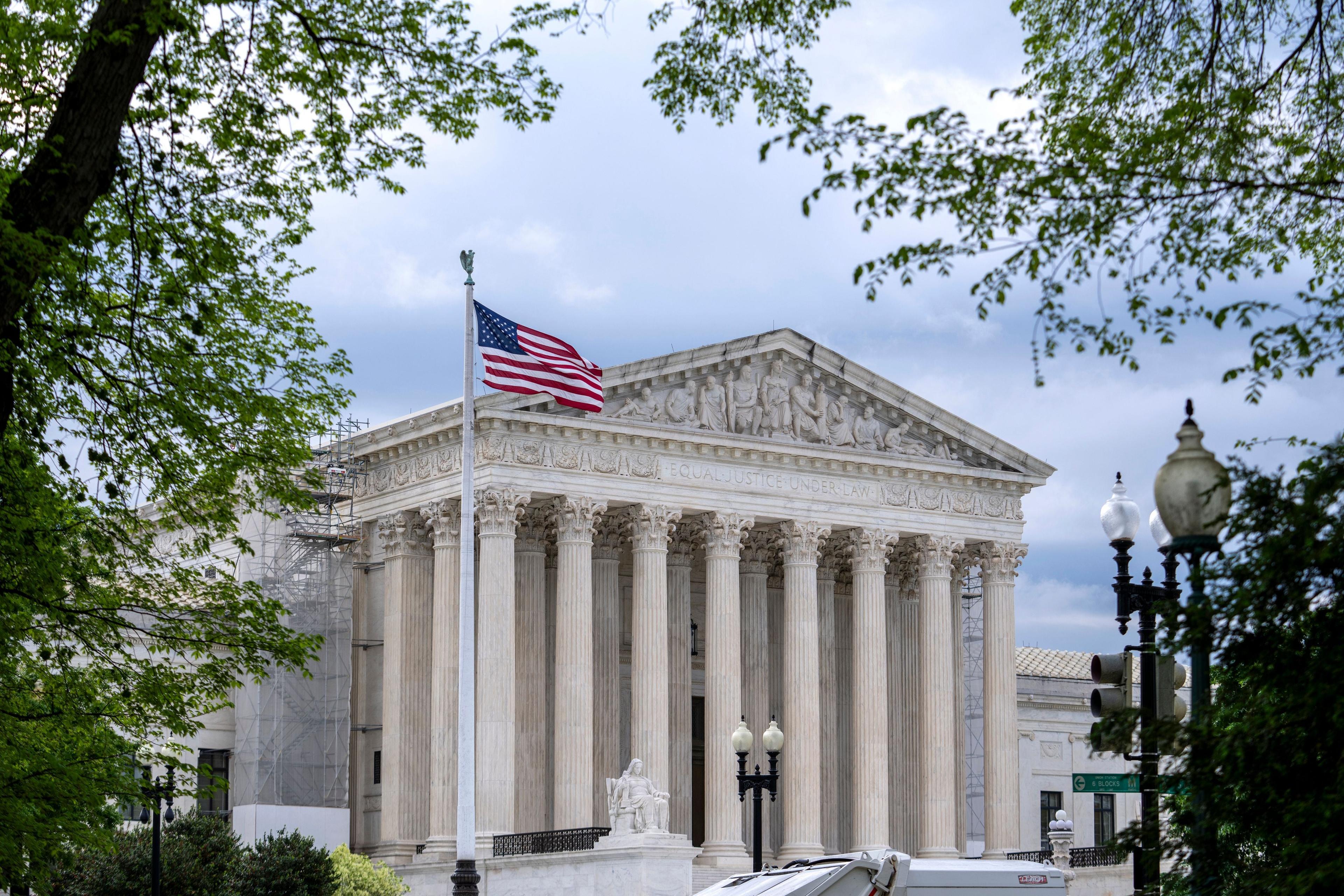
U.S. Supreme Court Strikes Down Louisiana’s Majority-Black District, Boosting Republicans
Key Takeaways
- Court strikes down Louisiana map creating second majority-Black district under Voting Rights Act.
- Ruling narrows use of race in redistricting, limiting minority protections.
- The decision is seen as boosting Republican chances in the House.
Supreme Court’s Voting Rights Act Ruling
The U.S. Supreme Court on Wednesday hollowed out a landmark Civil Rights-era law that has increased minority representation in Congress and elsewhere, striking down a majority Black congressional district in Louisiana and opening the door for more redistricting across the country that could aid Republican efforts to control the House.
In a 6-3 ruling, the court’s conservative majority found that Louisiana district represented by Democrat Cleo Fields relied too heavily on race.

Chief Justice John Roberts described the 6th Congressional District as a “snake” that stretches more than 200 miles (320 kilometers) to link parts of Shreveport, Alexandria, Lafayette and Baton Rouge.
“That map is an unconstitutional gerrymander,” Justice Samuel Alito wrote for the six conservatives.
The effect of the ruling may be felt more strongly in 2028 because most filing deadlines for this year’s congressional races have passed, while Louisiana “may have to change its redistricting plan to comply with the decision,” the AP reported.
The decision also framed a broader shift in how courts evaluate claims under Section 2 of the Voting Rights Act of 1965, with Alito writing that “allowing race to play any part in government decisionmaking represents a departure from the constitutional rule that applies in almost every other context.”
PBS and AP both described the ruling as striking down the map that included two majority-Black districts, while CBS News said the high court “struck down Louisiana’s congressional map that includes two majority-Black districts.”
How the Case Reached the Court
The ruling came in a dispute over Louisiana’s congressional maps that had been tied to Section 2 of the Voting Rights Act of 1965, which the AP described as the “main way to challenge racially discriminatory election practices.”
AP reported that it was unclear “how much of the provision — known as Section 2 of the Voting Rights Act of 1965 — remains,” while Axios said the Louisiana v. Callais ruling “does not erase Section 2 of the Voting Rights Act, but it effectively neuters it.”

CBS News said the high court upheld a lower court ruling that found Louisiana mapmakers relied too heavily on race when they redrew the state’s voting boundaries to comply with Section 2.
Axios described the court as rewriting the test used to apply Section 2 so it “can only take effect as long as protected seats don't infringe on the right of state lawmakers to draw partisan gerrymanders.”
The timeline of the Louisiana fight began with litigation over a map drawn in 2022, when Black voters “successfully sued to add a second majority-Black district in Louisiana in 2022,” Axios said, arguing they were underrepresented.
Axios added that lawmakers updated their maps in response, but “a group of non-Black voters sued the state after,” accusing lawmakers of relying too heavily on race to create the new maps.
The case then moved through a three-judge panel in 2024 that “agreed in 2024, setting the stage for the High Court's ruling,” Axios reported.
In the Supreme Court’s Louisiana ruling, AP said the justices “did an about-face” from a decision in a similar case from Alabama less than three years ago that led to a new congressional map for the state that sent two Black Democrats to Congress.
Reactions From Court, White House, and Critics
Reactions to the decision broke along partisan lines, with the White House and Democratic leaders offering sharply contrasting characterizations of what the ruling means for civil rights and representation.
The AP quoted White House spokeswoman Abigail Jackson saying, “This is a complete and total victory for American voters. The color of one's skin should not dictate which congressional district you belong in. We commend the court for putting an end to the unconstitutional abuse of the Voting Rights Act and protecting civil rights.”
The AP also reported that the chair of the Democratic Congressional Campaign Committee called the decision “appalling,” and it quoted Rep. Suzan DelBene of Washington state saying it was the latest in a long line of attacks by President Donald Trump and the conservative court “against the fundamental right of every American citizen to vote.”
CBS News quoted NAACP President Derrick Johnson saying, “Today's decision is a devastating blow to what remains of the Voting Rights Act, and a license for corrupt politicians who want to rig the system by silencing entire communities,” adding, “The Supreme Court betrayed Black voters, they betrayed America, and they betrayed our democracy.”
In the dissent, Justice Elena Kagan warned that the majority’s approach would “threatens a half-century's worth of gains in voting equality,” Axios reported, and CBS News quoted Kagan saying the law is “all but dead-letter.”
NBC News described Kagan’s dissent as saying the consequences are “far-reaching and grave” and that the ruling effectively “renders Section 2 all but a dead letter.”
NBC News also reported that conservative Justice Clarence Thomas said the ruling should “largely put an end” to a system he saw as unlawfully dividing people into districts based on race.
In the AP account, former President Barack Obama said the decision showed “how a majority of the current Court seems intent on abandoning its vital role in ensuring equal participation in our democracy.”
Coverage Divergence on What Changed
Different outlets emphasized different aspects of the same ruling, with some framing it as a narrowing of a legal test and others describing it as a near-total dismantling of Section 2’s practical effect.
AP focused on the court’s reasoning that Louisiana’s district relied too heavily on race and on the uncertainty about “how much of the provision — known as Section 2 of the Voting Rights Act of 1965 — remains.”

Axios, by contrast, said the ruling “does not erase Section 2 of the Voting Rights Act, but it effectively neuters it,” and it described the court’s rewrite of the test so it “can only take effect as long as protected seats don't infringe on the right of state lawmakers to draw partisan gerrymanders.”
CBS News described the legal change as raising “the bar plaintiffs must meet to prove a violation,” quoting Alito’s statement that “Section 2 imposes liability only when the evidence supports a strong inference that the State intentionally drew its districts.”
NBC News similarly described the court as telling states they can “almost never consider race when drawing maps to comply with Section 2,” while also noting that Alito said there may be “extreme situations where the use of race can be justified.”
Democracy Docket characterized the ruling as “guts Voting Rights Act” and said it “effectively invalidates Section 2 of the VRA as it has been understood for four decades without explicitly striking down the statute.”
Mother Jones went further, saying the ruling “essentially killing the remaining protections of the Voting Rights Act,” and it quoted Alito’s language that “Because the Voting Rights Act did not require Louisiana to create an additional majority-minority district.”
Fox News framed the decision as “sharply narrows states' use of race as a factor when drawing their congressional districts,” while still saying it “does not overturn the Voting Rights Act or Section 2.”
Political Stakes and Next Redistricting Moves
The ruling immediately fed into a broader redistricting push, with Republicans calling for special sessions and Democrats warning of long-term damage to minority representation.
“Supreme Court weakens a landmark Civil Rights-era law and aids GOP efforts to control the House Supreme Court weakens a landmark Civil Rights-era law and aids GOP efforts to control the House WASHINGTON (AP) — The Supreme Court on Wednesday hollowed out a landmark Civil Rights-era law that has increased minority representation in Congress and elsewhere, striking down a majority Black congressional district in Louisiana and opening the door for more redistricting across the country that could aid Republican efforts to control the House”
Politico reported that the Supreme Court “triggered a second wave of the redistricting wars” and that GOP candidates, elected officials, and party chairs across Alabama, Georgia, Mississippi, Tennessee and South Carolina called for special sessions to dismantle minority-majority districts and create more aggressive gerrymanders.
Politico quoted billionaire Rick Jackson saying, “There is no time to waste,” and it quoted Sen. Marsha Blackburn saying, “I’ll do everything I can to make this map a reality,” while also reporting that Alabama Gov. Kay Ivey rejected calls for a special session on Wednesday, citing a separate court ruling that prevents the state from redrawing its maps until 2030.
The AP reported that Trump “touched off a nationwide redistricting competition this year to boost Republican chances of preserving their House edge,” and it quoted him calling the decision the “kind of ruling I like.”
Axios said the ruling could boost the Republican majority in the House by an additional 19 seats when compared to 2024 maps, and it described the potential effect as reshaping voting “all across the South.”
NBC News said the decision means Louisiana will need to redraw its map, and it reported that Louisiana’s primary is May 16, just two weeks away, while primaries are underway ahead of November’s midterm elections.
The AP also said the effect may be felt more strongly in 2028 because most filing deadlines for this year’s congressional races have passed, and it noted that Louisiana “may have to change its redistricting plan to comply with the decision.”
In a statement, the AP quoted Fields saying the decision’s “practical effect is to make it far harder for minority communities to challenge redistricting maps that dilute their political voice.”
More on USA

U.S. Prepares Extended Blockade of Iran’s Ports and Strait of Hormuz, Pentagon Estimates $25 Billion
14 sources compared
Donald Trump Posts AI Image With Rifle, Threatens Iran With “No More Mr. Nice Guy”
13 sources compared
King Charles III And Queen Camilla Visit New York 9/11 Memorial Ahead Of 25th Anniversary
14 sources compared

King Charles III Urges U.S. Congress To Defend Checks On Executive Power
27 sources compared