Full Analysis Summary
Zapatero's Caracas visit
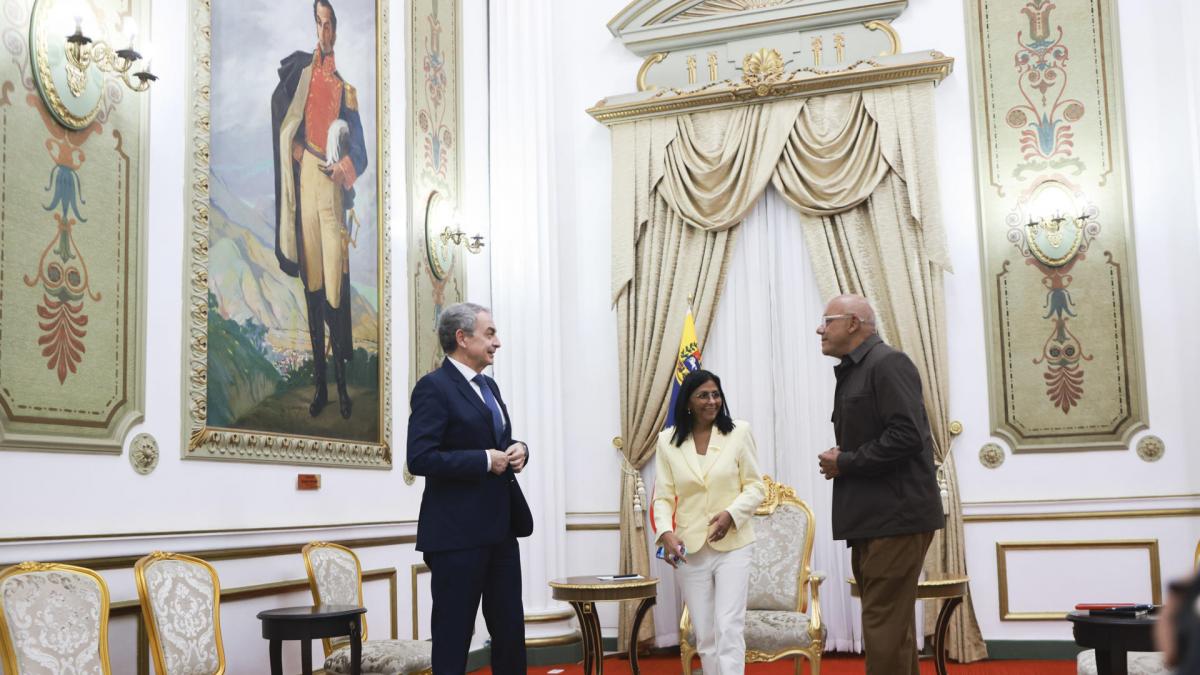
Former Spanish prime minister José Luis Rodríguez Zapatero visited Caracas to participate in the Program for Peace and Democratic Coexistence.
He met with Venezuela's acting president Delcy Rodríguez and other officials, including National Assembly president Jorge Rodríguez.
State media televised the visit.
The Venezuelan presidency described the trip as part of Bolivarian diplomacy of peace emphasizing brotherhood, dialogue and solidarity.
Zapatero said he felt great confidence in Delcy Rodríguez.
Coverage Differences
Tone and emphasis
El Mundo (Western Mainstream) frames Zapatero’s Caracas work in the context of long‑standing facilitation and close ties — describing a “far‑reaching, almost daily” relationship — while Diari ARA (Western Mainstream) and lnginnorthernbc.ca (Other) emphasize the visit’s public diplomacy and Zapatero’s expressed confidence. The three sources thus differ in framing: El Mundo underscores long political intimacy and facilitation, Diari ARA reports official framing and ceremony, and lnginnorthernbc.ca foregrounds Zapatero’s optimistic assessment and conference remarks. Each source’s phrasing is the basis for these contrasts (El Mundo “far‑reaching, almost daily”; Diari ARA “Bolivarian diplomacy of peace”; lnginnorthernbc.ca “he sees the best atmosphere…”).
Venezuelan amnesty law overview
A central public theme of the visit was support for a broad amnesty law for political prisoners.
Zapatero publicly backed an amnesty bill introduced by Delcy Rodríguez on Jan. 30 and described it as a turning point.
Venezuelan officials and the National Assembly signaled a legislative push and gradual releases that began earlier in the month.
The bill, as reported, excludes serious human-rights violations, crimes against humanity, and war crimes.
Sources say the National Assembly remains in early readings, and officials are calling the law a decisive step toward peace.
Citations below.
Coverage Differences
Narrative detail and emphasis
All three sources note Zapatero’s support for an amnesty initiative, but they emphasize different aspects: Diari ARA (Western Mainstream) highlights the bill’s text and exclusions and quotes officials predicting immediate releases; lnginnorthernbc.ca (Other) stresses Zapatero’s belief the government will follow through and quotes Delcy framing the law as “decisive” after Maduro’s departure; El Mundo (Western Mainstream) notes Zapatero’s involvement in talks on a broad amnesty law and his meetings with families of freed detainees but places that within wider scrutiny of his role. Each source is reporting overlapping facts but with different focal points (legal exclusions, political framing, or broader mediation role).
Zapatero mediation portrayals
Reports consistently describe Zapatero as a mediator and interlocutor with opposition figures, though accounts differ.
Some sources say he met opposition deputy Timoteo Zambrano and has a track record mediating government-opposition talks and facilitating prisoner releases.
El Mundo portrays a more strategic and controversial facilitation, alleging he helped arrange a tailored 'opposition' in the National Assembly and held meetings at the Spanish embassy.
lnginnorthernbc.ca emphasizes long-standing dialogue with both sides as the route to progress.
Diari ARA reports the meetings without the accusatory framing used by El Mundo.
Coverage Differences
Contradiction / Tone
El Mundo (Western Mainstream) reports allegations of Zapatero arranging a tailored “opposition” and engaging in political engineering (including named deputies and embassy meetings), which it presents as critical reporting and links to consultancy payments; by contrast Diari ARA (Western Mainstream) neutrally reports his meetings with Timoteo Zambrano and mediation work, while lnginnorthernbc.ca (Other) frames his contacts as constructive dialogue. The distinctions reflect El Mundo’s investigative/critical narrative versus the other outlets’ more neutral or favorable coverage.
Media reporting split
El Mundo uniquely includes a list of allegations and critical reporting on Zapatero's activities, from alleged consultancy payments linked to a Plus Ultra adviser to accusations he pressured the Grupo de Puebla and failed to denounce an alleged electoral fraud.
Diari ARA and lnginnorthernbc.ca omit those accusations and instead foreground official statements, ceremony, and Zapatero's optimism.
This divergence creates a clear reporting split between investigative critique and public-diplomacy reportage.
Coverage Differences
Missed information / Tone
El Mundo (Western Mainstream) reports specific allegations — consultancy payments, pressure on Grupo de Puebla, and criticism for not denouncing an alleged electoral fraud — while Diari ARA (Western Mainstream) and lnginnorthernbc.ca (Other) do not report those claims and focus on the visit’s official language and Zapatero’s supportive statements. The contrast reflects El Mundo’s investigative emphasis versus the other outlets’ omission of those critical details.
Zapatero visit coverage
Details of the private conversations remain limited.
The three sources together show both tangible outcomes: reported gradual releases and meetings with detainees' families; and open questions about Zapatero's influence and motives.
Diari ARA records the presidency's public framing and a Speaker's prediction that "everyone will be released that same day" once the law is approved, while lnginnorthernbc.ca highlights Zapatero's optimism that the law will be enacted.
El Mundo stresses investigative concerns and long-term ties that complicate a simple reading of the visit.
The net picture is overlapping factual reporting combined with contested interpretation and incomplete public detail.
Coverage Differences
Ambiguity / Unclear details
All sources report similar public events (meetings, conference, discussion of an amnesty), but Diari ARA explicitly notes the presidency “gave no details of the conversation,” lnginnorthernbc.ca emphasizes Zapatero’s optimistic assessment of the country’s atmosphere and progress through dialogue, and El Mundo flags unresolved questions by listing allegations and contextualizing Zapatero’s long engagement. Together they show agreement on events but disagreement or omission on private substance and interpretation.