USA01 January, 20263 min read
Zohran Mamdani Swears Himself In on Quran, Becomes New York's First Muslim Mayor
This article is an automated aggregation of coverage from news outlets. Our editorials offer in-depth analysis curated by the NewsCord team.
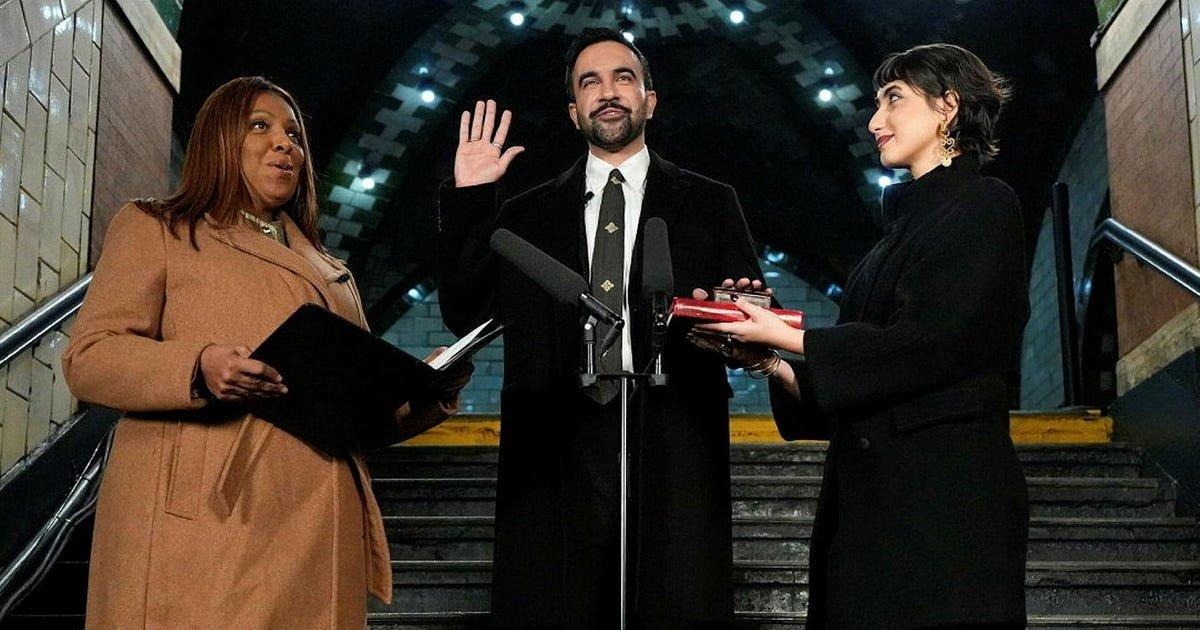
Sworn in just after midnight in the decommissioned Old City Hall subway station Took the oath with his hand on a Quran, becoming New York City's first Muslim mayor
95 outlets told this the same way.
Outlets did split on Trump Interrupted by Protesters at San Antonio Rally for Ken Paxton →
Mamdani inauguration details
Zohran Mamdani was sworn in as New York City's mayor on January 1, 2026, in two ceremonies that broke several historical precedents. A private, family-only midnight oath was held beneath City Hall at the decommissioned Old City Hall subway station. That midnight ceremony took place on the platform beneath City Hall and used Islam's holy book for the oath, making Mamdani the first New York mayor sworn in on a Quran.
“The small, family-and-advisers-only ceremony was administered by Attorney General Letitia James; a larger public inauguration was planned later that day, reportedly outside City Hall with Senator Bernie Sanders to administer an oath.”
Reports say he placed his hand on two Qurans: a family heirloom and a small late‑18th/early‑19th‑century pocket Quran on loan from the Schomburg Center. Mamdani, 34, is the city's first Muslim mayor, its first mayor of South Asian descent, and the first born in Africa, and he is among the youngest mayors in generations. The private solemnity was followed by a daytime public inauguration outside City Hall that featured national progressive figures and cultural moments as the city marked the transition in a highly visible way.

Religious Text Symbolism
Mamdani's choice of religious text and the specific Qurans used were highlighted across outlets as symbolically resonant. Multiple reports noted he placed his hand on two Qurans, a family heirloom from his grandfather and a small pocket Quran loaned by the New York Public Library's Schomburg Center, selected with the help of his wife.
Coverage framed that detail as connecting his personal faith to the city's diverse Muslim history and to Black Muslim intellectual heritage through the Schomburg volume. Reporting also emphasized the historic nature of using a Quran in a mayoral oath in New York, noting that prior mayors typically used a Bible and that the oath itself does not require any religious text.

Mamdani campaign agenda
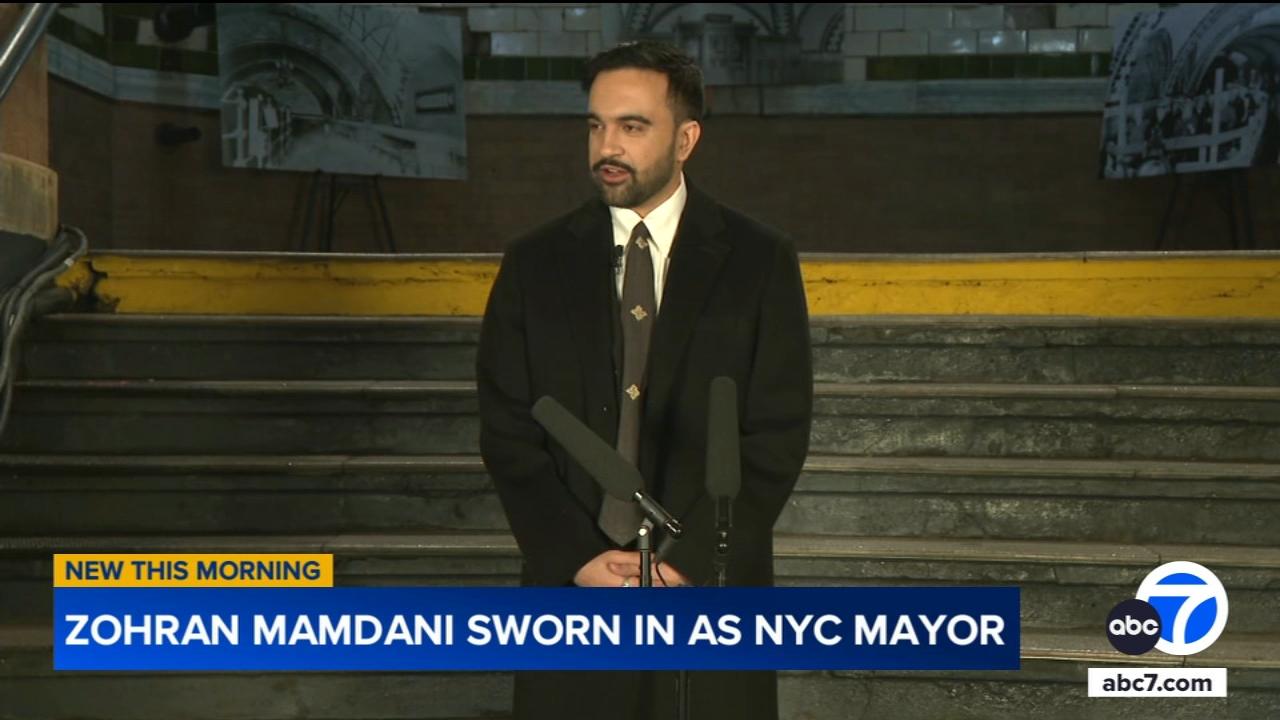
Mamdani’s inaugural remarks and his campaign record positioned him as a democratic socialist focused on affordability for working New Yorkers. Reporting across mainstream and regional outlets listed signature promises — free buses, universal childcare, a rent freeze affecting roughly one million stabilized apartments, pilot city-run grocery stores, and proposals to raise taxes on the wealthy to pay for programs — and quoted him or allies framing the agenda as transformative rather than incremental. Coverage also noted the campaign’s grassroots tactics and record turnout, which supporters cast as a mandate for ambitious reform.
“His three ‘Day One’ priorities are: universal free childcare ... fare‑free city buses, a rent freeze by appointing Rent Guidelines Board members who support 0% increases.”
Transition and governing challenges
Transition choices and immediate governing challenges drew mixed coverage. Mamdani announced early personnel moves, including naming Mike Flynn as transportation commissioner, and retained some established officials to reassure business and civic leaders.
Reporting also flagged transition stumbles, including a vetting failure over an aide’s past antisemitic tweets. Observers noted lingering skepticism in parts of the Jewish community about his statements on Israel, and the political reality of needing Albany’s cooperation along with potential pushback from unions and boards that control housing and policing policy.

Inauguration celebration and reactions
The public inauguration and celebratory events underscored both enthusiasm and partisan friction.
“He returned to City Hall midday for a public ‘Inauguration of a New Era’ celebration where Congresswoman Alexandria Ocasio-Cortez gave opening remarks and Senator Bernie Sanders administered the oath of office.”
A City Hall event and a large block-party-style public celebration drew thousands.

Sen. Bernie Sanders and Rep. Alexandria Ocasio-Cortez took visible roles, and cultural moments were woven into the program.
Some outlets described the day as an 'Inauguration of a New Era.'
At the same time, coverage noted lingering national political tensions, most notably campaign-era warnings from former President Trump about funding that later softened into a more cordial post-election meeting.
Coverage also recorded polarized reactions to symbolic choices such as swearing on a Quran.