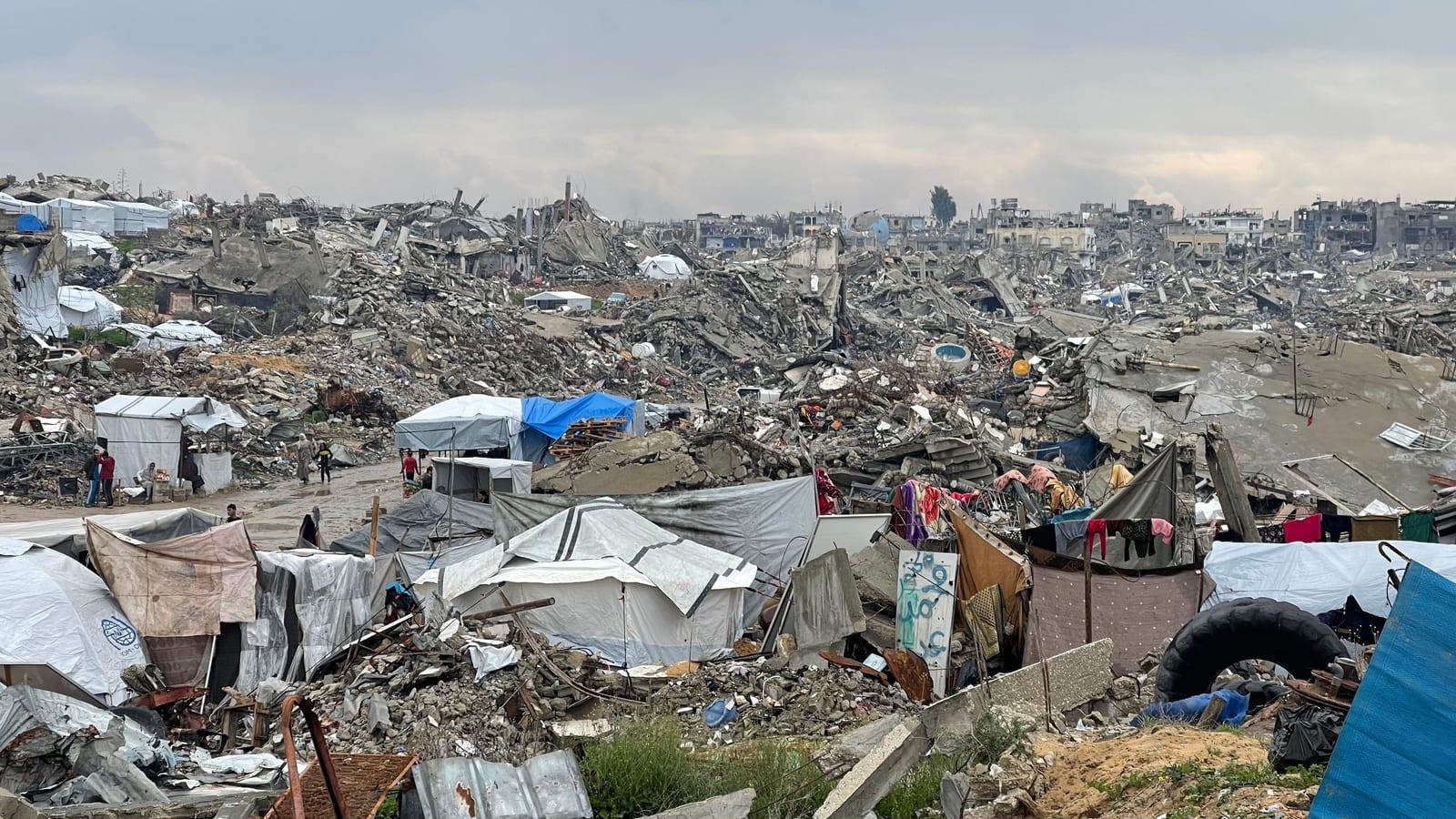
On the evening of Tuesday 26 May 2026, on the eve of Eid al-Adha, Israel fired at least five missiles into the upper three floors of the al-Kayali building, a residential block in the Rimal neighbourhood of Gaza City, in the middle of one of the city’s busiest market areas, while shoppers filled the streets below. Israel killed at least five people, on the lowest reported figure, and six on the most widely-carried figure. Among the dead: the Hamas commander Mohammed Odeh, his wife, his son, his daughter, and at least one other woman. Israel wounded between twelve and more than twenty.
The next morning, BBC News, the Los Angeles Times, The Independent, The Times and NBC News all wrote headlines that named exactly one of those dead people: the commander. The woman, the child, the family, the market, the Eid eve, the residential building, are all there in the same articles, in body copy written by the same desks. None are in the headlines. Each headline is contradicted by the article it sits on top of.
1. The five headlines, as they ran
| Outlet | What they published, 27 May 2026 |
|---|---|
| BBC News | “Israeli strike in Gaza City kills new head of Hamas’s military wing” |
| LA Times (AP wire) | “Hamas says Israeli airstrikes killed its new military leader in Gaza” |
| The Independent | “Israel kills new Hamas military leader in Gaza strike” |
| The Times | “New Hamas chief killed in Gaza airstrike, Israeli military says” |
| NBC News (Reuters wire) | “Hamas’ newly appointed armed wing chief in Gaza killed, Israel says” |
Other outlets carrying the same story on the same wires the same day produced headlines that named the militant claim and the Palestinian dead in the same line. The accurate construction was not hypothetical. It was published:
- Washington Times (AP wire): “Israel says it targets new Hamas leader in Gaza as Palestinians report 3 dead”.
- Helsinki Times: “Israel claims Hamas leader killed after deadly Gaza strike”.
- Al Jazeera: ran the Hamas-confirmation piece and a separate same-day piece headlined “Israeli air attacks kill seven Palestinians in Gaza”.
This is the controlling evidence. The framing chosen by BBC, LA Times, Independent, Times and NBC was not forced by the brevity of the headline format. Other desks fit both pieces of information into the same number of characters on the same day.
2. The facts on the ground
The strike
Tuesday 26 May 2026, around 21:30 local (19:30 GMT). The al-Kayali building, Rimal neighbourhood, central Gaza City. The BBC’s own copy describes the location as “a residential building in one of Gaza City’s busiest market areas”. Al Jazeera, citing witnesses on the ground, describes the same location as “in the middle of Remal, an area filled with markets and a lot of shops. Muslims were shopping, getting ready for the Eid holiday.” Israel struck the building with at least five missiles, hitting the upper three floors “almost simultaneously from different directions” (BBC, eyewitness account). One resident reported the sound of a helicopter overhead before the attack.
The dead
| Source | Killed | Wounded | Composition reported |
|---|---|---|---|
| AP (LA Times, Washington Post, regional members) | At least 5 | 12 | Odeh, his wife, son, daughter, and “another woman” |
| Reuters (CBC, NBC, Irish Times) | 6, including at least one woman | 20+ | Family and others |
| Al Jazeera | At least 6 (rose from 3) | Dozens | Civilians |
| Hamas / Odeh family | Odeh, wife, two sons (Hamas) / wife and one son (family, via Reuters) | , | , |
The minimum confirmed toll across these sources is five to six dead, twelve to twenty-plus wounded. The dead include at least one woman (Reuters / CBC) and at least one child (AP names Odeh’s daughter; Hamas says two of his sons).
The wider ceasefire toll
Every article cited the same Gaza Health Ministry figure: Israel has killed more than 900 Palestinians in Gaza since the 11 October ceasefire took effect (BBC and Irish Times use roughly 900; Al Jazeera 906; CBC roughly 900). The Israeli-side toll over the same period: four Israeli soldiers (BBC, CBC, Al Jazeera). That is a ratio on the order of 225 to 1, a documented asymmetry the same articles report and then write headlines around.
3. The mechanics of the erasure
Five distinct techniques are at work across the headlines. They are not separate failures; they compound.
3.1 The militant as sole grammatical object
Every headline names exactly one victim: the militant Israel killed. The other people Israel killed, including a woman and at least one child, are not in the headline at all. They are not unnamed civilians; they are not “others”; they are not numerical. They are absent.
- BBC: subject = “Israeli strike”, verb = “kills”, object = “new head of Hamas’s military wing”.
- LA Times: subject = “Israeli airstrikes”, verb = “killed”, object = “its [Hamas’s] new military leader”.
- Independent: subject = “Israel”, verb = “kills”, object = “new Hamas military leader”.
- Times (passive): subject = “New Hamas chief”, verb = “killed”, attribution = “Israeli military says”.
- NBC (passive): subject = “Hamas’ newly appointed armed wing chief”, verb = “killed”, attribution = “Israel says”.
This is not a brevity constraint. The same outlets routinely write headlines that name multiple casualty categories (“Strike kills commander and four civilians”, “Airstrike on market kills six, including children”). The single-object headline here is a choice. The reader who sees only the headline is not informed that anyone else died. They have to read past the lead to find out. The composition of who died, woman, child, family members shopping for Eid, is buried still further down.
3.2 The “says” hedge that hedges the wrong claim
The Times and NBC headlines end with “Israeli military says” / “Israel says”. This is not standard sourcing caution. It is sourcing caution applied to the wrong proposition.
What is in dispute, and therefore correctly hedged: that the man Israel killed was a senior Hamas military commander. (Hamas later confirmed; the initial Israeli claim was a claim.) What is not in dispute: that Israel killed people in a residential building. That is observed fact, recorded by hospitals, the civil defence and witnesses. It does not need the “Israel says” hedge.
By placing the hedge on the headline’s only proposition, these outlets implicitly hedge the entire event, the killing itself, and not just the contested identity claim. The reader is left with the impression that the whole story is Israel’s account of itself. The dead Palestinians become Israel’s claim, not their families’ grief.
3.3 “Despite the ceasefire”: agentless atmosphere
The BBC’s own standfirst: “Despite the Israel-Hamas ceasefire agreed in October, violence in Gaza has continued on a near-daily basis.” Each clause is a separate problem.
- “Despite the ceasefire”: “despite” implies an outcome contrary to the parties’ intentions or efforts. The 900-plus killings the BBC’s same article reports are not “despite” Israeli policy; they are Israeli policy, executed by Israeli aircraft and Israeli ground forces. The conjunction quietly absolves the actor.
- “violence in Gaza”: “violence” is an abstract noun. “in Gaza” attaches the violence to the place, not to the agent inflicting it. Compare the construction the same desk uses for the inverse symmetry (“Hezbollah rocket fire on northern Israel continues”), where the actor is named and the place is the target. Here the place absorbs the noun and the actor disappears.
- “has continued on a near-daily basis”: a verb-phrase chosen for atmospheric continuity. Killing is not weather. It does not happen “on a near-daily basis”. It is done, by an actor, on the days it is done. The frequency adverbial naturalises the killing as a steady-state condition of Gaza, as if it were rainfall.
Stitched together, “Despite the Israel-Hamas ceasefire agreed in October, violence in Gaza has continued on a near-daily basis” is a sentence that takes “Israel has killed 906 Palestinians in Gaza during the truce, including children, women, displaced people and aid workers”, the BBC’s own sourced figure, and renders it as background weather.
3.4 The market and the Eid eve as missing context
Every body in the five pieces, and the BBC’s especially, includes the line: Israel struck a residential building in one of Gaza City’s busiest market areas, on the eve of Eid al-Adha, while shoppers filled the streets below. That context is missing from all five headlines. It is the single most material piece of information for a reader trying to understand what kind of military operation this was. It is the difference between “targeted assassination” and “strike on a market-area residential building.” The former is the headline. The latter is what the journalists in the same byline have written below.
3.5 “Ceasefire” in scare-mode without consequence
Four of the five pieces (BBC, LA Times, Independent, NBC via Reuters wire) refer to the October “ceasefire” and report the 900-killings figure inside the same article. None of the headlines reflect that this strike is the latest of more than 900 Israeli killings during the seven-month “ceasefire”. A reader scanning only the headline would not know that this is the 906th-or-so Palestinian Israel has killed in a “ceasefire” that has lasted seven months. That is the relevant frame for what kind of event this is.
Take action
File seven complaints in one click.
One click sends a tailored complaint to each of the five mastheads and to the two wire originators, anchored to each outlet’s own accuracy standard: BBC via the BBC complaints API under Editorial Guidelines Section 3, The Times via IPSO under Editors’ Code Clause 1, LA Times Reader’s Representative, The Independent Reader’s Editor under the Editors’ Code it voluntarily adopts, NBC NewsStandards, AP Standards desk (with a corrected wire advisory ask), and Reuters Standards desk under the Trust Principles (with a Handbook trashline ask).
4. The decisive argument
The headline is contradicted by the article’s own body and by the article’s own cited sources.
This is the single argument that every relevant standards code is designed to test:
- BBC Editorial Guidelines, Section 3 (Accuracy): “We strive to be accurate and establish the truth of what has happened ... Where the BBC reports details of an event ... we will normally do so directly. The accuracy of headlines is of particular importance.” A headline whose only object is the militant target, when the body reports at least four other people Israel killed, is not accurate by the BBC’s own standard.
- Ofcom Broadcasting Code, Section 5 (Due Accuracy): the BBC is regulated by Ofcom for due accuracy and due impartiality.
- IPSO Editors’ Code, Clause 1 (Accuracy): “The Press must take care not to publish inaccurate, misleading or distorted information or images, including headlines not supported by the text.” This is the controlling rule for The Times. The Independent is not an IPSO member (it self-regulates), but the Editors’ Code is the benchmark it voluntarily adopts.
- AP Statement of News Values and Corrections Policy: “when we’re wrong, we must say so as soon as possible.” The LA Times runs AP wire copy. A correction at the AP wire level fixes every downstream masthead at once.
- NBC News Standards and Practices: accuracy obligations; corrections policy.
- Reuters Trust Principles and Reuters Handbook of Journalism: headline must reflect the reporting beneath it; corrected-wire “trashline” requirement on the wire originator.
The complaint to each outlet is not “I disagree with your politics.” It is the narrow, evidenced, code-based claim: your headline names only the militant target as a victim, while your own reporters’ text, hospitals you cite, and the Gaza Health Ministry and civil defence you cite, all record that Israel killed five or six people, including at least one woman and at least one child, and that Israel struck a residential building in a busy market area on the eve of Eid. Under your applicable accuracy standard, the headline requires correction.
5. The remedy
In every complaint, the campaign asks for one or more of the following, in this order of preference:
- Headline correction to a construction that names the agent, the militant target and the civilian dead in the same line. Examples drawn from the articles’ own copy:
- “Israeli strike on Gaza City market-area building kills Hamas commander and five others on eve of Eid”
- “Israel kills new Hamas military chief, his family, and others in Gaza City residential strike”
- “At least six killed, including a woman, as Israeli strike hits Gaza City market-area building targeting Hamas commander”
- A published correction or clarification note on the article recording the change and the reason, per the outlet’s corrections policy. Without the note, the change is silent and unaccountable.
- For wire originators (AP, Reuters): a corrected wire advisory issued to all downstream members. The AP version is on LA Times, Washington Post, ABC affiliates and many regional members. The Reuters version is on CBC, NBC, Irish Times. A single wire correction reaches them all.
- For the BBC: correction of the “violence in Gaza has continued” standfirst. The accurate construction the article’s own body supports is: “Israel has killed more than 900 Palestinians in Gaza since the October ceasefire began.”
6. The accurate alternative existed
Three outlets, on the same wires the same day, fit both pieces of information into the same line.
- Washington Times (AP wire): “Israel says it targets new Hamas leader in Gaza as Palestinians report 3 dead”. Names the militant claim, names the Palestinian dead.
- Helsinki Times: “Israel claims Hamas leader killed after deadly Gaza strike”. Names Israel, names the killing, marks the contested claim as a claim.
- Al Jazeera: ran a separate same-day piece headlined “Israeli air attacks kill seven Palestinians in Gaza”. Names Israel, names the Palestinians, in the headline.
Same character count. Same desks. Same day. The five outlets we complain about chose not to write it. The complaint to each is not that an accurate headline was impossible. It is that an accurate headline was published, on the same wires, by other desks, in the same number of characters, in the same news cycle. The choice not to write it is the choice that requires accountability.
Take action
File seven complaints in one click.
One click sends a tailored complaint to each of the five mastheads and to the two wire originators, anchored to each outlet’s own accuracy standard: BBC via the BBC complaints API under Editorial Guidelines Section 3, The Times via IPSO under Editors’ Code Clause 1, LA Times Reader’s Representative, The Independent Reader’s Editor under the Editors’ Code it voluntarily adopts, NBC NewsStandards, AP Standards desk (with a corrected wire advisory ask), and Reuters Standards desk under the Trust Principles (with a Handbook trashline ask).