Syria12 June, 20263 min read
AFP Team Finds Probable Mass Grave Near Damascus Linked to Saydnaya Prison
This article is an automated aggregation of coverage from news outlets. Our editorials offer in-depth analysis curated by the NewsCord team.
Mass grave dating to 2014 found in Saidnaya, Rif Dimashq. Syrian Interior Ministry announced discovery in coordination with the National Commission for the Missing.
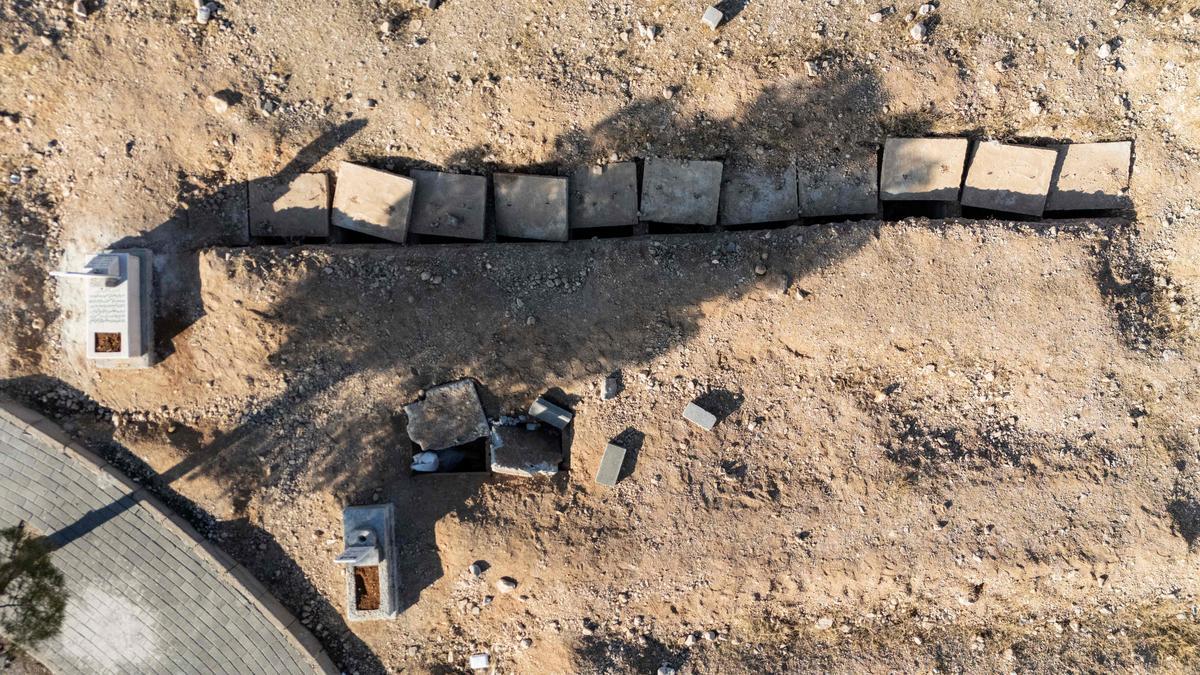
Mass grave near Damascus
An AFP team saw what it described as a mass grave on a vacant lot about thirty kilometers northeast of Damascus in the area of Jisr Bagdad, where rows of graves formed a trench more than a meter deep and were covered with concrete slabs that had been displaced. In Jisr Bagdad, a White Helmets rescue worker, Abdel Rahmane Mawas, said by phone that "We think this is a mass grave" and that his teams had found an opened vault with seven bags filled with bones. The site is tied to the prison symbol of Saydnaya, with the Jisr Bagdad location lying about twenty kilometers from the town of Saydnaya, according to the AFP report.
The AFP account also links the discovery to the period after the fall of Bashar al-Assad, saying that since December 8, new authorities and residents of the capital’s outskirts have begun to identify sites that would host mass graves. The Le Devoir report places another search near Najha, southeast of Damascus, where Ziad Aleiwi described a deep trench surrounded by military observation posts and said residents reported people routinely combing the area.

Evidence, DNA, and calls
At the Jisr Bagdad site, Abdel Rahmane Mawas said six of the bags bore a name and that the bags were "transferred to a safe location," with "DNA tests" to follow. The Le Devoir account describes Omar Al-Salmo, a Civil Defense official, noting that since the regime’s fall his team had received more than a hundred calls informing them of mass graves and that people think that at every military site, there is one. Human Rights Watch urged the new authorities to protect and preserve the evidence, including those found in mass graves, and called for cooperation with the International Committee of the Red Cross (ICRC), which it said could provide essential assistance to protect the evidence.
In the same AFP-linked reporting, Diab Serriya, cofounder of the Association of Detainees and Missing Persons of Saydnaya Prison (ADMSP), said he first learned of the site in 2019 through the testimony of a defector from the intelligence services. Mediapart frames the work as a race against time to preserve traces of terror in the regime’s deserted headquarters, describing tens of thousands of Syrians traveling to search for missing relatives from mass graves to abandoned prisons.
Saidnaya grave and next steps
On Friday, the Syrian Ministry of Interior announced the discovery of a mass grave in the city of Saydnaya in the Rif Dimashq Governorate, dating back to 2014, and the Syrian News Agency (SANA) said it contained the remains of a number of martyrs of the rebels from the Western Qalamoun battles. The ministry said security forces "drew a security cordon around the site" to protect the place, preserve the evidence and landmarks, and ensure the area was not tampered with until procedures were completed. The National Commission for the Missing said it conducted, in coordination with competent authorities, an initial on-site assessment in Saidnaya in response to reports from residents about sites suspected of containing human remains or mass graves.
Mediapart’s reporting connects the broader effort to collect evidence of regime abuses, describing a race against time to preserve traces of terror as Syrians search for missing relatives. In the AFP-linked account near Damascus, the report also describes how residents and teams are trying to identify who is buried, with Diab Serriya saying "The road will be long" before learning who is buried.