EL PAÍS
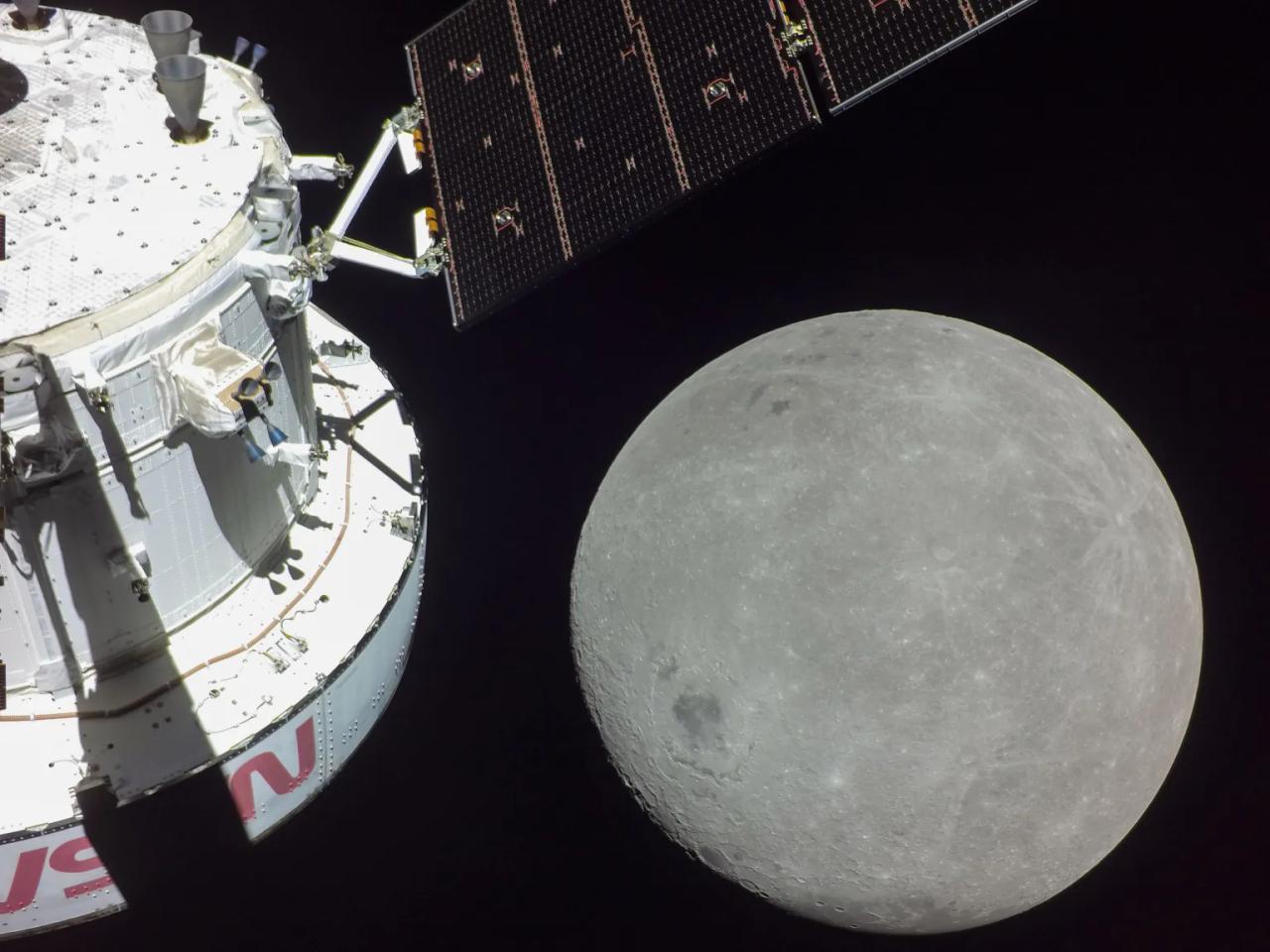
The first astronauts to travel to the Moon in more than half a century won’t land there, nor will they even risk approaching to enter orbit, as the Apollo missions did. They will only circle it, at an altitude of more than 7,400 kilometers. However, the advantage of staying at that prudent distance is that they will have a privileged view of the far side: they will be the first to see it in full, gazing at parts never seen by human eyes.
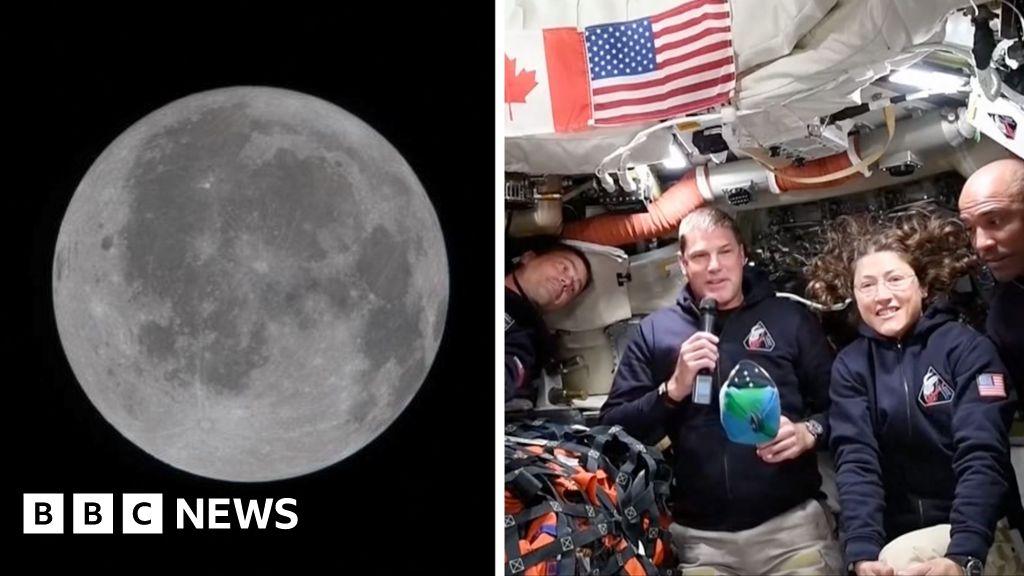
Commander Reid Wiseman, pilot Victor Glover, and mission specialists Christina Koch and Jeremy Hansen have spent years training to observe all manner of craters, seas (maria), and other features of the far side’s geology. Until they launch, they won’t know exactly what they’ll be able to see at that mission’s culminating moment, during which they could also break a historic record: humans who have gone the farthest from Earth. Everything depends on the final launch date and time.
That moment will determine how much of the far side is sunlit when they arrive five days later; the rest will be invisible to them. The possible launch windows in April yield a smaller sunlit area on the far side than the opportunities in March. That’s one reason NASA wanted to push preparations to launch the mission as soon as possible. But a fault detected in the rocket’s upper stage after a full dress rehearsal delayed the launch.
Circling the Moon with fewer risks
In this new era of spaceflight, NASA isn’t willing to let the crew of the Orion spacecraft — on its first crewed flight — risk what Apollo 8 did in December 1968, the first crewed voyage to the Moon. When they got there, the space cowboys aboard it had to dare to slow the craft — by firing its engines powerfully — to insert it into lunar orbit. Artemis 2, by contrast, will stay on a free-return trajectory, so named because the spacecraft loops and returns on its own, tracing a figure-eight path. It behaves like a boomerang, leveraging the gravitational pull of Earth and the Moon.
Using a free-return trajectory is the simplest and safest way humanity has to visit another world. But for that entire choreography of paths and gravitational pulls to work, you need to propel the spacecraft toward the Moon on the precise day and time. That greatly limits the launch windows, which for Artemis 2 can only take place on five or six days of each lunar cycle. And on the day that is ultimately chosen, there are only two hours to attempt it. If the weather forecast for those hours looks unfavorable, NASA will postpone the launch. This will be the most complex and dangerous phase of the mission.
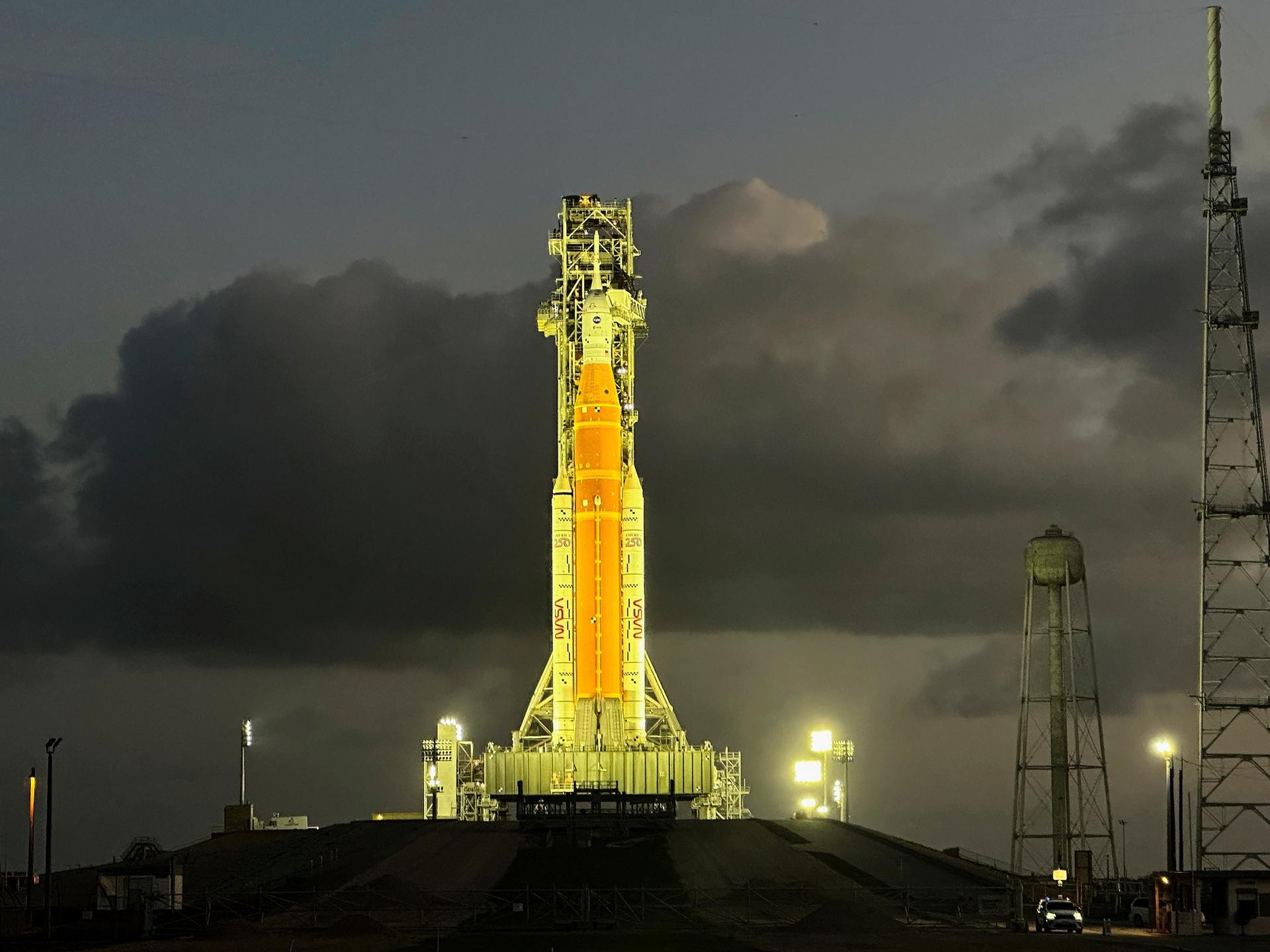
The Orion spacecraft is as wide as a van, though almost four times taller, and weighs as much as two buses. To loft such a behemoth into space and place it into a safe initial orbit around Earth — the first essential step in any spaceflight — you need a colossal rocket like the SLS. Its total height, with the spacecraft inside, reaches 98 meters: the height of a 30‑story building, but loaded with two million liters of the highly explosive liquid hydrogen.
All that fuel and energy is necessary for the vehicle to overcome Earth’s gravity and rise into space, to altitudes over 100 kilometers. Once there, it must keep climbing and accelerating to reach speeds above 27,000 kilometers per hour, required to enter orbit.
The SLS is the largest and most powerful rocket to achieve that feat in the entire history of the space race. In just eight minutes it can place the Orion into orbit, after which it will take almost an hour and a half to complete its first orbit around the Earth.
Once Orion is safely in space, NASA has designed a tight test program that will extend through the first day of the Artemis 2 mission. The goal is to certify that the spacecraft is ready to travel with humans to the Moon. And to that end, the most practical step is to place it into a high Earth orbit — reaching up to nearly 70,400 kilometers — and thereby send it into deep space.
No one has been farther from Earth since, in 1972, the Apollo lunar missions concluded. In addition to testing life‑support and propulsion systems, during this second, extended lap around Earth, Orion separates from the rocket’s upper stage and performs proximity‑approach maneuvers to it. It’s a slow and sophisticated space dance between the two components, lasting several hours and requiring manual control by the Artemis 2 pilot. It will serve as the first test for what, in 2027, will be Artemis 3’s big goal: to test the docking between the spacecraft and the lunar descent module —still under fabrication—, essential for astronauts to step onto the Moon’s surface in Missions 4 and 5 of this program, currently planned for 2028.
Having completed the second orbit around Earth, the Orion returns to within less than 200 kilometers of altitude. A full day of testing has elapsed, and it must be ready to undertake its real journey to the Moon. This is the decisive moment, and the spotlight falls on the European Space Agency (ESA)-designed and Airbus-built service module. The European Service Module provides electricity — with its solar panels deployed —, water, and temperature control to the crew’s capsule. Its engines will also propel the spacecraft for the rest of the journey. One day, one hour, and 37 minutes after liftoff, it blasts toward the Moon thanks to the main engine’s powerful thrust.
Because it is a free-return trajectory — and the spacecraft will not enter lunar orbit — from that moment there will only be a few, much gentler burns of the service module’s auxiliary engines. They will serve to correct the trajectory, preventing the craft from deviating. There will be roughly one correction every 24 hours, during the four days of the outbound journey to the Moon. Inside the crew capsule — which the mission’s own astronauts have nicknamed Integrity — they are preparing for the lunar flyby.
All missions that travel to the Moon have to circle it, venturing into the far side, a region almost unexplored by the human eye. Only then can we behold that lunar hemisphere, which we call the hidden side because it’s always pointing away from Earth.
In the Artemis 2 mission, during that flyby, the astronauts could be farther from Earth than any others before — if the mission launches on April 1, they will surely do so — surpassing Apollo 13’s distance. Then the far side of the Moon will look as large as a basketball we’re holding with an outstretched arm. Even though it may not seem like much, it’s more than 50 times larger than how we see it from Earth or from the International Space Station.
The Artemis 2 crew will dedicate those central hours of the mission to photographing and studying the details, colors, and even the shadows of the far side, as they fly over it; and, especially, taking advantage of the so‑called radio silence: the astronauts will lose contact with Earth for at least half an hour when they are on the far side.
It’s inevitable — the Moon blocks and is a barrier that radio signals cannot cross — a silence that affects all lunar missions. It will end when Earth reappears into view, at which moment the Artemis 2 crew will try to recreate Earthrise, a science icon captured in 1968 by Apollo 8.
After the observation phase of the far side is finished, the astronauts can relax. Being a free-return trajectory, the return is automatic: there isn’t a single maneuver to initiate the return. Only, again, minor trajectory corrections once during each of the four days of the return journey.
The first of those days will be almost entirely free, and from then on they will also conduct scientific experiments, new endurance and piloting tests, and public appearances via video calls with Earth. It is the final stretch of 10 days in a next‑generation capsule, far more comfortable and better equipped than the Apollo-era capsules. Yet there are four people in the interior space of a wide van‑like capsule, with a multitude of instruments in the middle, and sharing the space 24 hours a day during the mission.
As the return nears completion, at an altitude of 120 kilometers above the Earth’s surface, the capsule will have separated from the rest of the Orion spacecraft’s components. Then it orients itself with its own engines, seeking the proper angle to plunge into the atmosphere. This is about minimizing the risks of this final phase of the journey, which is as critical as liftoff.
There will be 16 minutes of dizzying descent, from the moment the crew capsule enters the atmosphere at speeds over 40,000 kilometers per hour and slows down, first due to air friction — which heats its outer skin to more than 2,700°C — and then thanks to several sets of parachutes opening.
Finally, if all goes well, the speed will drop to about 30 kilometers per hour, and the capsule will softly land on the Pacific Ocean, off the coast of San Diego (California, U.S.).
During the brief and dangerous descent, the spacecraft also loses contact with the control base for a short time. That brief suspense, before the splashdown that will end the mission, will give way to a waiting period of up to two hours. It is the time needed for the recovery ship to arrive and for numerous checks to be carried out before the lunar passengers board the craft.
They will go down in history as the four astronauts who resumed the conquest of Earth’s Moon, after half a century of hiatus. And despite not being able to set foot on it, the lunar landscapes will be etched in their minds. Views of craters and seas of the Moon’s far side that no human had been able to observe, and that, thanks to their meticulous scientific work, will no longer be lost to time.