Europe10 July, 20263 min read
Bayeux Tapestry Returns to England, Arriving at British Museum in London After Overnight Transfer
This article is an automated aggregation of coverage from news outlets. Our editorials offer in-depth analysis curated by the NewsCord team.
Bayeux Tapestry arrived at British Museum in London on a one-year loan from France. Transfer occurred overnight under tight security for the fragile 11th-century, 225-foot tapestry.

Secret crossing to London
The Bayeux Tapestry returned to England after nearly 1,000 years, arriving at the British Museum in London on July 10 following a secrecy-shrouded overnight transfer from France.
The operation involved a truck that crossed from France on a vehicle shuttle train through the Channel Tunnel, after an 11-hour, 560km trip escorted by police.
British Museum Director Nicholas Cullinan said, "It feels extraordinary that after so much work and planning and care and thought that it’s actually happening," as museum staff and British and French diplomats applauded the arrival.
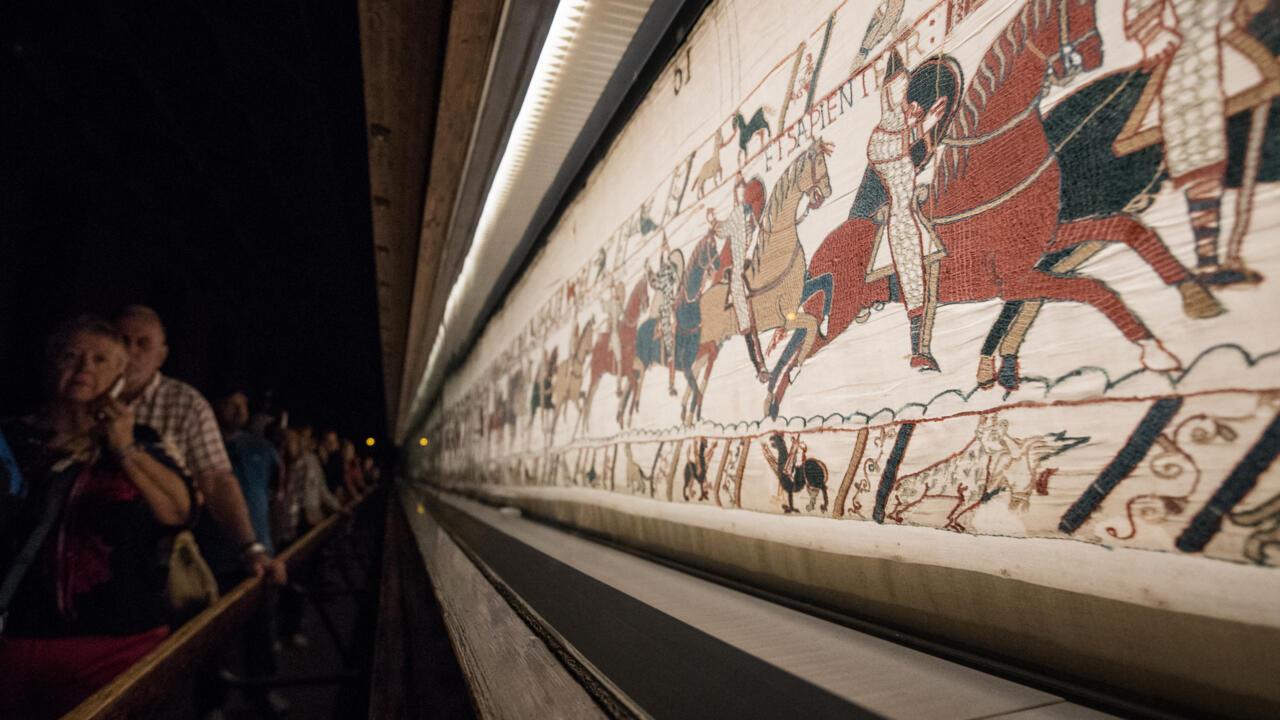
The tapestry, described as a 70m work stitched in wool thread on linen fabric, was folded accordion-style in a climate-controlled case placed inside a shock-absorbing cradle before being eased into a loading bay.
The exhibition is scheduled to run at the London museum from Sept. 10 to July next year, with the museum expecting it to be one of its most popular in its history.
Diplomacy, tickets, and voices
The loan was announced during a state visit to the UK by French President Emmanuel Macron in July last year, and retired British diplomat Peter Ricketts said it was "an extraordinary mark of friendship and confidence in the UK to entrust this object to us for a year." Macron’s role was also framed as a shared-history gesture, with Town & Country quoting him saying, "The Bayeux Tapestry will follow the same path as the warriors whose story it tells and land on British soil." Nicholas Cullinan compared public demand to a major music festival, telling the Taipei Times, "It was like trying to get tickets to Glastonbury," after about 100,000 tickets were sold in their first day on sale this month.
The tapestry’s story is tied to the Norman invasion of England, depicting events leading up to the Battle of Hastings in October 1066 when William, Duke of Normandy, defeated King Harald’s Anglo-Saxon army. The work’s scale and content were emphasized in the reporting, including that it features 627 people and 737 animals and tells its story in 58 scenes.
What happens next
After arrival, the tapestry is set to spend several days acclimatizing before it is carefully unpacked and unfolded for an exhibition the British Museum expects to be one of its most popular in its history. The loan is also described as part of a reciprocal cultural exchange, with the British Museum to loan treasures from the Sutton Hoo hoard and other items to museums in Normandy. French cultural figures opposed the loan in some quarters, and France 24 quoted art historian and journalist Didier Rykner saying, "We've never transported something this fragile," while critics argued that moving the textile was an unnecessary risk.
France 24 also reported that curators at the British Museum said bespoke transport technology was designed to reduce risk, with lead curator Michael Lewis acknowledging, "There is never any movement that goes without any risk whatsoever." In the run-up to the display, the tapestry is scheduled to be presented to the public from September 10 through July 2027, with the museum’s ticket sales and the expected scale of attendance tied to the loan’s diplomatic and heritage stakes.