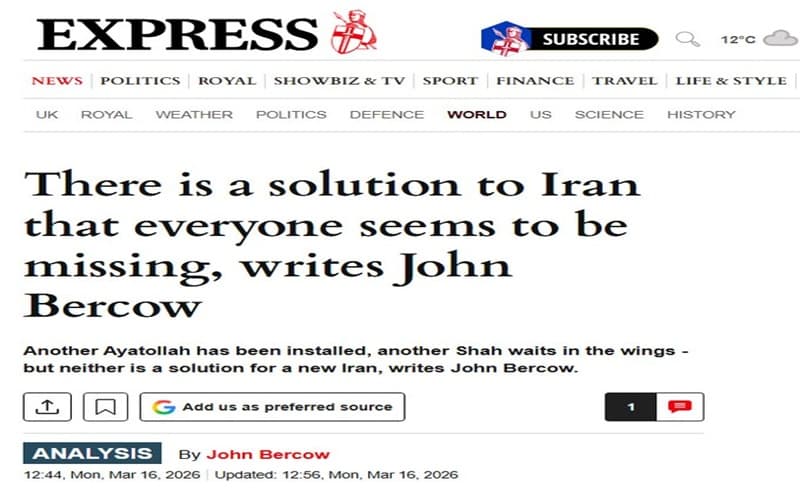
Beyond Shah and Supreme Leader: A Viable Alternative Emerges for Iran
Key Takeaways
- Iran's future debate shifts toward organized resistance and a structured democratic roadmap.
- The article questions a viable alternative beyond the ruling clerical establishment and monarchy.
- Based on John Bercow's analysis published March 16, 2026 in the Daily Express.
Leadership entrenchment risk
Bercow’s central argument is clear: Iran today is not witnessing renewal, but entrenchment.
“Citing John Bercow’s analysis in Express, the debate over Iran’s future shifts toward organized resistance and a structured democratic roadmap A recent analysis by John Bercow, published in Daily Express on March 16, 2026, raises a critical question about Iran’s future: if neither the ruling clerical establishment nor a return to monarchy offers a solution, what viable alternative exists”
Following the death of Ali Khamenei, the rapid elevation of his son, Mojtaba Khamenei, underscores a system struggling to preserve itself rather than reform.
According to Bercow, this transfer of power—effectively a hereditary succession within a system that once rejected monarchy—reveals a regime at a dead end.
Rather than projecting authority, the move signals fragility, driven by internal fears of instability and the possibility of renewed nationwide uprisings, particularly in the wake of protests earlier in 2026.
The consolidation of power around Mojtaba Khamenei, with his established ties to the Islamic Revolutionary Guard Corps, reflects the regime’s increasing reliance on its security apparatus.
Yet this approach, Bercow suggests, may only deepen the very crisis it seeks to contain.
Western alternatives dismissed as credible
At the same time, he dismisses simplistic alternatives gaining attention in Western discourse.
In particular, the renewed focus on Reza Pahlavi—son of Iran’s last Shah—does not, in his view, constitute a credible democratic path forward.
Political legitimacy, he argues, cannot be derived from lineage, media visibility, or diaspora gatherings, but must be rooted in sustained engagement, credibility, and sacrifice.
Iran’s modern history reinforces this point.
The 1979 revolution itself was, in part, a rejection of hereditary rule.
Today, many Iranians continue to reject both forms of authoritarianism—clerical and monarchical alike—calling instead for a fundamentally different political order.
Organized opposition as viable alternative
It is within this context that Bercow directs attention to organized opposition movements, particularly the National Council of Resistance of Iran.
“Citing John Bercow’s analysis in Express, the debate over Iran’s future shifts toward organized resistance and a structured democratic roadmap A recent analysis by John Bercow, published in Daily Express on March 16, 2026, raises a critical question about Iran’s future: if neither the ruling clerical establishment nor a return to monarchy offers a solution, what viable alternative exists”
For over four decades, the NCRI has positioned itself as a structured alternative to the ruling system, with its principal component, the People’s Mojahedin Organization of Iran, maintaining networks inside Iran despite severe repression.
Bercow highlights the scale of sacrifice associated with this movement, noting that tens of thousands of its members have faced imprisonment, torture, and execution.
He also points to its role in exposing aspects of Iran’s nuclear program, underscoring its operational capacity and international relevance.
At the center of this alternative stands Maryam Rajavi, whose long-standing advocacy for a democratic republic is framed around a detailed ten-point plan.
This framework includes universal suffrage, free elections, separation of religion and state, gender equality, abolition of the death penalty, and a non-nuclear Iran.
Crucially, Bercow emphasizes that such proposals go beyond rhetoric.
In contrast to vague or personality-driven alternatives, they offer a structured and actionable roadmap for political transition—something historically essential in moments of systemic crisis.
The question now, as framed in the Express analysis, is whether Mojtaba Khamenei’s leadership will stabilize the current system or accelerate its internal contradictions.
Historical precedent suggests that durable political change does not arise spontaneously, but through organized movements capable of stepping into the vacuum with legitimacy and a clear plan.
Reflecting this reality, the NCRI has announced the formation of a provisional government framework aligned with Rajavi’s ten-point plan, positioning itself as a ready alternative in the event of systemic change.
More on Iran

Iranian missiles strike Dimona and Arad, injuring over 100.
47 sources compared
Israel and U.S. Strike Natanz Nuclear Facility Again; Iran Blames Attack
69 sources compared

Iran Attacks Diego Garcia with Long-Range Missiles, Targeting U.S.-UK Base
82 sources compared
Trump Defends Iran War by Citing Pearl Harbor
12 sources compared