USA26 September, 20262 min read
Bruno Rodríguez Parrilla Accuses US at UN of Economic War and Humanitarian Crisis
This article is an automated aggregation of coverage from news outlets. Our editorials offer in-depth analysis curated by the NewsCord team.
Cuba says US blockade is economic war intended to provoke humanitarian crisis. Foreign Minister Bruno Rodríguez Parrilla claims more than 7,000 containers blocked, harming Cubans.
9 outlets told this the same way.
Outlets did split on White House Officials Question How Long Katie Zacharia Will Stay Press Secretary After First Briefing →
Cuba calls blockade war
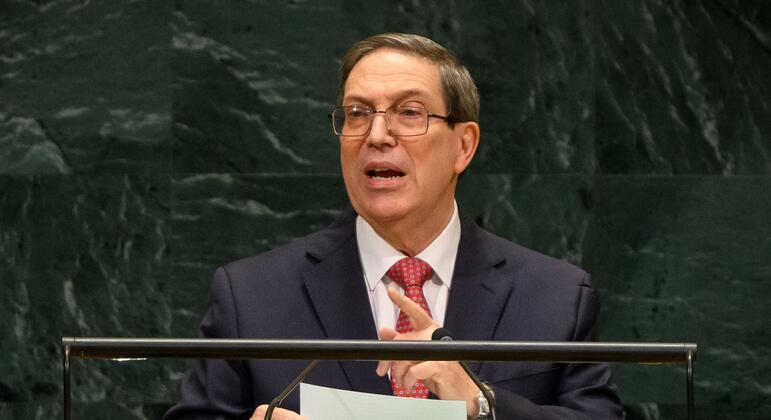
Cuba’s foreign minister, Bruno Rodríguez Parrilla, accused the US at the UN of waging an economic war and calling its blockade a crime and collective punishment. Rodríguez Parrilla told the UN General Assembly that the US is deliberately attempting to provoke a humanitarian crisis on the island, and he said the policy has intensified and become more cruel and dangerous with an energy blockade. Rodríguez Parrilla warned that the US maintains a “multidimensional aggression” that has lasted nearly seven decades and that, since January 2026, it has intensified with an energy blockade that prohibits all countries from exporting fuels to Cuba.
“Cuba denounces the ‘energy blockade’ as ‘an act of war.’”
Rodríguez Parrilla described the blockade as “an act of war” and said it amounts to a naval blockade codified in international law as an act of war. Rodríguez Parrilla added that “the threat of the use of military force” against the island “persists,” and he said that if carried out it would constitute a crime of great magnitude.

Containers, sanctions, and dialogue
Rodríguez Parrilla said the US blockade has detained more than 7,000 containers with food, medicines, and medical devices in ports of third countries. Rodríguez Parrilla argued that the blockade is “an act of collective punishment” aimed at creating a humanitarian crisis, something prohibited by International Humanitarian Law. Rodríguez Parrilla said Washington pressures entrepreneurs from other countries to abandon their investments on the island and pressures sovereign governments to renounce Cuban medical services.
Rodríguez Parrilla rejected the US accusation that Cuba represents “an unusual and extraordinary threat” to its national security, and he exclaimed, “If Cuba is not a threat, the blockade is!” Rodríguez Parrilla asserted that Cuba is advancing “a process of changes, deeply transforming the economic and social model,” while reiterating willingness to dialogue with Washington on the basis of seriousness, respect, sovereign equality, and observance of international law.
US travel restrictions under review
The Trump administration was considering imposing new restrictions on Cuban officials traveling to the United Nations, a move aimed at pressuring Havana, as the head of Cuban diplomacy accused the US of inflicting collective punishment through increasingly harsh measures. The US State Department was contemplating “strict controls” against officials planning to return next month for the UN annual vote on the decades-old U.S. embargo of Cuba, according to American officials and an internal document obtained by the Associated Press. Rodríguez criticized the “lack of progress” in talks between Havana and Washington and condemned the January petroleum blockade imposed by the Trump administration.
Rodríguez said, “What characterizes the current state of relations between Cuba and the United States is the brutal hardening of the economic and financial embargo and the total oil blockade imposed on our country, which amounts to a naval blockade,” in an interview with the AP. Rodríguez said Cuba remains willing to keep communication channels open, while the article said Cuban officials are already subjected to heavy restrictions in New York and Washington due to Cuba’s designation as a “state sponsor of terror” by the United States.