Full story
Canada opens bridge alone
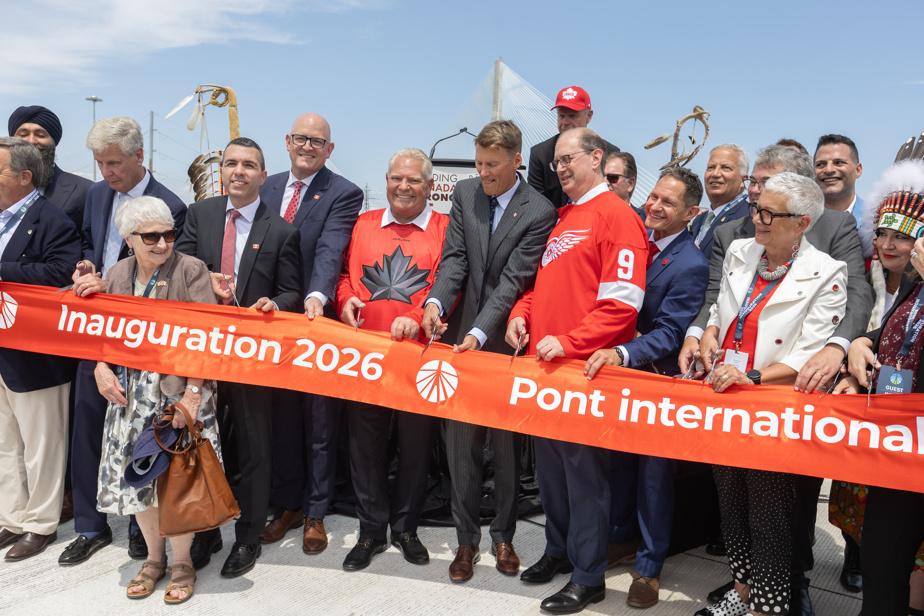
Canada held a Canada-only ribbon-cutting for the Gordie Howe International Bridge in Windsor, Ontario, with no American officials present after Donald Trump threatened new tariffs and Canada canceled a joint ceremony.
“Canada marked the opening of a bridge connecting Windsor, Ontario, and Detroit, Michigan in a quiet celebration without United States officials after a dispute over toll-sharing and new threats of 50 percent tariffs from US President Donald Trump further strained tense relations between the two countries”
The BBC said the bridge was intended to be a celebration marking the opening of an international bridge connecting Detroit, Michigan and Windsor, Ontario, but Canadians hosted their own event solo on Friday after being disinvited from the joint plan.

At the same ceremony, infrastructure minister Gregor Robertson said, "Given the recent tariff action from the US, we felt that we should focus today on celebrating here in Canada," while the BBC reported that Trump acknowledged the snub in a social media post.
The BBC also reported that the bridge will help support more than C$1bn ($710m; £530m) worth of goods that pass through the Windsor-Detroit crossing each day, and that Canada agreed to fully pay for the bridge’s construction to bypass US political resistance.
In Windsor, Ontario, BNN Bloomberg reported that the cable-stayed bridge connecting Windsor and Detroit, Mich., was set to open “as early as” noon Monday, according to the Windsor-Detroit Bridge Authority (WDBA).
Trump, Carney, and Ford clash
Trump used Truth Social to frame the exclusion as a U.S. snub, writing that Canada “disinvited” the United States from the ceremony while also claiming the original deal “no longer stands.”
The Detroit Free Press quoted Trump saying, "Canada disinvited the United States of America to the opening of the Gordie Howe Bridge, which is fine," and it reported that he added, "We changed the terms of the Deal so that the United States of America now gets 50% of the Profit."

Canada’s Mark Carney faced scrutiny over how revenues would be shared, and the BBC reported that Robertson told the BBC that Canada was dealing with an administration that "They renege on deals. They don't follow agreements."
Ontario Premier Doug Ford praised Carney for “an excellent job of getting this deal done,” while the BBC also quoted Conservative member of parliament Shuvaloy Majumdar saying the scenario shows Canada has been negotiating "with weakness."
In Windsor, Ontario, BNN Bloomberg reported that Robertson said it was his understanding the bridge would still open on Monday despite the U.S. not confirming the opening date on its side of the border, adding, "The systems are all go here on this side of the border."
What’s at stake next
The dispute over toll revenue and timing of the bridge opening has left the U.S. and Canada with competing narratives about what comes next, even as the bridge is scheduled to open to traffic on Monday.
The Hill reported that the bridge was scheduled to open to passenger and commercial traffic on Monday, and it said Trump had threatened to block the 1.5-mile bridge from opening in February.
Radio-Canada reported that the bridge’s inauguration took place on Friday, July 24, 2026 in Windsor without American authorities after threats of new tariffs by President Donald Trump, and it said the bridge was expected to open to car and truck traffic on Monday afternoon.
CBC reported that the ceremony focused on the benefits of the bridge for both Canada and the U.S., and it quoted Gregor Robertson saying, "That faster predictable border crossing will save carriers roughly 850,000 hours a year," while also noting the deal’s first-15-years structure for net toll revenues.
Looking ahead, CBC said vehicles could begin crossing "as early as 12 p.m." ET on Monday, and it added that people could begin using the pedestrian and cycling path on Aug. 5 at 8 a.m.