China23 April, 20267 min read
China Hits Record 68 GW Solar Export Surge in March, Ember Analysis Shows
This article is an automated aggregation of coverage from news outlets. Our editorials offer in-depth analysis curated by the NewsCord team.
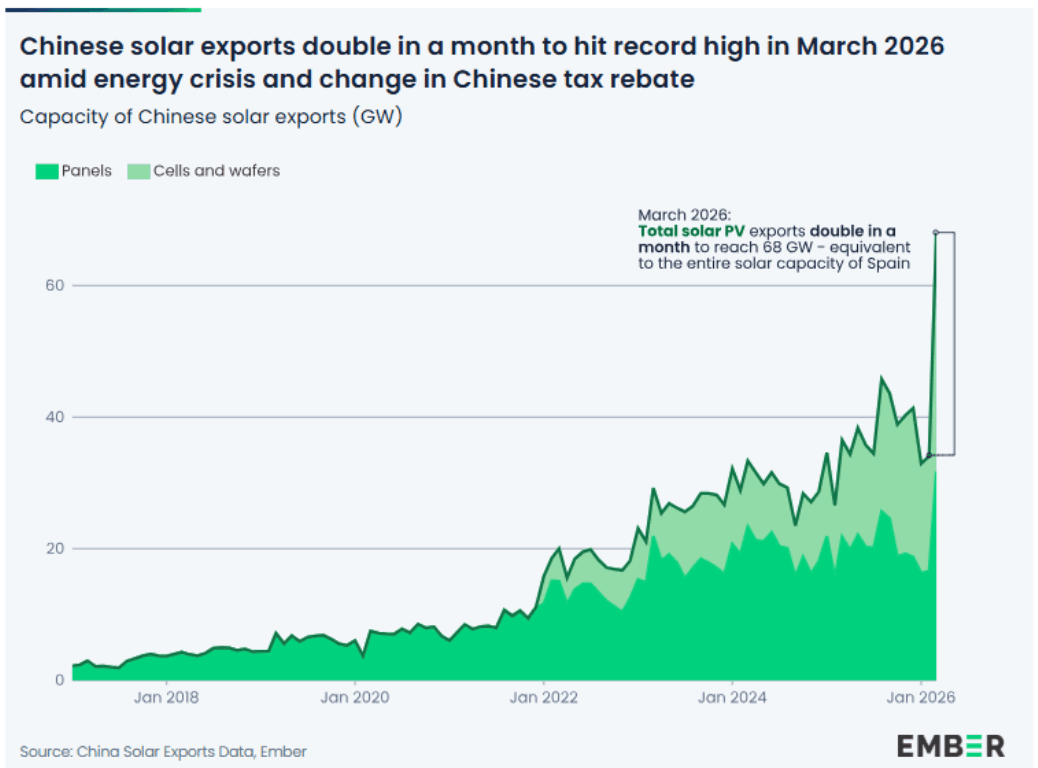
March solar exports reached 68 GW, a new Chinese record. Exports doubled from February to 68 GW in March.

Record 68GW exports
China’s solar exports hit a record high in March, reaching 68 gigawatts (GW) of solar components and photovoltaic panels, according to analysis of Chinese customs data by the energy think-tank Ember. Climate Home News reports that the March volume was “capable of generating 68 gigawatts (GW)” and describes it as “the equivalent of Spain’s entire solar capacity.” Semafor similarly says Chinese solar exports “doubled from the previous month to reach 68GW in March—equivalent to Spain’s entire solar capacity,” citing Ember.
Renew Economy frames the same figure as a “Solar surge” and says exports “hitting a record 68 gigawatts (GW) in March, double the previous month.” Multiple outlets tie the spike to timing and policy, with Climate Home News noting the export surge was driven in part by a rush to export “before an export tax rebate ended on April 1—adding 9% to solar panel costs.”
Ember’s Euan Graham, quoted by Climate Home News, called the volumes “absolutely gigantic,” adding, “We will see over the coming months how much of that was linked to the tax rebate and how much of that is additional demand.” Together, the reporting places March’s export surge at the center of a broader energy-market shift, with Semafor linking it to countries “stockpiled ahead of an expected price increase” and to energy disruptions tied to the Strait of Hormuz.
Energy crisis and policy deadlines
The March export surge is repeatedly linked to the US-Israel war with Iran and the resulting pressure on oil and gas prices, which outlets say accelerated demand for clean-energy technologies. Climate Home News says the Iran war “has caused oil and gas prices to soar and threatens supply shortages,” and it describes the export spike as a response to that energy crisis. Semafor similarly ties the exports to countries “scrambled to find alternative energy sources” as “the effective closure of the Strait of Hormuz” left them more exposed to fossil-fuel disruptions.
Renew Economy states that “The US-Israel war with Iran has had a major impact on global energy markets,” driving up oil prices and “result[ing] in a major boost to electric vehicle sales and a major rethink on diesel fuel use.” Several outlets also emphasize the role of a specific policy deadline: Climate Home News reports that Chinese manufacturers rushed to export “before anexport tax rebate ended on April 1,” and it says the rebate end “adding 9% to solar panel costs” was a major driver. GreentechLead and Electrek both describe the same April 1 change as an effective cost increase tied to export tax rebates, with Electrek saying it “effectively adding 9% to solar panel costs.”
Climate Home News adds that earlier this year “the Chinese government announced that the solar export tax discount was coming to an end,” and it quotes Trivium China saying Beijing had become “frustrated with state tax resources being used to subsidise overseas consumers.” In that framing, Euan Graham of Ember argues that the export spike reflects both the tax-rebate timing and broader demand, while Qi Qin of the Centre for Research on Energy and Clean Air says “Policy deadlines can create a sharp one-month jump in export,” and that higher oil and gas prices are “more likely to support demand over the medium term rather than explain such a strong spike in one single month.”
Asia and Africa lead
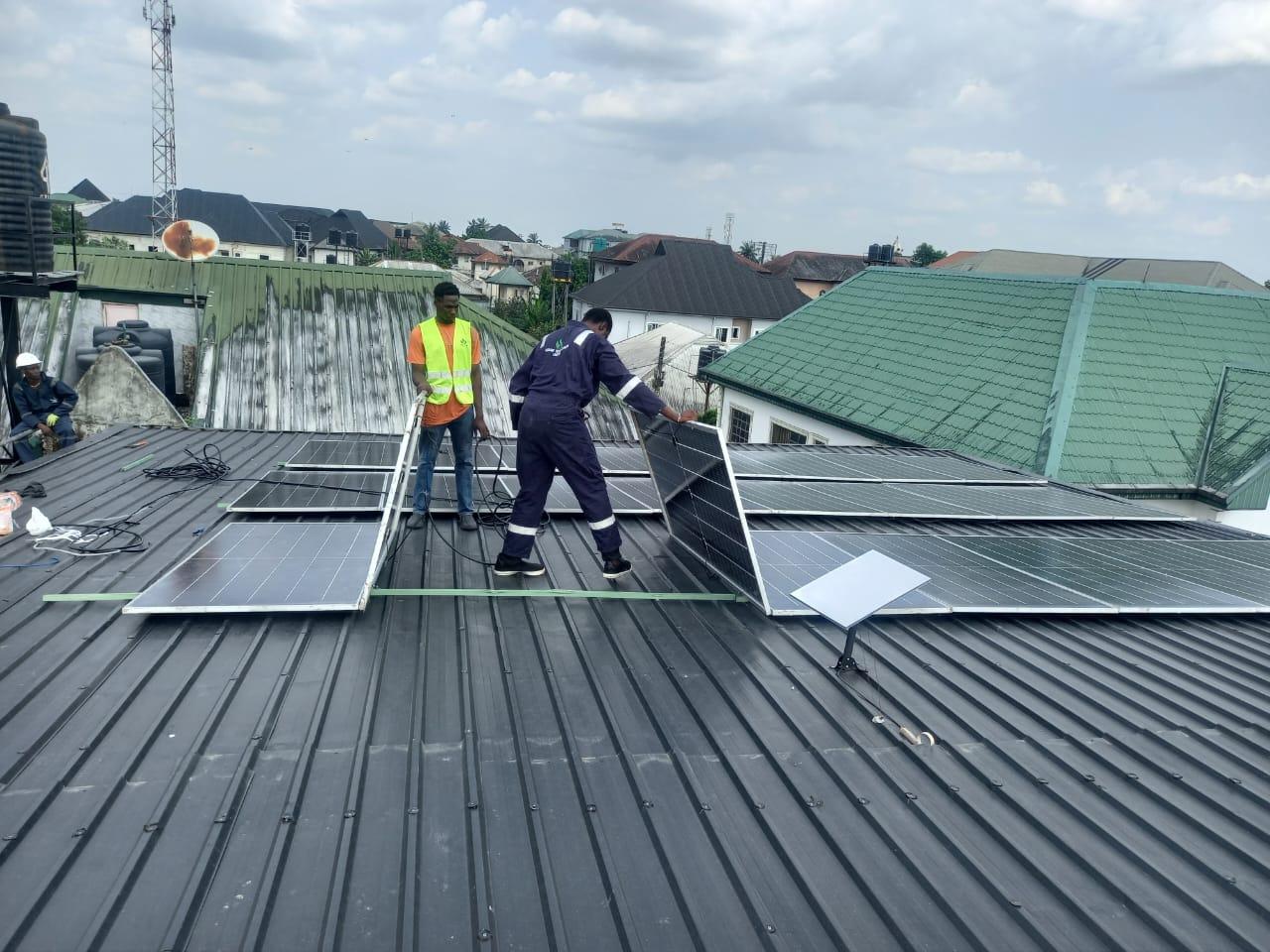
Outlets report that the export increase was concentrated in Asia and Africa, which together accounted for three-quarters of the rise. Climate Home News says “Three-quarters of the increase came from exports to Asia and Africa,” and it adds that exports to Africa reached 10GW last month, a “176% increase compared with the previous month” while exports to Asia “doubled to 39GW.” Semafor echoes that framing, saying “Africa and Asia, both heavily dependent on fossil fuel imports from the Middle East, together accounted for three-quarters of the increase.”
Renew Economy similarly reports that “Exports to Africa, for example, rose by 176 per cent compared to February 2026 to reach 10 GW in March 2026, while exports to Asia doubled to reach 39 GW.” GreentechLead and Electrek provide additional country-level detail, with GreentechLead saying “India saw imports rise 141 percent, adding 6.6 GW,” and Electrek adding that India’s imports rose “141% (+6.6 GW)” while Malaysia “jumped 384% (+1.8 GW)” and Lao PDR “climbed 108% (+2.3 GW).” In Africa, GreentechLead reports “Nigeria surged 519 percent, Kenya 207 percent, and Ethiopia 391 percent,” while Electrek lists “Nigeria (+519%), Kenya (+207%), and Ethiopia (+391%)” and says each imported more than 1 GW “for the first time.”
PV Tech adds that exports to India grew by “6.6GW between February and March 2026,” and it states that Africa’s largest month-on-month increase was led by Nigeria, Ethiopia, and Kenya, with Ember noting the trade “predominantly” consists of solar cells. Across the reporting, the pattern is that countries most exposed to fossil-fuel price swings are importing solar products at record levels, while the Middle East is described as an outlier due to disruptions tied to the Strait of Hormuz.
Panels vs cells shift
Beyond headline totals, the reporting highlights a shift in what China is exporting, with cells and wafers increasingly overtaking finished panels. Climate Home News says “In October last year, Chinese exports of solar cells and wafers overtook already assembled solar panels,” and it adds that “In March alone, Chinese solar panel exports reached 32 GW while cells and wafers exports amounted to 36 GW.” Renew Economy likewise reports that “it is not necessarily solar modules that China is exporting at record rates,” and it says “Ember notes that exports of PV cells and wafers have been soaring” and that “panels increasingly being assembled outside of China.”
GreentechLead provides the same March breakdown, stating “China’s exports of solar cells and wafers reached 36 GW in March, rising 108 percent and overtaking panel exports,” while “panel exports increased 91 percent to 32 GW.” Electrek repeats the same numbers, saying “panel exports rose 91% month over month to 32 GW, while cell and wafer exports climbed 108% to 36 GW.” PV Tech adds that cell and wafer exports “rose 108% to 36GW” between February and March, and it describes the export mix as “upstream components” accounting for a larger share of total solar exports.
The outlets connect this to manufacturing capacity outside China, with Climate Home News saying the increase is “partly driven by growing solar manufacturing and assembly capacity outside China,” and it notes that countries seek to produce more of their own solar capacity and export panels to other markets. GreentechLead and Electrek both describe local assembly as a structural shift, with Electrek saying “Countries aren’t just importing panels; they’re increasingly assembling them locally.”
Broader cleantech and next steps
Several outlets place the solar export boom within a wider cleantech surge that includes batteries and electric vehicles, and they connect it to energy security and fossil-fuel volatility. Semafor reports that Ember’s “latest electricity report” found that “record solar generation growth in 2025 was enough to displace gas-fired electricity equivalent to all LNG exports through the Strait of Hormuz last year,” and it adds that “the global EV fleet displaced 1.8 million barrels per day of oil demand, roughly 13% of US crude oil production.” GreentechLead similarly says “China’s broader cleantech exports including batteries and electric vehicles rose sharply,” and it states that “Total exports of solar, batteries and EVs increased 70 percent year-on-year and 38 percent month-on-month in March 2026.”
GreentechLead also reports that “Battery exports alone climbed 44 percent from February to reach $10 billion,” and it attributes demand to “demand in the European Union, Australia and India for energy storage solutions.” Electrek adds that “Solar, batteries, and EVs combined jumped 70% year over year in March 2026 and 38% compared to February,” and it reiterates Ember’s framing that “Solar has already become the engine of the global economy, and now the current fossil fuel price shocks are taking it up a gear.” At the same time, PV Tech and Climate Home News emphasize that policy changes around April 1 could alter pricing and future export volumes, with PV Tech stating that “on 1 April, the Chinese Ministry of Finance and State Taxation Administration will end export tax rebates for the VAT of solar PV products exported overseas.”
PV Tech explains that this means manufacturers “will not be able to claim back as much as 13% of their VAT,” and it says “this is likely to cause manufacturers to increase the prices of their products.” Climate Home News similarly notes that the export tax rebate ending on April 1 “adding 9% to solar panel costs” was a major driver of the March spike, and it quotes Euan Graham saying the coming months will show “how much of that was linked to the tax rebate.”