Technology and Science20 April, 20267 min read
Honor Robot Wins Beijing Half-Marathon, Beating Jacob Kiplimo’s World Record
This article is an automated aggregation of coverage from news outlets. Our editorials offer in-depth analysis curated by the NewsCord team.
Lightning, a humanoid robot by Honor, won Beijing's robot half-marathon in 50:26. It surpassed the human world record for half-marathon, held by Jacob Kiplimo.
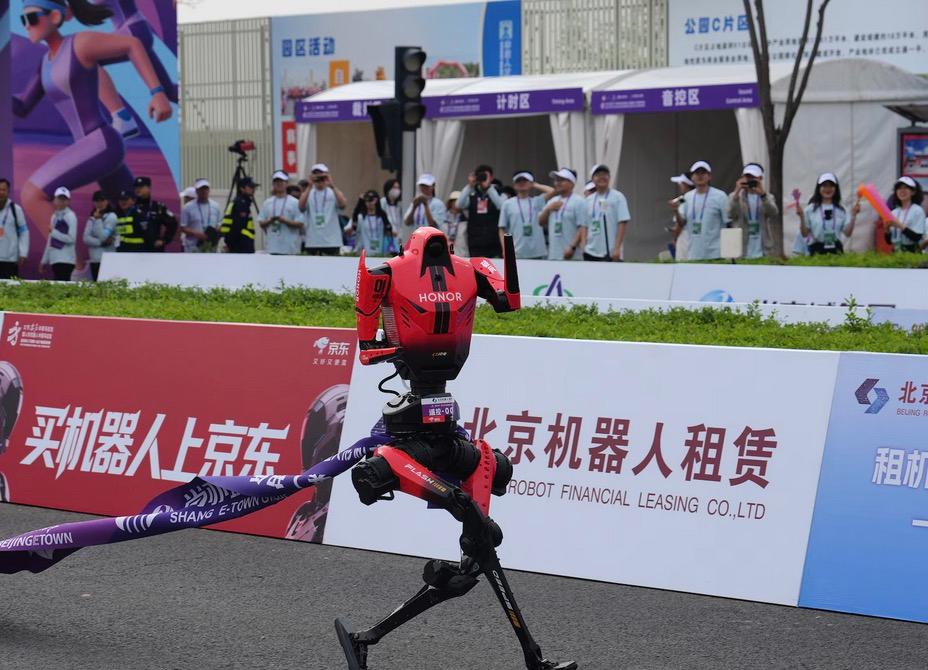
Beijing robot half-marathon
A humanoid robot won a half-marathon race for robots in Beijing on Sunday, running faster than the human half-marathon world record in a demonstration of China’s technological progress.
The winner, from Honor, a Chinese smartphone maker, completed the 21-kilometer (13-mile) race in 50 minutes and 26 seconds, according to a WeChat post by the Beijing Economic-Technological Development Area, also known as Beijing E-Town, where the race kicked off.

That time was faster than the human world record holder, Uganda’s Jacob Kiplimo, who finished the same distance in about 57 minutes in March at the Lisbon road race, as described by Associated Press.
The Associated Press account also said the performance marked a significant step forward from last year’s inaugural race, when the winning robot finished in 2 hours, 40 minutes and 42 seconds.
The race included hiccups, with Associated Press reporting that “one robot fell flat at the start line” and “another bumped into a barrier.”
ABC News similarly described that the competition “wasn’t without hiccups — one robot fell flat at the start line, another bumped into a barrier,” and it placed the event in Beijing as well.
Reuters was cited by FOX 9 Minneapolis–St. Paul as saying “more than 100 humanoid robots tested their running chops in a half-marathon,” and it added that “the 12,000 humans also in the race proved to be no match for some of them.”
Autonomy, scoring, and design
Race organizers said the event mixed autonomous and remote control, with Beijing E-Town reporting that “about 40% of the robots navigated the course autonomously, while the others were remotely controlled,” as Associated Press and ABC News both stated. Global Times, as cited by Associated Press and ABC News, reported that a separate, remotely-controlled robot from Honor was the first to cross the finish line in 48 minutes and 19 seconds, while it said the winning robot used autonomous navigation and received the championship under the event’s weighted scoring rules. CCTV, also cited by Associated Press and ABC News, reported that the runners-up, which were also from Honor and used autonomous navigation, finished in about 51 minutes and 53 minutes respectively, and it said “A robot served as a traffic officer to direct the participants with its arm gestures and voice.”
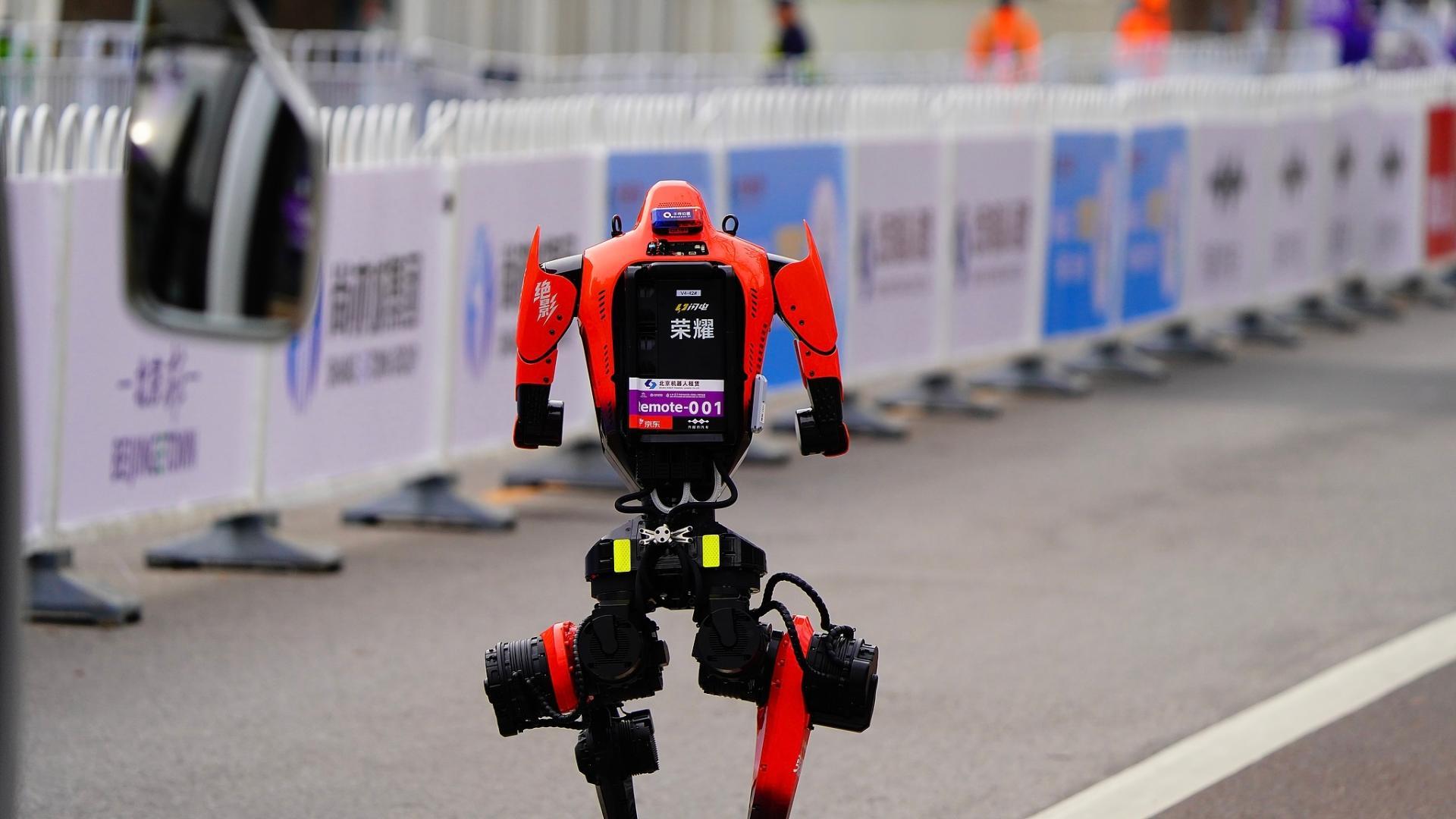
The Associated Press account also included technical details from Honor’s test development engineer Du Xiaodi, who said the robot design was modeled on outstanding human athletes and used “long legs of about 95 cm (around 37 inches).” Du Xiaodi told reporters that the robot was equipped with what he called a powerful liquid-cooling system, “which was largely developed in-house,” and he framed the technology transfer potential by saying, “Looking ahead, some of these technologies might be transferred to other areas.”

The same Du Xiaodi quote appeared in PBS’s Associated Press reprint, where he added, “For example, structural reliability and liquid-cooling technology could be applied in future industrial scenarios.” The Next Web’s account added more engineering specifics, saying the robot “Lightning” navigated the 21-kilometre course autonomously “using multi-sensor fusion and real-time decision-making algorithms,” and it described a second Lightning unit remotely controlled that crossed the finish line in 48 minutes and 19 seconds.
What spectators and engineers said
Spectators and engineers described the race as a turning point in how robots relate to humans, while also acknowledging the event’s glitches. Associated Press quoted Sun Zhigang, who watched the race last year, saying, “I feel enormous changes this year,” and he added, “It’s the first time robots have surpassed humans, and that’s something I never imagined.” Wang Wen, also quoted by Associated Press, said robots “seemed to have stolen much of the spotlight from human runners in the event” and argued, “The robots’ speed far exceeds that of humans,” adding, “This may signal the arrival of sort of a new era.”
The same sentiment was echoed in Fox News’s account of the event, which quoted Sun Zhigang saying, “It’s the first time robots have surpassed humans, and that’s something I never imagined,” and it quoted Wang Wen saying, “The robots' speed far exceeds that of humans.” The Next Web described the winning robot as “Lightning” and said the entire development-to-marathon-entry process took one year, while also reporting that “Lightning still collided with a barricade near the finish line and fell, requiring staff to help it back up before it completed the race.”
In the context of what the race is meant to prove, Du Xiaodi told Associated Press, “Looking ahead, some of these technologies might be transferred to other areas,” and he specifically pointed to “structural reliability and liquid-cooling technology.” CNBC’s account also quoted Du Xiaodi, saying, “Running faster may not seem meaningful at first, but it enables technology transfer, for example, into structural reliability and cooling, and eventually industrial applications,” and it described the robot as part of a broader push toward industrial applications.
How outlets framed the same race
Different outlets emphasized different aspects of the same Beijing half-marathon, from the headline-breaking time to the policy and commercialization implications.
Associated Press framed the robot’s 50 minutes and 26 seconds as “a show of China’s technological leaps,” while also noting that the competition “wasn’t without hiccups” and that one robot fell and another bumped into a barrier.
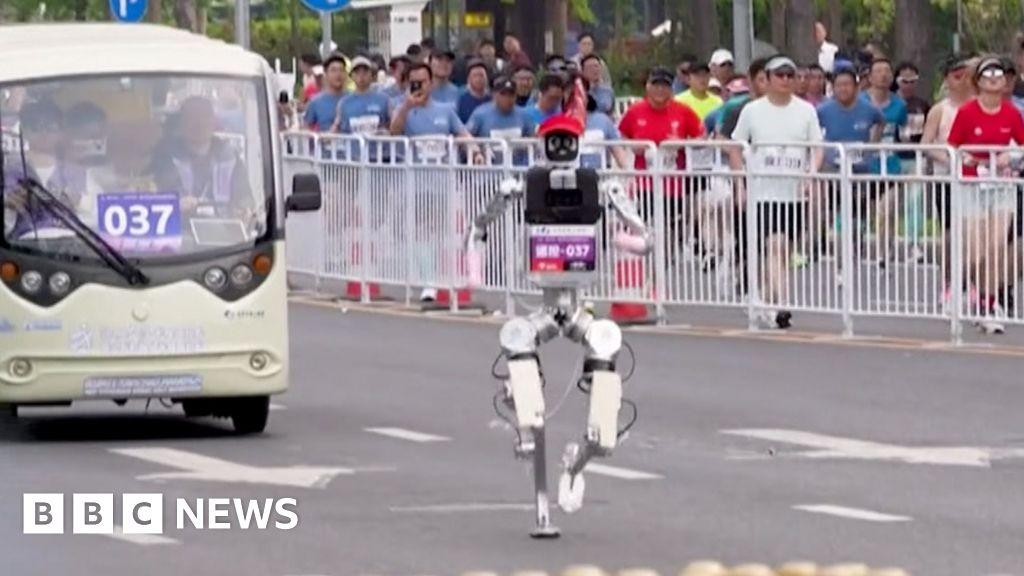
ABC News similarly highlighted the record-beating performance and repeated the same core details, including that the winner from Honor finished in 50 minutes and 26 seconds and that the race was held in Beijing alongside a human race.
FOX 9 Minneapolis–St. Paul, drawing on Reuters, foregrounded the scale by saying “more than 100 humanoid robots” competed alongside “the 12,000 humans,” and it used the framing that “the fastest one crossed the finish line of the 21.1-kilometer circuit in Beijing with a time that topped the world record time.”
ESPN’s write-up focused on the same time and the same “hiccups,” stating “one robot fell flat at the start line, and another bumped into a barrier.”
The Next Web, by contrast, leaned into technical and institutional framing, calling the robot “Lightning,” describing “multi-sensor fusion and real-time decision-making algorithms,” and stating the event was the “second edition of the Robot World Humanoid Robot Games Half-Marathon.”
CNBC added an explicit commercialization lens, saying experts pointed out that “running does not necessarily translate into commercial uses,” and it quoted Chu Tianqi’s warning that “If people don't know how to use AI now… they will definitely become obsolete.”
Policy stakes and next steps
The race was also presented as part of China’s broader robotics and “embodied intelligence” push, with multiple outlets tying the event to national planning and investment. Associated Press said that in China, technology has evolved into an area of competition with the U.S. with national security implications, and it quoted Beijing’s latest five-year plan that vows to “target the frontiers of science and technology.” It also said speeding up development of products like humanoid robots and their applications is part of the 2026-2030 plan for the world’s second-largest economy.
The Associated Press report further cited London-based technology research and advisory group Omdia, which “recently ranked three Chinese companies — AGIBOT, Unitree Robotics and UBTech Robotics Corp. — as the only first-tier vendors” in its global assessment for shipment numbers for general-purpose embodied intelligent robots. It added that “They all shipped more than 1,000 units of the robots last year, with the first two companies shipping more than 5,000 units,” and it described the race as a showcase for a sector moving quickly.
The Next Web went further, saying the 15th Five-Year Plan covering 2026 to 2030 elevates robotics and “embodied intelligence” to one of the country’s top ten “new industry tracks,” and it reported “a one-trillion-yuan ($138 billion) state-backed fund” for humanoid robots, industrial automation, and embodied AI. Al Jazeera, meanwhile, described the half-marathon’s aim as encouraging innovation and popularizing the technologies used in creating and operating such machines, and it quoted Xie Lei, 41, saying robots could “become part of our daily lives” within several years and be used for “dangerous jobs, even firefighting.”