China’s Hypercompetition Cuts EV Prices: Geely EX2 Starts Under $12,000
Key Takeaways
- European buyers can legally import Chinese EVs with homologation and home delivery.
- Prices are falling in China due to hypercompetition and a flood of cheap EVs.
- Direct cross-border orders from China with European homologation and home delivery.
China EV price shock
A new wave of low-cost electric vehicles is reshaping the global price conversation, with Reuters describing a “showcase for how hypercompetition in China has driven new car prices” in the world’s largest car market to “a fraction of the level of the next-largest market, the U.S.”
“The China EV Marketplace is the Chinese e-commerce platform that now allows European customers to buy road-legal electric cars and plug-in hybrids directly from China and have them delivered to their home, with customs clearance included”
In March, Reuters said “the average new car in the U.S. had a list price of $51,456, according to Kelley Blue Book,” while in China there are “more than 200 battery-powered models” for sale at “less than the equivalent of $25,000,” according to DCar.
Reuters compiled a list of “the five best-selling electric vehicles in China that start under $12,000 using DCar data,” and framed the comparison as a consumer arithmetic exercise: “for about the price of an average new car in the U.S., a consumer in China could buy all five of these EVs.”
The Reuters list begins with Geely EX2, with a “Starting price, $10,060,” and describes features including “a front trunk” and “a 14.6-inch central touchscreen running on a system that Geely developed.”
Reuters also said the “top-trim version has a range of about 255 miles on the Chinese test standard,” and noted that the EX2 is known as the “Star Wish” in China and that Geely “began sales in Brazil, Indonesia and Thailand last year.”
Reuters quoted auto analyst Felipe Munoz saying, “When you get in, you don’t feel like you are in a small car,” adding, “It feels better in terms of quality and bigger in terms of size.”
Models and features
Reuters’ price comparison is anchored by a set of specific small EV models and their starting prices, with each vehicle described through a mix of technical and design details.
Wuling Hongguang MiniEV is listed with a “Starting price, $6,560,” and Reuters said the company “has stretched the micro car for 2026 to accommodate four doors and a bit more seating room in the back for adults,” while also emphasizing that “the boxy city car remains tiny by American standards.”
Reuters added a performance framing for the basic model, saying it has “a top speed equivalent to just 62 miles per hour and a China-rated battery range of just 127 miles,” and it described a larger subcompact EV that “starts at just over $8,000 in China.”
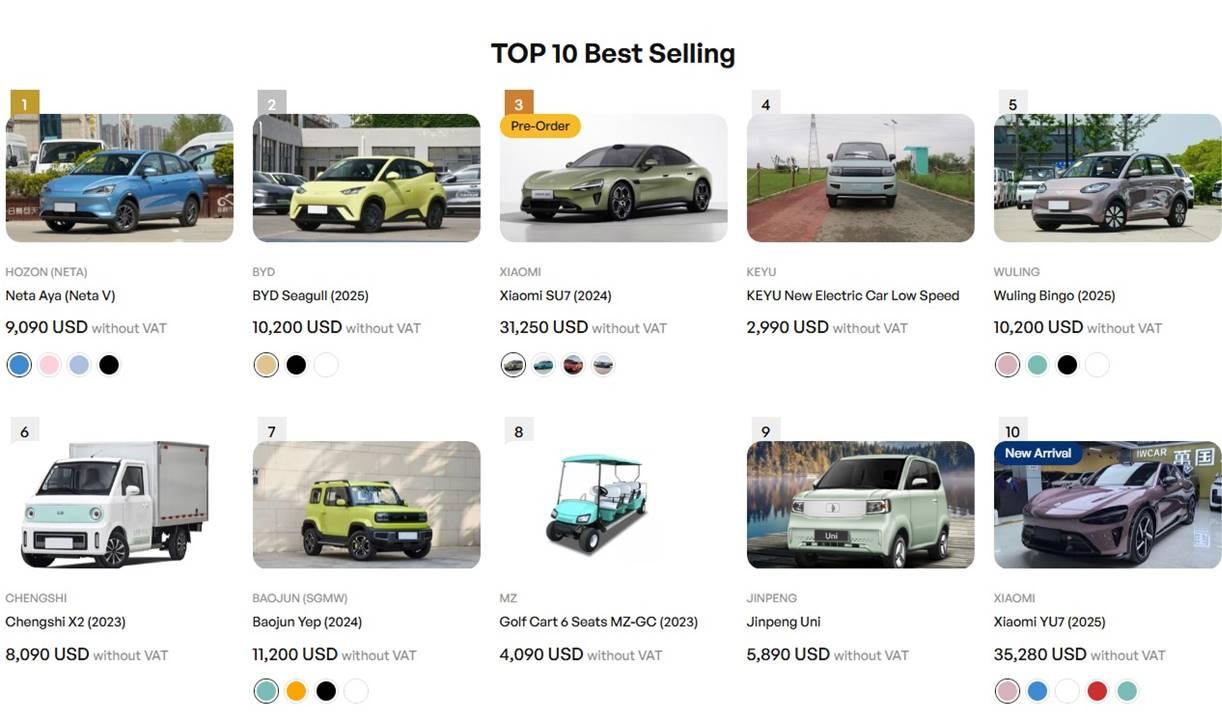
For the BYD lineup, Reuters listed “BYD Seagull: Starting price: $10,200,” and also included “BYD Yuan UP: Starting price: $10,945” and “BYD Qin Plus DM: Starting price: $11,675,” while describing BYD as “China’s biggest player in small EVs.”
Reuters said BYD’s “top three models starting under $12,000 accounted for 700,000 vehicle sales over the past 12 months in China,” and described the Seagull’s “optional lidar remote sensing system for driving assistance including automated lane changing” in the “2026 Seagull.”
Reuters also reported that the “2026 model gets a standard set of two wipers,” after noting that BYD “equipped it with a single “monoblade” windshield wiper” at launch and that “Some drivers complained it did not handle heavy rain.”
The Reuters piece also described the Seagull’s “battery range of about 314 miles on the premium version, according to Chinese testing standards.”
Importing to Europe
While Reuters’ comparison focused on what is (and is not) available in American showrooms, other reporting describes a new path for Europeans to buy Chinese electric vehicles with European homologation and home delivery.
“China’s best-selling car , the BYD Seagull Call it a different kind of sticker shock”
Forococheselectricos said “China EV Marketplace” will allow Europeans “to buy Chinese electric cars with European homologation and home delivery,” and described the service as “a new sales model” that signals “that you cannot put gates on the field and that trade barriers are only a temporary patch against the flood of cheap electric vehicles from the Asian giant.”
The platform’s pitch is that it removes the need for customers to manage customs and port pickup, because “Until now, those who imported a vehicle had to handle the customs procedures themselves and collect it at the port of arrival, a complex process that deterred many interested parties.”
For the first time, the reporting says, “European users will be able to order from Europe an electric car or a plug-in hybrid manufactured in China and receive it at their own home as if it were a conventional online purchase.”
The service also ties its growth to tariff structure, stating that in the “first half of 2025 it reached sales of 7,000 units, representing a 66 percent rise compared with the same period of the previous year,” and that the increase was “driven mainly by plug-in hybrids, since these are not subject to tariffs of up to 35 percent that the European Union applies to pure electric cars.”
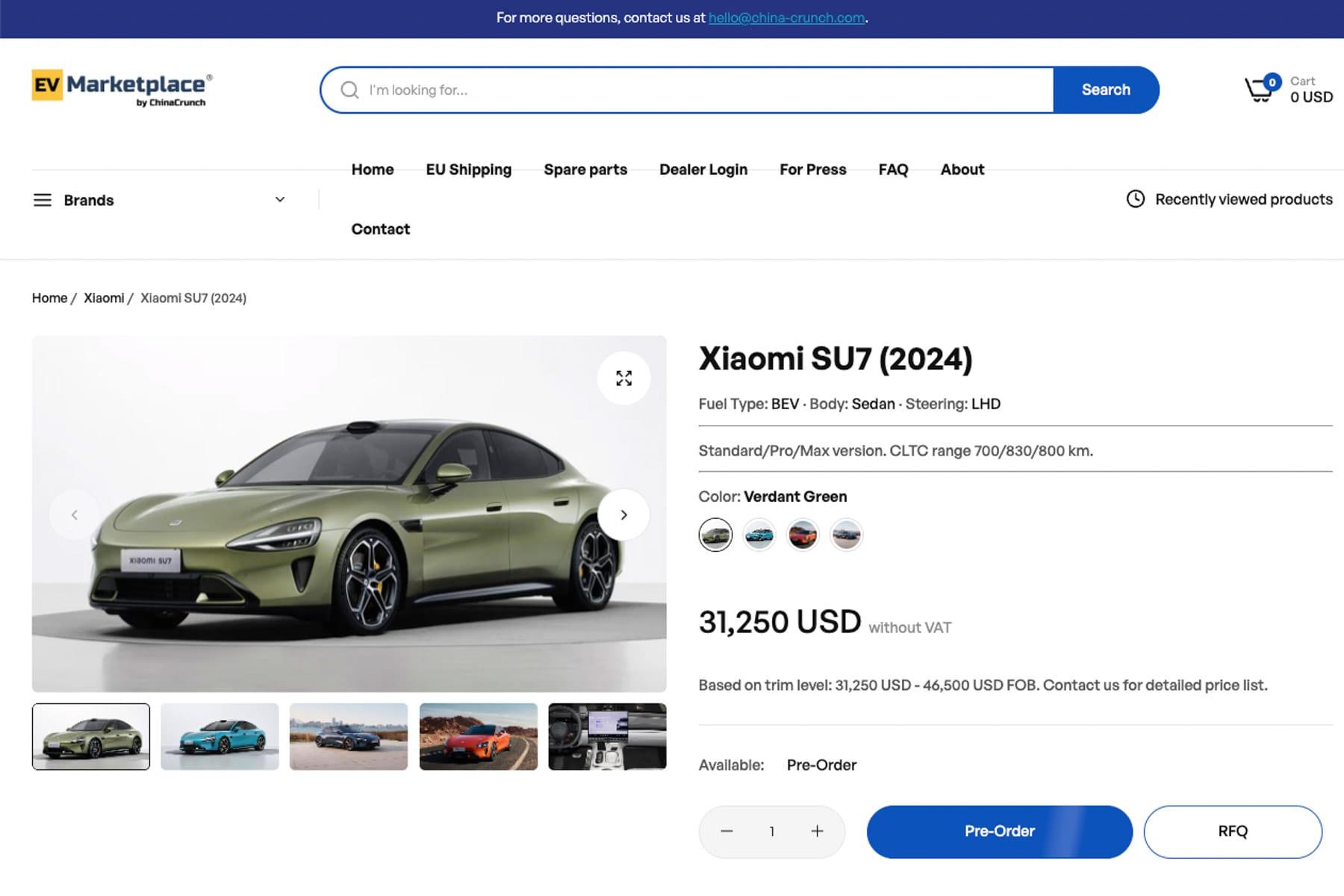
The reporting adds that the lineup includes models such as “the BYD Seagull (the Chinese Dolphin Surf) the Xiaomi SU7 and YU7, as well as appealing proposals like the Geely Geome Xingyuan,” and it provides a detailed pricing and specification example for the Geely Geome Xingyuan.
It says the compact is “A 4.13-meter-long compact,” with an entry motor of “58 kW (78 hp)” and a “30.1 kWh pack (310 km CLTC),” and it gives an entry price of “7,900 euros” plus “345 euros in processing fees and 2,580 euros for homologation.”
How the platform sells
Electrive’s account of the China EV Marketplace service emphasizes that customers can order directly from China and receive vehicles at home, with customs clearance included, and it frames the change as a removal of “traditional complexities and headaches.”
The outlet says the platform “now allows European customers to buy road-legal electric cars and plug-in hybrids directly from China and have them delivered to their home, with customs clearance included,” and it adds that the company “claims to be the largest online shop for Chinese electric vehicles and serves customers worldwide.”
It also repeats the scale claim, stating that “In the first half of the year, the company sold 7,000 vehicles, a 66% increase over the first six months of 2024,” and it attributes the growth to plug-in hybrids because “these are not subject to special tariffs when exported to the EU.”
Electrive quotes Jakub Gersl, Chief Operating Officer of China EV Marketplace, saying, “Our new service eliminates the traditional complexities and headaches associated with international car imports,” and it specifies that “Previously, customers had to handle the customs clearance themselves and pick up the electric car at the port.”
The outlet also states that “The minimum order quantity on EV Marketplace is one vehicle,” and that the service is open to “private customers,” not only importers.
It lists brands available through the platform, including “BYD, Xpeng, Nio, and Leapmotor,” and it says the lineup also includes cars from manufacturers without European distribution networks such as “Wuling, Baojun, Avatr, and Xiaomi.”
Electrive provides price examples for specific models, including “The BYD Seagull is offered on the platform for $10,200 net,” and it contrasts that with BYD’s European pricing for the same model name, saying BYD sells it as “Dolphin Surf in Europe for €22,990 (about $26,650).”
Downsides and fees
Electrive also details limitations that could erode the headline price advantage, focusing on charging standards, parts availability, and software and registration requirements.
“You can now buy an electric car in China and legally import it to Europe”
It says that “these are vehicles built to Chinese specifications,” and specifically that “as all electric vehicles are equipped with the Chinese GB/T charging standard, not the CCS connector commonly used in Europe.”
Electrive adds that “Although they come with a free adapter so they can be charged at CCS charge points, this may affect charging performance,” and it warns that “Spare parts are likely to be hard to obtain and there is no guarantee that the vehicle’s operating system language can be changed.”
The outlet also notes potential connectivity constraints, stating “There may also be usage restrictions if the systems or apps can only communicate with Chinese servers.”
On the cost side, Electrive says there is “a net $400 fee for optional customs clearance by China EV Marketplace, and EU vehicle type-approval is offered for a net surcharge of $1,500,” while also stating that “Both customs clearance and EU-type approval are necessary to import and register the vehicles.”
It further says that “Transport is also charged separately depending on the vehicle,” and it frames the final outcome as dependent on whether costs remain favorable after all charges are tallied.
Forococheselectricos similarly raises the charging question, saying “Fast charging is a different matter, as we will need an adapter because in China they use a format different from ours (GB/T) compared to CCS Combo,” and it adds that “these adapters are expensive, around 1,000 euros, bulky, and not all vehicles are compatible.”
More on Business

Frasers Group Launches €38 Per Share Takeover Offer for Hugo Boss
10 sources compared

Turkey Triples Defense Exports Since 2021, Aiming To Double Deliveries In Two Years
12 sources compared

Guyana and Dominican Republic Sign Contract for Oil Exploration in Berbice Block
10 sources compared
SAIC Plans First EU Electric Vehicle Factory in Spain’s Galicia, Ferrol and As Pontes
10 sources compared