Connor Christou Uses Anthropic’s Claude to Turn Keragon Cancer Treatment Into AI Experiment
Key Takeaways
- Connor Christou, Keragon founder, diagnosed with cancer, used AI to fight it.
- He integrated wearables and biomarker data into a real-time AI health-monitoring system.
- The stories show founders applying AI experiments to personal health challenges.
Patient uses Claude
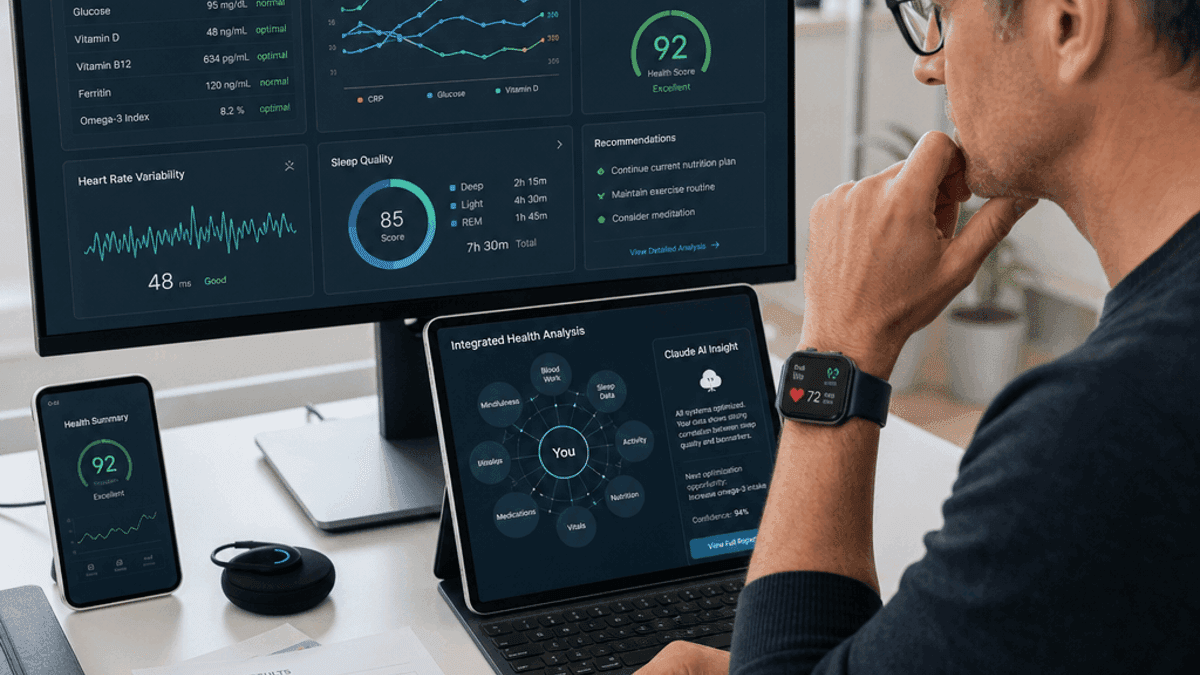
Connor Christou, founder of Keragon, turned his cancer treatment into an AI experiment by feeding his health data into Anthropic’s Claude, including blood work, scan results, wearable device metrics, and daily journal entries.
“Conno Christou doesn’t leave things to chance”
TechCrunch reported that Christou told an editor from his home in Athens, where he lives part time, "I realized my doctors were looking at snapshots," adding that Claude could see how he felt across days rather than only at the time of a blood test.

In the Tech Buzz account, Christou said, "Claude could see all of it at once," and described using the system to ask Claude to find patterns, flag anomalies, and suggest questions for his oncologist.
The TechCrunch story also says a doctor told him, "We see an 11-by-11-by-8 centimeter mass behind your sternum," after pre-op exams changed everything following an arm swelling after a workout.
Treatment math and limits
TechCrunch says Christou’s first oncologist recommended a lighter chemotherapy regimen with a roughly 60% success rate for his presentation, while a second doctor recommended a harder regimen with that number around 85%.
In TechCrunch’s account of his decision-making, Christou said, "As founders, we hold the wheel," and argued that people should not feel compelled to follow the first advice they receive.
The Tech Buzz story says Christou was careful to note that he never used Claude to make treatment decisions, telling TechCrunch, "I'm not asking Claude to diagnose me," and framing the chatbot as a tool to help him understand what doctors were telling him.
TechCrunch also includes a caution from Danielle Bitterman, clinical lead for data science and AI at Mass General Brigham, who told the New York Times that general-purpose chatbots are frequently wrong and "have not been thoroughly evaluated" for personalized diagnoses.
AI expands beyond one case
While Christou’s personal approach centered on using Claude to organize his own health information, the Tech Buzz piece says the move highlights how startup founders are becoming early adopters of AI-powered healthcare using tools like Claude to make sense of complex medical data.
“Israeli-founded AI biotech company Immunai announced Thursday a new discovery collaboration with German pharmaceutical giant Boehringer Ingelheim aimed at identifying novel T-cell targets across immuno-oncology and autoimmune diseases”
The Tech Buzz article also says the healthcare AI market is exploding, citing McKinsey projecting the technology could unlock $1 trillion in value, while noting that most attention focuses on clinical applications like AI reading X-rays and predicting patient deterioration.
In a separate development, the Jerusalem Post reports that Israeli-founded AI biotech Immunai announced Thursday a discovery collaboration with German pharmaceutical giant Boehringer Ingelheim valued at up to $15 million and running through 2027.
The Jerusalem Post quotes Immunai CEO Noam Solomon, PhD, saying, "This collaboration brings together large-scale, clinically grounded data, translational science and functional validation to support broad target discovery across both fields."
More on Technology and Science

OpenAI Sunsets ChatGPT Atlas Browser, Pivots to ChatGPT Desktop App With ChatGPT Work
13 sources compared

FTC And Five States Reach 10-Year Right-To-Repair Settlement With Deere & Company
10 sources compared

Microsoft Fixes 165 Vulnerabilities, Including Exploited SharePoint Zero-Day CVE-2026-32201
13 sources compared

Meta Disables Ray-Ban Meta Camera After Users Tamper With Capture LED
18 sources compared