EU, UN Estimate Gaza Recovery Needs $71.4 Billion Over Next Decade
Key Takeaways
- Gaza needs $71.4 billion over the next decade for recovery and reconstruction.
- $26.3 billion needed in the first 18 months.
- RDNA was produced jointly by the EU, UN, and World Bank.
A decade of rebuilding
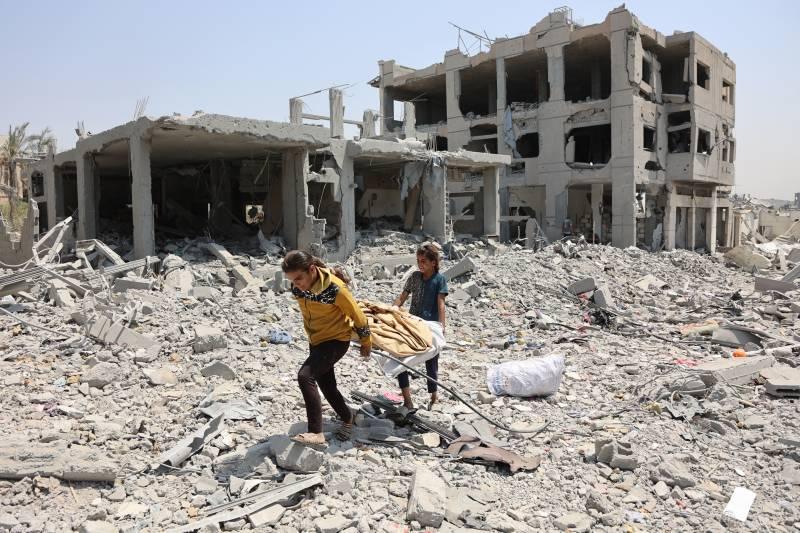
The European Union and the United Nations released a final assessment estimating that Gaza will require $71.4 billion for recovery and reconstruction over the next decade following nearly two years of conflict.
“SUBMIT BLOG/ VLOG latest Islamabad Red Zone to remain closed on April 21 amid security measures for US-Iran talks Topless Turkey miners stage hunger strike over unpaid wages EU to host Taliban officials for talks on deporting Afghans Pakistan to appoint economic ministers in key world capitals FIA announces 1,394 new jobs for youth Islamabad Red Zone to remain closed on April 21 amid security measures for US-Iran talks Topless Turkey miners stage hunger strike over unpaid wages Over $71 billion and one decade needed to rebuild Gaza: UN-EU assessment Published: 08:53 PM, 20 Apr, 2026 Latest, World”
The Gaza Rapid Damage and Needs Assessment (RDNA), conducted jointly with the World Bank, found that $26.3 billion will be needed in the first 18 months alone to restore basic services, rebuild key infrastructure and support economic recovery.

The report estimated physical damage at $35.2 billion, while economic and social losses reached $22.7 billion.
It said housing, health care, education, commerce and agriculture were among the hardest-hit sectors, and that housing damage was extreme: more than 371,000 housing units were damaged or destroyed, with over half of hospitals no longer functioning.
The assessment described the impact on human development as “catastrophic,” estimating that progress has been set back by 77 years.
It also said nearly all schools have been affected and that Gaza’s economy has shrunk by 84%.
The RDNA estimated that about 1.9 million people have been displaced—many multiple times—and that more than 60% of residents have lost their homes, while women, children, people with disabilities and other vulnerable groups were identified as bearing the heaviest burden.
What the war did
Multiple outlets tied the RDNA’s damage figures to the course of the conflict, describing how Gaza’s infrastructure and services were reduced and how displacement escalated.
Arab News said the final assessment determined that $26.3 billion would be required in the first 18 months to restore essential services, rebuild critical infrastructure, and support economic recovery, while also stating that “Much of Gaza — including schools, hospitals, and other civic infrastructure — has been reduced to rubble.”

It linked that destruction to “a withering Israeli military offensive following the unprecedented Hamas attack on Oct. 7, 2023.”
Anadolu Ajansı similarly said the RDNA was released Monday by the EU, UN, and the World Bank and that $26.3 billion would be needed in the first 18 months, with physical infrastructure damage estimated at $35.2 billion and economic and social losses at $22.7 billion.
The assessment’s housing and health impacts were also described in consistent terms across outlets: more than 371,888 housing units destroyed or damaged, more than half of hospitals non-functional, and nearly all schools destroyed or damaged.
The Whistler Newspaper said “Nearly the entire population of 1.9 million people has been displaced, often multiple times,” and that “over 60 per cent losing their homes.”
Al Arabiya English reported that the UN and EU said the “scale and extent of deprivation” pushed back human development by 77 years, and it repeated that Gaza’s economy contracted by 84%.
Conditions for recovery
The RDNA’s authors and the outlets carrying it emphasized that reconstruction depends on enabling conditions, including security, humanitarian access, and movement of people and goods.
Sky News said the report calls for the “minimum conditions” needed for recovery and reconstruction to succeed are “a sustained ceasefire and adequate security,” and it added that the report also calls for unimpeded humanitarian access, free movement of people, goods and reconstruction materials between Gaza and the West Bank, and a “functional, transparent financial system.”
WAFA Agency reported that the RDNA provides the analytical foundation for early recovery planning and reconstruction “in line with UN Security Council resolutions, including UNSCR 2803,” and it stated that recovery efforts must run in parallel with humanitarian action, ensuring a transition from emergency relief toward reconstruction at scale across both the Gaza Strip and the West Bank.
WAFA also said the EU and the UN emphasized that recovery and reconstruction should be Palestinian-led and incorporate approaches that actively support the transition of governance to the Palestinian Authority in line with UNSCR 2803.
The Palestinian News Network said the RDNA stressed that reconstruction efforts must proceed alongside humanitarian assistance, with a phased transition from emergency relief to large-scale rebuilding across both Gaza and the West Bank, and it said the EU and UN outlined key conditions including “a sustained ceasefire, secure conditions on the ground, and unhindered humanitarian access.”
It further said the report highlighted the need for free movement of people and goods, restoration of essential services, a functioning financial system, and clear, accountable governance structures.
Al Arabiya English echoed the same framework, stating that the UN and EU emphasized “a set of enabling conditions” and that without them “neither recovery nor reconstruction can succeed.”
Governance and political links
Beyond physical rebuilding, the assessment described governance arrangements and a political framework as prerequisites for reconstruction and for the implementation of UNSCR 2803.
WAFA Agency said the EU and the UN “equally recognise that a set of enabling conditions must be met for UNSCR 2803 to be implemented effectively on the ground,” and it listed requirements such as “a sustained ceasefire and adequate security” and “unimpeded humanitarian access and immediate restoration of essential services.”

It also said “free movement of people, goods, and reconstruction materials, within and between Gaza and the West Bank” was critical, and it described the need for “clear, accountable governance, including the definition of mandates and establishment of conditions for the transitional administrative bodies under UNSCR 2803.”
WAFA further stated that a “credible pathway for the Palestinian Authority’s future governance across the entire Occupied Palestinian territory, including Gaza, the West Bank and East Jerusalem” was essential.
The Palestinian News Network said the EU and UN said recovery efforts should be led by Palestinians and aligned with governance arrangements under the Palestinian Authority, while supporting a broader political framework based on a two-state solution.
It also said the report emphasized that rebuilding Gaza, implementing Resolution 2803, and advancing a two-state solution are “inherently interconnected,” warning that none can succeed in isolation.
Arab News similarly described the assessment as linking reconstruction to a political process aimed at a two-state solution, while stressing that “a sustained ceasefire, humanitarian access, restoration of essential services, free movement of people and goods, clear governance arrangements, and international financial support are necessary conditions for success.”
Numbers, dates, and framing
While the core RDNA figures were consistent across many reports, outlets differed in how they presented the timeline and the total cost in local currency or pounds, and some accounts added additional conflict context.
WAFA Agency dated the release to “JERUSALEM, April 20, 2026,” and said the assessment followed “24 months of conflict,” while Sky News said the report was designed to assess the scale of destruction “over the next decade” and described the rebuilding cost as “more than £50bn.”

Sky News also gave a specific figure for the first 18 months: “£19.5bn ($26.3bn),” and it repeated that “more than 370,000 homes have been destroyed” and “half of Gaza's hospitals are not working.”
The Irish Independent said the EU and UN estimate “€60bn over 10 years,” and it added that the publication on Monday came “six months after a ceasefire took effect between Israel and Hamas.”
TRT World described the RDNA as saying “Recovery and reconstruction needs are estimated at around $71.4 billion,” and it framed the conflict as “two years of war” that followed the “October 7, 2023 Hamas attack on Israel.”
The Whistler Newspaper, meanwhile, described the conflict trigger as “the Hamas attack on Israel on October 7, 2023,” and it stated that “more than 72,000 Palestinians, mostly civilians have been killed” according to the health ministry in Hamas-run Gaza.
Across these accounts, the RDNA’s emphasis on enabling conditions remained a shared throughline, with Sky News quoting “a sustained ceasefire and adequate security” and the Palestinian News Network stressing that reconstruction must proceed alongside humanitarian assistance with a phased transition from emergency relief to large-scale rebuilding.
More on Gaza Genocide

RDNA Finds Gaza Needs More Than $71 Billion Over Next Decade for Recovery
11 sources compared

Northern Israel Residents Shut Schools And Shops To Protest Lebanon Ceasefire
11 sources compared

Israeli Attacks Push Gaza Death Toll to 72,551, Injuries Reach 172,274
13 sources compared

EU Foreign Ministers Postpone Sanctions Against Israel Over Gaza and West Bank
11 sources compared