Europe03 May, 20269 min read
European Union Grants Serbia Candidate Status After Stabilisation And Association Agreement Talks
This article is an automated aggregation of coverage from news outlets. Our editorials offer in-depth analysis curated by the NewsCord team.
EU accession path for Serbia is described as a long, conditional road. Governance reforms, notably judiciary, influence EU funding and accession progress.

Serbia’s EU path
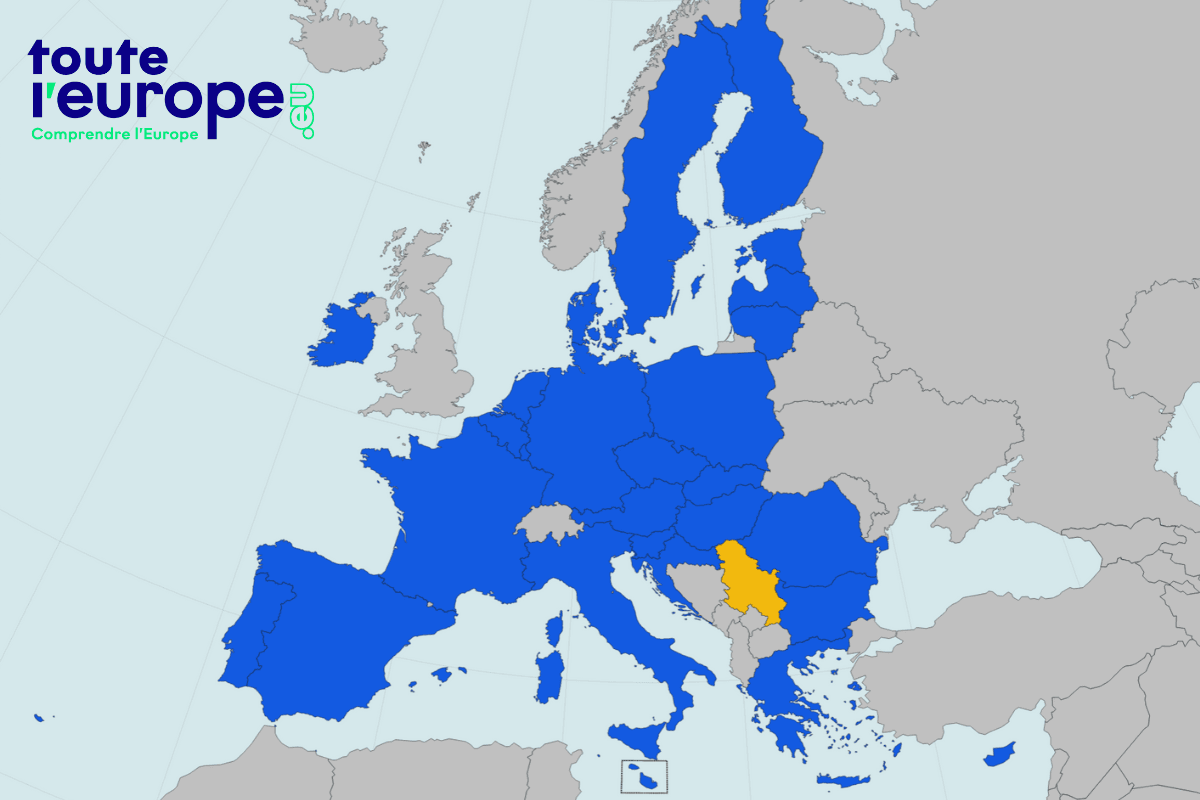
Serbia’s EU accession process began with negotiations toward a Stabilisation and Association Agreement (SAA) with the European Union on October 10, 2005, but the text’s signing was delayed on the Serbian side while awaiting Belgrade’s full cooperation with the International Criminal Tribunal for the former Yugoslavia (ICTY). This UN judicial body was active from 1993 to 2017 and was tasked with judging those responsible for war crimes committed during the conflicts of the 1990s in the Balkans, a condition that shaped the early pace of talks. Kosovo’s declaration of independence on February 17, 2008, and tense relations with Serbia, which does not recognize this independence, also jeopardized the signing of the SAA.
In parallel, the arrests of Radovan Karadžić in July 2008 and Ratko Mladić in May 2011 were presented as demonstrations of Serbia’s efforts. Serbia obtained a visa-free regime for its citizens traveling to the Schengen area on December 19, 2009, and on the same day Belgrade officially submitted its application to begin the EU accession process. On October 12, 2011, the European Commission gave its green light to grant Serbia candidate country status, and on March 1, 2012, the European Council confirmed this opinion so that Serbia officially became a candidate.
The Stabilisation and Association Agreement then finally entered into force in September 2013, after multilateral negotiations between Serbia and Kosovo overseen by the EU resulted in the signing of an agreement opening the way to normalisation of relations on April 19, 2013. By June 28, 2013, member states approved the Commission’s recommendation to open accession negotiations with Serbia, and accession negotiations formally began at the start of the following year with talks proceeding “theme by theme” in EU terminology through “chapters.”
Chapters, criteria, and funding
The EU’s enlargement framework is presented as highly regulated and based on criteria set in 1993 in Copenhagen and then in 2006, with the European Commission publishing assessments that examine independence of the press and its pluralism, respect for minorities, separation of powers, the anti-corruption fight, and independence of justice. RTBF describes how candidate states must pursue political and economic development policies that allow them to integrate into the EU economy, with the doors of the European market opening gradually and customs duties suspended as export is facilitated. In Serbia’s case, Touteleurope.eu says that of a total of 33 negotiating chapters, 22 have been opened so far, with two provisionally closed—“science and research; education and culture”—and with institutional issues and environmental issues “currently under discussion.”
It also reports that a resolution adopted on July 6, 2022, by Members of the European Parliament lamented Serbia’s “backsliding” on essential issues for joining the EU, urging progress in rule of law, fundamental rights, freedom of expression, strengthening media pluralism, and normalising relations with Kosovo. The normalisation of relations with Kosovo is described as an essential condition for Serbia’s EU membership, with agreements signed since 2013 with Pristina “far from all being implemented.” On the funding side, Touteleurope.eu says that as part of a new Western Balkans candidate countries support plan validated by member states in May 2024, Serbia was invited to prepare an economic and institutional reform program and that the European Commission approved this national plan in October 2024, releasing 1.5 billion euros for the country in the form of loans and grants conditional on implementing reforms.

El Mundo adds that the controversial justice reforms approved by the Serbian Parliament in January, the so-called Mrdic laws, could cost the Balkan country up to 1.5 billion euros following Enlargement Commissioner Marta Kos’s announcement, and it frames the Growth Plan as totaling six billion euros for the period 2024-2027. El Mundo further states that Serbia received its first payment of 56.5 million euros in mid-January out of a total of 1.58 billion euros planned, and it quotes Kos saying “For now, we have halted all payments from the Growth Plan because there has been a regression in the area of justice.”
Kos’s warning and the “Mrdic laws”
The latest pressure point described in the sources centers on justice reforms and the EU’s leverage over payments, with Enlargement Commissioner Marta Kos delivering a warning that Serbia must choose whether it aligns with EU rule-of-law expectations. La Matinale Européenne quotes Kos telling Serbia’s N1 channel, “It is becoming increasingly difficult for those in Brussels who want to move forward with Serbia to defend their position,” and it links her warning to “two judicial amendments adopted at the end of January” that, according to Kos and “independent experts,” would lead to a “significant weakening of the rule of law.” La Matinale Européenne reports Kos’s call for Belgrade to “suspend the implementation of these laws,” while also noting that Belgrade agreed to seek the Venice Commission’s opinion of the Council of Europe, described as advising member states on constitutional questions.
It adds that Kos said the Commission threatens Serbia with a freeze of pre-accession funds and economic aid and that “The Commission is currently examining whether Serbia still meets the criteria for payments under EU financial instruments,” with “About 1.6 billion euros of loans and grants are budgeted for Serbia.” El Mundo provides a more specific framing by saying the “Mrdic laws” approved by the Serbian Parliament in January could cost Serbia up to 1.5 billion euros after Kos’s announcement, and it states that Kos accused Belgrade of “backsliding” in judicial reforms. El Mundo quotes Kos saying, “You can't have a foot in two camps,” and it ties the EU’s position to Serbia’s foreign policy closeness to the Kremlin and to the tense political climate after “almost a year and a half of student protests against corruption following the Novi Sad train station accident on 1 November 2024.”
It also says Kos criticized reforms that give more powers to the presidents of the courts over judges and remove guarantees ensuring the independence of prosecutors, raising concerns within the EU and the Council of Europe. The same El Mundo report says the Venice Commission published recommendations to modify these laws and that the European Commission stated Serbia should include these recommendations “as soon as possible,” while Kos said, “Until this is corrected, they will not benefit from European financial support.”
Diverging portrayals of trust
The sources also diverge in how they describe the status of EU payments and the level of certainty around any freeze, even while agreeing that justice reforms have triggered EU scrutiny. El Mundo says Kos revealed last Thursday at the University of Fribourg, Switzerland, that the EU will freeze the funds allocated to Serbia, and it adds that the decision “has not yet been officially corroborated by Brussels,” while also quoting Kos’s statement that payments were halted due to regression in justice. La Matinale Européenne similarly frames the issue as conditional leverage, saying Kos warned that the Commission is examining whether Serbia still meets criteria for payments under EU financial instruments and that “The sword of Damocles hangs over the entire relationship between the Union and Belgrade.”
It further reports that at the end of December the Commission concluded a financing agreement with the Serbian government for pre-accession aid of 219.9 million euros for 2025 to 2027, with 139.4 million euros paid to Belgrade as grants, and it states that “This money is now on the line.” Touteleurope.eu, meanwhile, describes a broader pattern of EU assessment and conditionality, saying that despite a support plan releasing 1.5 billion euros in October 2024, the European Commission’s assessment the following year is severe and that in November 2025 the Commission’s executive expressed concern about “anti-EU rhetoric and strong polarization of society” amid mass protests since November 2024. It also says the report invites Belgrade to realign its foreign policy with that of the EU as the country’s ties with Russia are highlighted, while noting that Belgrade did not align with EU sanctions against Moscow and that a free-trade agreement between Serbia and China came into effect in July 2024.
RTBF’s enlargement explainer provides a different angle by emphasizing that the Commission’s assessments can show candidate states advancing toward accession or stagnating, and it describes Montenegro as “the closest candidate for accession” after judicial reforms and others, while describing North Macedonia as told in November that it “must intensify its efforts” and that “there is no progress.” In that context, the Serbian case is portrayed in the sources as a test of whether reforms meet EU expectations, with La Matinale Européenne quoting Bojana Zorić saying “No progress has been recorded since 2021,” and with El Mundo quoting analysts and journalists about whether the EU will insist on restoring the situation prior to the laws.
Consequences and next steps
Across the sources, the consequences of Serbia’s EU accession setbacks are framed through conditional funding, legal review, and the demand to realign political choices with EU policy. La Matinale Européenne says Kos warned that “Once this opinion is issued, we expect these laws to be revised accordingly and in an inclusive manner, involving all stakeholders,” tying the next step to the Venice Commission’s opinion of the Council of Europe. It also reports that Kos said the Commission threatens Serbia with a freeze of pre-accession funds and economic aid and that “The Commission is currently examining whether Serbia still meets the criteria for payments under EU financial instruments,” while stating that “About 1.6 billion euros of loans and grants are budgeted for Serbia.”
“According to these assessments, candidate states advance toward accession, or stagnate.”
El Mundo adds that Kos said “For now, we have halted all payments from the Growth Plan” and that “Until this is corrected, they will not benefit from European financial support,” making the immediate consequence of the justice rollback explicit. Touteleurope.eu describes a longer arc of conditionality, saying that the European Parliament urged Serbia to normalise relations with Kosovo and that agreements signed since 2013 with Pristina are “far from all being implemented,” while also noting that Serbia’s ties with Russia and China raise questions among Europeans. It states that Belgrade did not align with EU sanctions against Moscow, and it says a free-trade agreement between Serbia and China came into effect in July 2024, “in contradiction with the potential integration of the Balkan country into the single market and the EU's common commercial policy.”
The same source reports that in November 2025 the Commission’s executive expressed concern about “anti-EU rhetoric and strong polarization of society” amid mass protests across the country since November 2024, and it says the report invites Belgrade to realign its foreign policy with that of the EU. RTBF’s broader enlargement framing emphasizes that reforms are demanded and that candidate states advance toward accession or stagnate based on Commission assessments, with judicial reforms and anti-corruption efforts treated as recurring benchmarks.