Gaza Genocide09 July, 20263 min read
Hamas Dissolves Gaza Government Emergency Committee, Prepares Power Transfer to UN-Backed Technical Committee
Hamas dissolves Gaza's Government Emergency Committee, clearing the way for transfer. Transfer to a UN-backed technocratic committee to run civilian Gaza.
AP News was read line by line by the Watchdog: 2.7. See the score →
Hamas dissolves Gaza committee
Hamas announced on Monday that it had dissolved its Government Emergency Committee in Gaza and was preparing to transfer power to a UN-backed technical committee as part of a U.S.-brokered ceasefire deal. AP reported that Hamas said only “technical and professional staff” would remain to run the Palestinian enclave’s day-to-day affairs, while teleSUR said the Hamas-led administration formally dissolved its internal government on July 6, 2026. The AP account said the new entity is led by President Donald Trump’s Board of Peace and that the technocratic committee must control all weapons in Gaza “as laid out in the ceasefire agreement,” while teleSUR said disarmament and Israeli withdrawal remained unresolved obstacles to Gaza’s reconstruction.
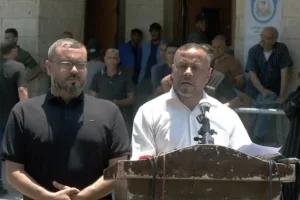
In Deir al-Balah, Gaza Strip, AP reported that Ismail al-Thawabta, general director of the Hamas-run Government Media Office, said “only technical and professional staff” would remain in their positions to run day-to-day affairs. teleSUR framed the dissolution as part of a transition after Hamas’s internal government had been linked to Hamas’s governance for two decades, with the origins traced to January 2006 elections in which Hamas won 74 of 132 seats.

Debate over weapons and power
Hamas spokesperson Hazem Qassem described the dissolution as “a positive step forward on the path to implement the ceasefire deal,” while Israeli Foreign Minister Gideon Saar dismissed the move as designed to avoid disarmament. AP reported that Saar wrote on X, “As long as Hamas retains its weapons, any civilian government will of course operate as Hamas dictates,” and that the Board of Peace said it would assess the impact based on “actions, not promises.” In the Al Jazeera account, Mohammed al-Farra’s resignation and the dissolution were presented as a demonstration of seriousness to facilitate the administrative transition process, and Al Jazeera reported that the NCAG head Ali Shaath welcomed the announcement as soon as necessary resources and capabilities are available.
The Jerusalem Post reported that Hamas clarified the resignation was “carried out in response to the national interest and in order to prevent Israel from making excuses,” and said Hamas told mediators the “ball is in the mediators' court.” AP also said negotiations between Israel and Hamas remain largely deadlocked over the second phase, including disarmament of Hamas and reconstruction of Gaza, with the first phase involving release of the last Israeli hostages held by Hamas in exchange for Palestinians detained by Israel.

What comes next for Gaza
AP said the technocratic committee is based in Cairo and chaired by Ali Shaath, a Gaza-born engineer and former official with the Palestinian Authority, with a mandate to restore essential services and oversee civilian affairs under U.N. and the Board of Peace supervision.
teleSUR described the central challenge of Hamas’s earlier administration as operating under a permanent state of siege, after Israel with cooperation from Egypt implemented a comprehensive land, air, and sea blockade that restricted movement of people, commercial goods, medical supplies, and construction materials.
The Jerusalem Post reported that Hamas warned against Israel’s “continuous attempts” to “hinder the implementation of the agreement and sabotage its path,” and said Hamas was putting the ball in mediators’ court to pressure all sides to bring the national committee into the strip.
AP reported that Israeli strikes continued almost daily after the ceasefire took effect on Oct. 10, and on Monday Israeli strikes killed at least five people in Gaza, including three in Khan Younis and two in an apartment in Gaza City, according to health officials.
teleSUR said the dissolution occurs within a context of a fragile 20-point peace plan brokered following a ceasefire agreement, while AP said the technocratic committee must control all weapons in Gaza and that Hamas did not say whether it would disarm or hand over security to an international force.