Gaza Genocide07 July, 20263 min read
Hamas Dissolves Gaza Government, Hands Authority to NCAG Under US-Brokered Peace Plan
Hamas dissolves Gaza government and transfers civilian administration to NCAG. NCAG will oversee Gaza's civilian administration under a US-backed ceasefire.
DW was read line by line by the Watchdog: 6.6. See the score →
Hamas dissolves Gaza government
Hamas, which controls the Gaza Strip, announced it would dissolve its government and hand over administrative authority to the National Committee for the Administration of Gaza (NCAG) as part of a US-brokered peace plan from October 2025. DW reported that Israeli Foreign Minister Gideon Saar reacted immediately with skepticism, saying that as long as Hamas retains its weapons, any civilian government will act according to Hamas directives. DW also said the NCAG is set to take over civilian administration, while its members “still remain in Cairo, Egypt, awaiting permission to enter Gaza,” and that the Board of Peace began its work in January 2026.
AOL reported that Hamas did not indicate any plans to disarm or hand over security to an international force, even as it described the move as evidence of its commitment to Gaza’s reconstruction after years of war. AOL added that the Board of Peace acknowledged Hamas’s announcement and stressed it would assess the impact based on “actions, not promises.”

Skepticism, quotes, and deadlock
DW quoted Simon Wolfgang Fuchs, an Islamic studies scholar at the Hebrew University of Jerusalem, arguing that the decisive factor is Hamas’s “political message” rather than the formal dissolution of its government. Fuchs told DW that Hamas wanted to signal it was “not to blame for the lack of political progress,” and he said the move was intended “to break out of this deadlock and get the political process moving again.” AOL reported that Israeli Foreign Minister Gideon Saar dismissed the move on X, writing, “As long as Hamas retains its weapons, any civilian government will of course operate as Hamas dictates,” and it said the technocratic committee is based in Cairo.
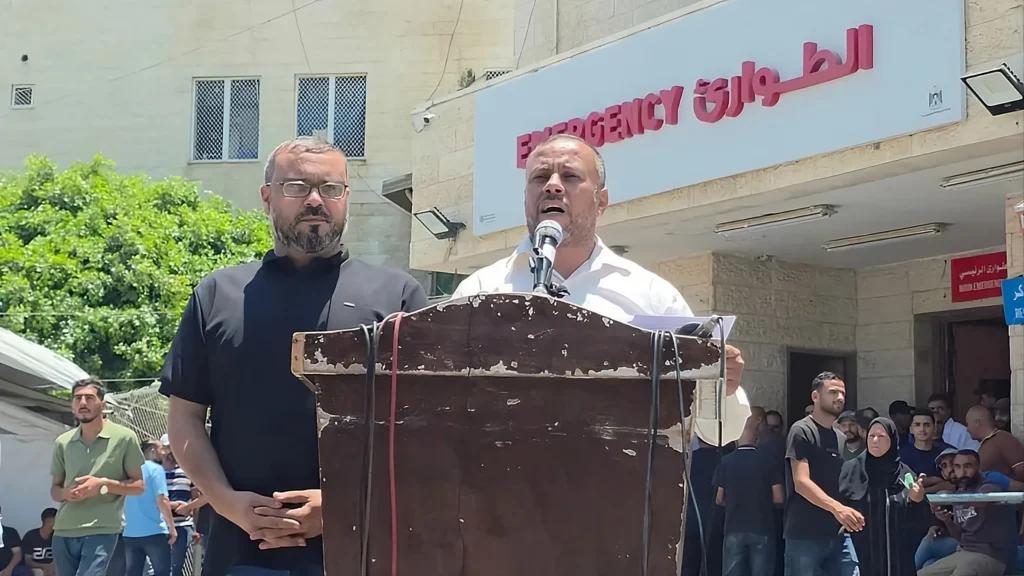
AOL also reported that at a news conference in the courtyard of Al-Aqsa Hospital in Deir al-Balah, Ismail al-Thawabta said “only technical and professional staff” would remain to run day-to-day affairs. AOL further stated that negotiations between Israel and Hamas remain largely deadlocked over the implementation of the second phase, including disarmament of Hamas and reconstruction of Gaza, nine months after the ceasefire was signed.

What’s at stake next
DW said significant doubts remain because Hamas declared willingness to hand over civilian administration but did not do so regarding its weapons, and it described this as the actual point of contention. DW reported that the Security Council Report emphasized interlinked steps that have so far stalled, thereby blocking the transition process, including a 15-point roadmap under which Hamas would relinquish military, police and administrative functions. AOL reported that the NCAG is chaired by Ali Shaath, a Gaza-born engineer and former official with the Palestinian Authority, and it said the committee’s mandate is to restore essential services and oversee civilian affairs under UN supervision and the Board of Peace.
AOL also said the committee must control all weapons in Gaza, as laid out in the ceasefire agreement, and it reported that Shaath said there must be “a unified security apparatus accountable to that authority.” DW added that the announced transfer of power has had virtually no practical consequences so far because transitional government members remain outside the Gaza Strip and the international stabilization force exists only on paper so far.