Lebanon27 July, 20263 min read
Hezbollah Fires Rockets Toward Northern Israel as Israel Bombards Southern Lebanon
This article is an automated aggregation of coverage from news outlets. Our editorials offer in-depth analysis curated by the NewsCord team.
Israel and Hezbollah are clashing directly, escalating the conflict. Israeli bombardment targets southern Lebanon, causing destruction.

The Guardian was read line by line by the Watchdog: 3.0. See the score →
Escalation and displacement
Israel and Hezbollah have clashed again, with Hezbollah resuming hostilities on March 2 by firing six rockets toward northern Israel, and Crisis Group says the escalation included Hezbollah unleashing a rain of about 200 rockets toward northern Israel on March 11 in coordination with a barrage of missiles from Iran. Crisis Group says Israel has bombarded southern Lebanon, the southern suburbs of Beirut, and the Beqaa Valley since March 2, with more than a million people fleeing their homes and up to one-fifth of the country’s population potentially displaced. The UN says the speed and scale of population displacement in Lebanon caused by the conflict are 'stunning,' warning that an average of 19,000 children are displaced every day.
UN agencies say more than one million people are now displaced, about 20% of the population, and UNICEF says more than 370,000 children have been forced to flee their homes in just three weeks. UNHCR says destruction of strategic bridges in the south has cut off entire districts from the world, isolating more than 150,000 people and severely limiting humanitarian access needed to deliver essential goods.

Talks, accusations, and voices
U.S. President Donald Trump said on Thursday morning that talks would take place today between Israel and Lebanon, writing on his Truth Social account that it would be an attempt to ease the atmosphere and that it has been about 34 years since the last dialogue between leaders.
An official Lebanese source told Agence France-Presse that Lebanon has not yet been informed of any planned contact with the Israeli side, saying: "We have no information about any contact with the Israeli side, and we have not been informed through official channels."
In his Easter message, Maronite Patriarch Bechara Boutros al-Rahi directly held Hezbollah and Iran responsible, saying the 'violation of Lebanon’s sovereignty by Iran through (Hezbollah)' has put the country on a dangerous path.
Rahi said the war imposed on Lebanon by Hezbollah and Israel has left casualties, destruction, and displacement, and he called for 'protecting civilians, and ensuring access to humanitarian aid without obstacles,' including opening humanitarian corridors as an international legal obligation.
Crisis Group says Hezbollah insists on preserving at least part of its arsenal to defend Lebanon against Israel’s expansionist aims, while the Lebanese government has tried to keep the national army out of the conflict.
Humanitarian and social stakes
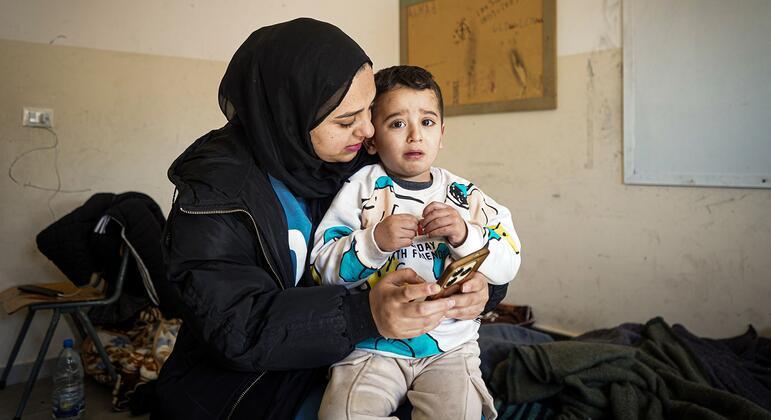
UN agencies warn that displaced households are taking shelter in informal, overcrowded and dangerous places, including unfinished buildings, public spaces and vehicles, while UNICEF says children face an 'endless cycle of bombardments and displacements' that 'significantly worsens their psychological trauma.' UNICEF detailed that to date at least 121 children have been killed and 395 injured, and UN Women Representative in Lebanon, Gielan El Messiri, said she had met 'women and girls forced to make heart-wrenching choices.' Crisis Group says the regions hardest hit by the conflict are those where the Shiite population is most concentrated, including southern Lebanon, the southern suburbs of the capital Beirut, and the Beqaa Valley.
The Guardian describes how the Lebanese diaspora, estimated to be about 15 million people spread across Australia, Europe, North and South America, has watched from afar as Israeli attacks on southern villages resulted in widespread destruction, with more than 1.2 million people displaced and roughly 14.3% of Lebanese territory ordered to be vacated. In the Guardian’s account, Ali Hamka said, "There is something especially painful about seeing a home destroyed twice in one lifetime," describing his family home in Bint Jbeil as among dozens "levelled" in attacks in April.