Iran Accuses the United States of Misusing the UN NPT Review Conference
Key Takeaways
- Iran says the US used the NPT Review Conference to misrepresent Tehran's peaceful nuclear program.
- Iran accuses Washington of aggression and misusing the conference to mask its violations.
- All of Iran's enriched uranium remains in Iran, not transferred abroad.
UN NPT Clash
Iran’s Permanent Mission to the United Nations accused the United States of using the Nuclear Non-Proliferation Treaty review conference to misrepresent Tehran’s nuclear programme and deflect attention from Washington’s own violations, as tensions between the two countries escalated at the UN.
“The Iranian ambassador and permanent representatives to the UN Office and other international organizations in Vienna says the United States “falsely portrayed” the Islamic Republic’s peaceful nuclear activities as a danger in a bid to wage two illegal acts of aggression against the country”
In a statement shared on its official X account, Iran’s mission said all of Iran’s enriched uranium remains under “full supervision of the International Atomic Energy Agency, and there is no report of even one gram of Iran's nuclear material being diverted.”
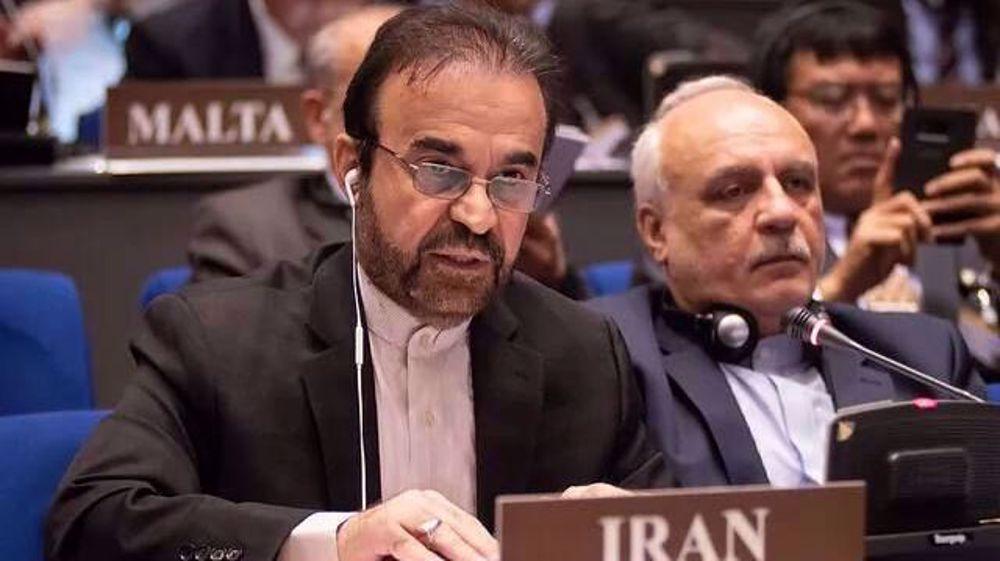
The mission also criticised international bodies, saying the UN Security Council, the IAEA Director-General and the Board of Governors had not only “failed to condemn these illegal attacks, but most regrettably, took actions that reversed the roles of the victim and the aggressor.”
Iran’s envoy Amir Saeed Irvani warned that lasting stability in the Gulf region would require an end to what he called ongoing aggression against Iran, along with guarantees that such actions would not be repeated and respect for Iran’s sovereignty.
Speaking at the conference, Irvani said Iran supported freedom of navigation in key waterways, including the Strait of Hormuz and the Gulf of Oman, but cautioned that continued military escalation could undermine regional and global security.
Irvani alleged that since February 28, the United States and Israel had been engaged in a “widespread and unjustified aggressive war” against Iran in violation of international law and the UN Charter, particularly Article 2(4), adding that the actions had disrupted maritime security.
The dispute unfolded as Iran was selected as one of the vice presidents for the month-long meeting, prompting US official Christopher Yeaw to criticise the selection as an “affront” to the treaty.
Uranium, Supervision, and Accusations
Iran’s UN messaging also centred on the claim that its enriched uranium has remained under IAEA supervision and that the United States has “falsely portrayed” it as a danger.
PressTV quoted Iranian ambassador Reza Najafi delivering remarks at the 11th Session of the Review Conference of the Parties to the Nuclear Non-Proliferation Treaty at UN headquarters in New York on Wednesday, saying the Americans “falsely portrayed” Iran’s peaceful nuclear activities as a danger in a bid to wage two illegal acts of aggression against the country.

Najafi said that “only in less than nine months in 2025 and 2026, two nuclear-weapon possessors launched unlawful military assaults against Iran,” and argued that Iran’s civilian nuclear program is under IAEA supervision.
He reiterated that “all of Iran’s enriched uranium has always been under the IAEA’s fullest supervision and accounted for, even up to its last gram, and till now there is no report whatsoever about the diversion of even one gram of such material.”
Najafi further claimed that the aim was to “distract attentions away from the 55 years of clear noncompliance of the US with its nuclear disarmament obligations, as well as to demonize Iran and to invade it.”
In the same statement, Najafi criticised the UN Security Council and the IAEA’s Board of Governors and its director general for failing to condemn what he described as the Minab tragedy, and he asked, “Does appeasement and silence towards the aggressors mean anything other than aiding and abetting them?”
He also alleged that US-Israeli attacks targeted Iran’s civilian infrastructure, listing schools, universities, hospitals, bridges, homes, mosques, churches, synagogues, and historical places, and he said those attacks included assassinating Ayatollah Seyyed Ali Khamenei.
PressTV added that Najafi said “Only in one case, 168 innocent children, aged between 7 and 12, were mercilessly torn to pieces in a triple-tap strike on a girl’s primary school in the southern Iranian city of Minab.”
Shamkhani on War Readiness
Outside the UN setting, Iran’s posture on uranium and potential conflict was framed in terms of readiness and limits on moving enriched material.
“I am not optimistic about the negotiations yielding results; the United States has no problem with the possible transfer of Iran's enriched uranium to Russia”
فرارو reported that Ali Shamkhani, described as “Advisor to the Leader of the Revolution,” said there was “no reason to transfer enriched uranium materials outside Iran and their concerns about the existence of these materials can be addressed.”
The same report said Shamkhani described the material as “yellowcake that has been reduced by sixty percent,” adding that “the possibility of returning to twenty percent exists,” and argued that “there is no need for all this trouble and all these complex steps to transfer these dangerous materials out of Iran.”
In a separate exchange, Shamkhani appeared in military uniform and told Ghassan Ben Jado, director of the Al Mayadeen network in Lebanon, that “it has a practical message. We are ready.”
The interview also asserted that Iran is “living in a state of war,” and Shamkhani said, “Therefore, we are prepared for any scenario that may arise.”
He described readiness as “accepting war, not threatening or attempting to wage war,” while saying enemies imposed “unjust conditions, unjust war, and unjust threats.”
When asked about the possibility of negotiating, Shamkhani said Iran has “repeatedly affirmed its readiness to negotiate practically with the United States of America,” while adding that “Europe has effectively proven that it cannot do anything.”
The report also included Shamkhani’s claim that in negotiations Iran voiced three “nos”: “We do not seek nuclear weapons, we will not produce nuclear weapons, and we will never store nuclear weapons.”
Uranium to Russia Debate
The question of whether Iran’s enriched uranium could be transferred to Russia became a focal point in Tabnak’s discussion of upcoming diplomacy and US preconditions.
Tabnak’s international service said that, on the eve of renewed diplomatic moves, Iran and the United States were preparing for a new round of negotiations planned to be held on Friday, 16 Bahman, with Oman mediating.

Tabnak said the talks came as military and security tensions remained high, and it described Washington’s approach as emphasizing diplomacy with pressure.
It reported that the United States had laid out preconditions for starting negotiations: a halt to uranium enrichment inside Iran, limits on the ballistic missile program, and an end to Iran’s support for proxy groups in the region.
In Tabnak’s interview with former Iranian diplomat Fereydoun Majlisi, Majlisi said Turkey acted as an intermediary between Iran and the United States because “the cost is lower,” and he argued that “war is very costly, has many entanglements, and is dangerous for Iran's future.”
Majlisi also said “Turkey is not only a close ally of the United States and Israel, but Iran is a large market for Turkey,” and he warned that “the fallout from a war in Iran could severely affect Turkey's development and the continuity of its economy.”
Tabnak stated that it had been announced that Iran’s enriched uranium may possibly be transferred to Russia, and it said Moscow expressed readiness in this regard.
The report also quoted Iranian MPs, including Ali Bagheri Kani, saying Iran has “no plan to transfer enrichment materials to any country and that negotiations are not about such a topic.”
Tabnak further asserted that the United States would agree to such a transfer because “its main concern is that these materials remain in the hands of the Islamic Republic,” and it claimed that “Keeping these materials would continue the same threat against Israel.”
Consequences and Competing Frames
Across the sources, the same nuclear dispute is framed through competing narratives about responsibility, compliance, and what comes next.
“Reza Najafi made the remarks in a statement delivered at the 11th Session of the Review Conference of the Parties to the Nuclear Non-Proliferation Treaty (NPT) at the UN headquarters in New York on Wednesday”
The Times of India reported that Iranian ambassador to the IAEA Reza Najafi rejected US remarks as “baseless and politically motivated,” saying, “It is indefensible that United States, as the only state ever to have used nuclear weapons, and the one that continues to expand and modernize its nuclear arsenal... seeks to position itself as an arbitrator of the compliance.”

In that same account, US official Christopher Yeaw criticised Iran’s selection as a vice president, calling it “beyond shameful and an embarrassment to the credibility of this conference,” while Iran’s envoy Amir Saeed Irvani urged the UN Security Council to address what he called ongoing aggression.
PressTV’s Najafi went further, warning that the US, described as “one of the Treaty’s depositories,” “publicly and explicitly forces Iran to fully abandon the exercise of this inherent right,” and it asserted that “when this unlawful demand was categorically rejected, the US, along with a nuclear armed non-party to the NPT, has waged two wars of aggression.”
PressTV also claimed that the US and Israel waged “two criminal wars on Iran,” including the “12-day one in June 2025 this year’s 40-day one in February 28,” and it said Iranian armed forces conducted “waves of successful strikes” against “sensitive and strategic American and Israeli targets throughout the region.”
Meanwhile, فرارو’s Shamkhani said “We are, in fact, living in a state of war,” and he argued that diplomacy must be paired with readiness, adding that there is “hope to prevent a catastrophe and an unlikely incident” if proposals are “free of threats.”
Tabnak’s Majlisi, by contrast, argued that continuing war would “destroy Iran's infrastructure and leave the country weak and broken,” and he said the cost of war is why Turkey mediates.
Even the uranium-transfer question is treated differently: Tabnak describes a possible transfer to Russia and says Moscow expressed readiness, while فرارو insists there is “no reason to transfer enriched uranium materials outside Iran.”
More on Iran

Trump Says U.S.-Iran Memorandum Will Be Signed Sunday, Strait of Hormuz Reopens
10 sources compared

Donald Trump Says U.S.-Iran Deal Will Be Signed Sunday, Strait of Hormuz Reopening
16 sources compared

Trump Says U.S.-Iran Memorandum Will Be Signed Sunday as U.S. Shoots Down Iranian Drones
11 sources compared

Donald Trump Says U.S.-Iran Memorandum Will Be Signed Sunday, Strait of Hormuz To Reopen
12 sources compared