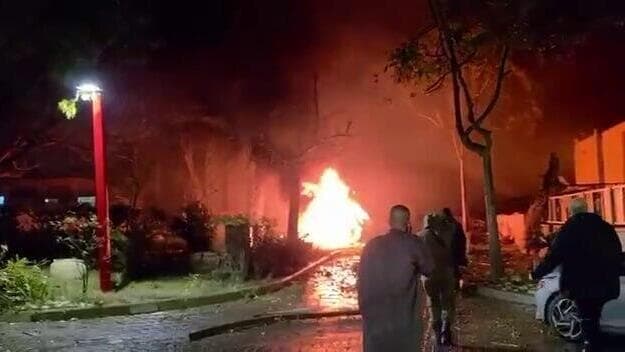
Iranian missiles strike Dimona and Arad, injuring over 100.
Key Takeaways
- Iranian missiles struck Dimona and Arad near Israel's Negev nuclear facility.
- Casualties exceed 100, with dozens injured in Dimona and Arad.
- Iran framed the strikes as retaliation for Israel's Natanz attack.
Attack Overview
Iranian missiles struck two southern Israeli cities, Dimona and Arad, on March 21, 2026, in one of the most intense escalations of the three-week conflict.
The attacks left over 100 people injured and caused extensive damage to residential buildings.

Iranian projectiles evaded Israel's air defense systems and directly hit populated areas, creating large craters and destroying multiple structures.
Israeli emergency services declared mass casualty incidents and deployed extensive rescue resources, including dozens of ambulances, helicopters, and mobile intensive care units.
The strikes occurred during what officials described as the ninth round of Iranian missile fire aimed at southern Israel within a 24-hour period.
Dimona Nuclear Target
The strike on Dimona, home to Israel's main nuclear research facility, carried particular strategic significance as it came within approximately 13 kilometers of the Shimon Peres Negev Nuclear Research Center.
Iranian state television framed the attack as a direct response to what Tehran claimed was a US-Israeli strike on Iran's Natanz nuclear enrichment complex earlier in the day.

The missile destroyed a one-story building and created multiple impact sites across the city.
Emergency responders treated 33 people at multiple locations, including a 10-year-old boy in serious condition with shrapnel wounds.
The International Atomic Energy Agency confirmed it was aware of the incident but reported no damage to the nuclear research center itself and no abnormal radiation levels detected in the area.
Arad Casualties
Hours after the Dimona strike, a second Iranian missile hit the city of Arad approximately 25 kilometers northeast, causing even more extensive damage and casualties.
“He reiterated his call for all the peoples of the nation to stand united against the enemy and work together for the central issues, foremost among them the liberation of Palestine”
Emergency responders described the scene in Arad as 'very difficult' with 'extensive destruction and chaos,' with missiles carrying conventional warheads containing hundreds of kilograms of explosives.
Medics reported that 75 people were injured in Arad, including 10 in serious condition, with 12 in moderate condition and the rest lightly wounded.
The strike damaged at least nine buildings, with some completely destroyed and others at risk of collapse.
Rescue workers combed through rubble searching for potential victims, while hospitals including Soroka Medical Center were placed on alert to receive the influx of casualties.
The Israeli military confirmed that interceptors were launched but failed to neutralize the ballistic missile before it struck.
Justification & Reactions
Iran claimed the attacks were legitimate retaliation for what it described as US and Israeli strikes on its nuclear facilities, particularly the Natanz enrichment complex.
Iranian state media quoted military sources stating that Tehran had shifted its strategy beyond proportional retaliation, warning that future responses would be broader and more damaging.

The Iranian Tasnim news agency declared that 'the enemy has once again received an unforgettable lesson' and that 'No area is safe from Iranian missiles.'
Israeli Prime Minister Benjamin Netanyahu described the evening as 'very difficult in the battle for our future' and vowed to continue striking Iran 'on all fronts.'
Defense Minister Israel Katz accused Iran of using weapons that amount to war crimes and described the conduct as consistent with what he called 'the behavior of a terror regime.'
The attacks prompted international concern, with UN nuclear watchdog chief Rafael Grossi urging 'maximum military restraint' to avoid nuclear accidents near sensitive facilities.
Strategic Assessment
The successful Iranian strikes raised serious questions about the effectiveness of Israel's air defense capabilities and represented a significant strategic development in the conflict.
“This article was produced by AFP”
Military experts noted that the missiles were not of an 'exceptional' or unfamiliar type, suggesting that Israel's defense systems may have been overwhelmed by the volume and coordination of the attack.
Iran demonstrated its ability to maintain effective command and control despite three weeks of heavy US-Israeli bombardment, with analysts describing the strikes as 'structured deterrence, designed to shape behavior and impose costs.'
The Israeli military announced it would investigate the failures and learn from the incidents, while Defense Minister Katz warned that Israel and the United States would begin intensifying their air strikes on Iran beginning March 22.
The attacks also showcased Iran's expanding missile range, as Tehran had previously targeted the joint UK-US military base on Diego Garcia in the Indian Ocean, approximately 4,000 kilometers from Iranian territory.
Regional Impact
The missile strikes had significant regional and global implications, exacerbating tensions across the Middle East and impacting international energy markets.
The attacks occurred amid Iran's partial closure of the vital Strait of Hormuz, through which 20% of global crude oil trade normally passes, causing Brent crude prices to surge over 50% to more than $105 per barrel within a month.
Twenty-two countries issued a joint statement condemning Iranian attacks on civilian infrastructure and expressing readiness to ensure safe passage through the strategic waterway.
Saudi Arabia responded by expelling Iran's military attaché and several embassy staff, ordering them to leave within 24 hours in protest against what it described as 'blatant Iranian aggression.'
The United Arab Emirates reported intercepting three ballistic missiles and eight drones launched from Iran, while Jordan's military said 240 missiles and drones had been fired at Jordan since the war began, wounding 24 people.
The escalating conflict also impacted civilians in the Israeli-occupied West Bank, where Iranian missile fragments caused damage to 27 buildings and injured nine people, including four Palestinians killed in a single incident.
More on Iran
Iran Attacks Dimona in Retaliation for Natanz Strike
44 sources compared

Iran Attacks Diego Garcia with Long-Range Missiles, Targeting U.S.-UK Base
82 sources compared

Trump Defends Iran War by Citing Pearl Harbor
12 sources compared
Israel's Defense Minister Warns Israel and United States Will Intensify Attacks on Iran
125 sources compared