Full story
Image, identity, detention
A widely circulated image of a Palestinian detainee in Gaza—blindfolded, bound with wire, and with an iron rod strapped to his back—has driven competing claims about who the prisoner is and where he is being held.
“The Israeli occupying army officially acknowledged the authenticity of a widely circulated image that documents the torture of a Palestinian prisoner inside the Gaza Strip”
Al-Jazeera Net described the image as showing a man “during his detention by Israel,” and said Israeli authorities “did not verify the authenticity of the image that swept across social media.”
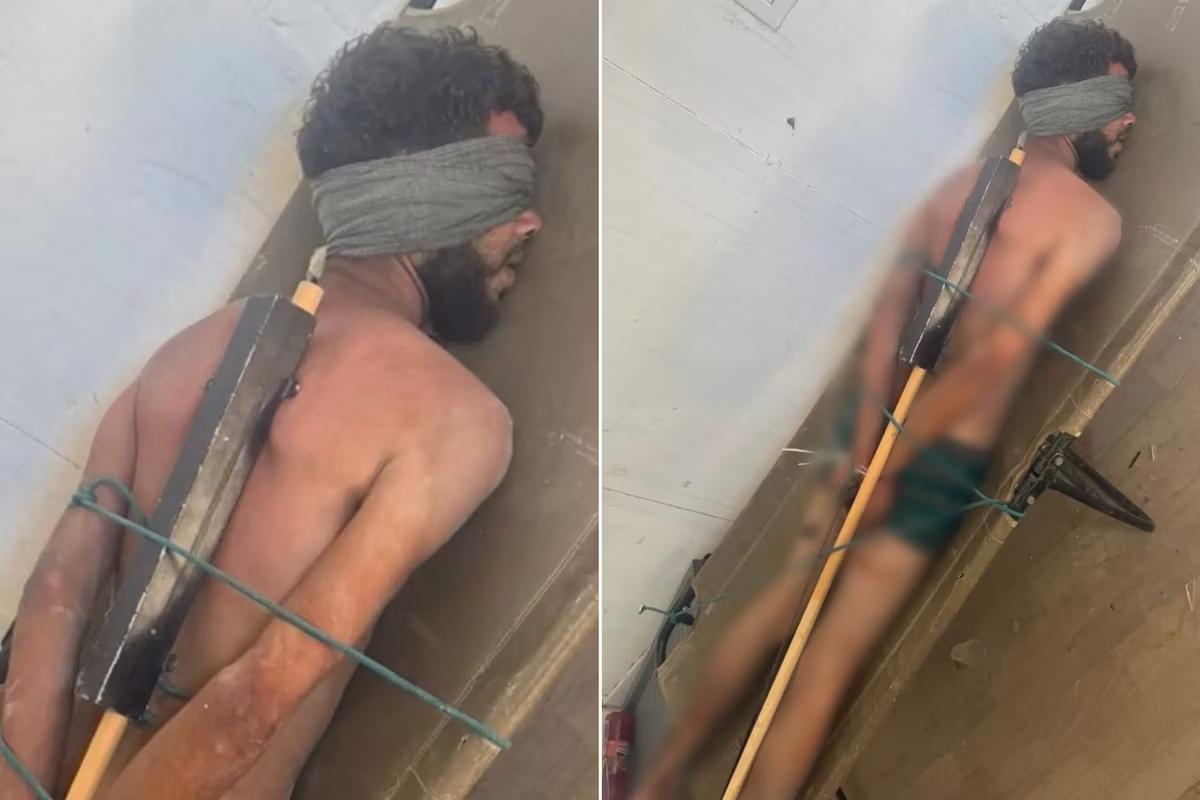
In the same account, Rana Abu Nassar and Jawda al-Goul each insisted the tortured prisoner was her missing son, with Rana saying the prisoner is her son Osama and Jawda saying her son Amin was arrested in November 2023 while attempting to move from southern Gaza to the northern part of the enclave.
Al-Jazeera Net also reported that the detained man’s hands were shown bound behind his back and his right leg tied to the lower corner of the bed in a screenshot of an Instagram post, with the Hebrew phrase 'Good morning' written over the image.
Anadolu Ajansı reported that the Israeli army confirmed the authenticity of the footage, saying in a statement carried by Israel's Army Radio that the footage “is real footage that occurred in the Gaza Strip,” while providing no details about where or when the incident occurred.
Witness accounts and claims
Euro-Mediterranean Human Rights Monitor testimonies published via alencontre describe Israeli civilians being brought into detention centers to watch and film torture, including at Zikim detention centers at the northern border of the Gaza Strip and at a site in southern Israel attached to the Negev prison.
In one account, Omar Abu Mudallala, 43, told Euro-Med Monitor that “brought in civilians to watch our tortures, naked,” and said the Israeli army brought Israeli civilians into the centers while beating detainees and telling them: “These are Hamas terrorists who killed you and who raped your wives on October 7,” as the civilians filmed.

Another former prisoner identified only as D.H., 42, told Euro-Med Monitor that “Israeli civilians were invited to witness the abuses and tortures we endured,” and said the Israelis sometimes brought their dogs to bark at detainees.
Anadolu Ajansı said the image sparked renewed calls for an independent investigation into the treatment of Palestinian detainees in Israeli custody, and it cited Palestinian and Israeli human rights groups saying about 9,500 Palestinians are held in Israeli prisons.
Al-Jazeera Net added that Khaled Muhajneh, a lawyer for the Palestinian Prisoners’ Affairs Commission, said the image “summarizes how a Palestinian can be stripped of his humanity simply because he is Palestinian,” and quoted him asking: “It is a heart-wrenching image. Until when?”.
Numbers, detention policy, fallout
The dispute over the image has unfolded alongside broader claims about detention conditions and the scale of arrests, with Al-Jazeera Net saying “Around 1,200 Palestinians from the Gaza Strip are detained in Israel under a law that allows indefinite detention.”
“No mother would wish to find herself in the position of Rana Abu Nassar or Jawda al-Goul in Gaza, after each of them saw a photo of a prisoner she believes is her son, blindfolded, stripped of everything except his underwear, tied to a small bed, with his face turned toward the ground during his detention by Israel, and while each mother clings to both hope and fear, the prisoner ultimately remains the son of only one of them”
Al-Jazeera Net also reported that Amani Sarhanneh of the Palestinian Prisoners Club said the organization had provided “the two names of the men in the circulating image” to the Israeli army to try to arrange lawyers’ visits.
Anadolu Ajansı, meanwhile, cited Palestinian and Israeli human rights groups saying about 9,500 Palestinians are held in Israeli prisons, where detainees face torture, starvation, and medical neglect that have resulted in the deaths of dozens of prisoners.
Revolution Permanente described testimonies from Gazans detained in camps built since the start of the Gaza war, and it quoted Bahaa Abu Rokba saying, “They gave us one can of tuna for a hundred detainees, a cucumber and a little bread in the evening.”
Revolution Permanente also said Israeli colonial forces opened investigations into the unexplained death in detention of 48 Gazans, including 35 at this site in the Negev desert, and announced on June 11 the gradual closure of this center.