Technology and Science21 May, 20263 min read
James Webb Detects Repeating Cloud Cycles on WASP-94A b, Showing Clear Evening Skies
This article is an automated aggregation of coverage from news outlets. Our editorials offer in-depth analysis curated by the NewsCord team.
JWST tracked daily weather cycles on WASP-94A b, a hot Jupiter in a binary system. Morning clouds form on WASP-94A b and dissipate by evening, showing daily atmospheric cycles.
JWST Finds Daily Clouds
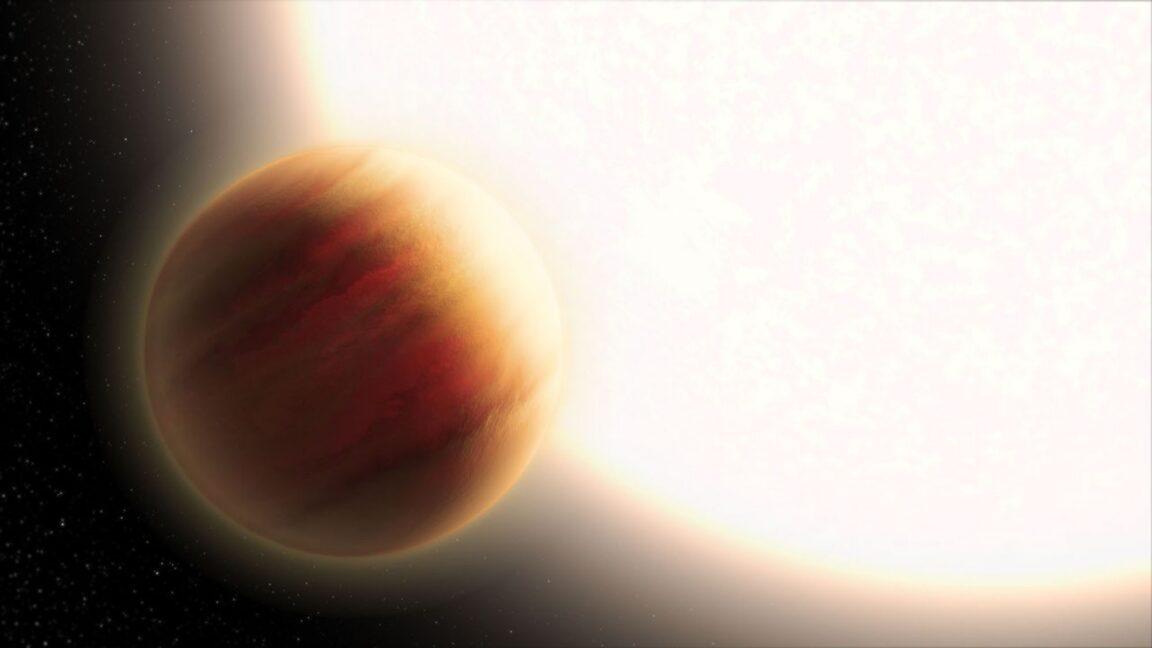
Astronomers used the James Webb Space Telescope to detect repeating cloud cycles on the hot Jupiter exoplanet WASP-94A b, where clouds form on the night side and clear by the early evening. In the study, Johns Hopkins co-author and program PI David Sing said, "general cloudiness has been a thorn in our side," describing how the new method lets researchers "clear the view" and measure what the clouds are made out of. The work focused on WASP-94A b in the Microscopium constellation, nearly 700 light years away from Earth, and used separate measurements of the planet’s leading edge and trailing edge as it passed in front of its star.
“The results are published today in the journalScience.”
Researchers reported that mornings on WASP-94A b are riddled with clouds made of magnesium silicate, while the evening has clear skies, revealing a strong day-night weather contrast. The results were published in the journal Science, and the team said the clearer evening sky allowed them to look at the trailing edge in a way the Hubble telescope could not provide.
Morning Fog, Clear Evenings
The Times described WASP-94A b as a gas giant that orbits so tightly that a year lasts just four Earth days, with atmospheric temperatures well above 1,000C on its starlit side. It said the planet appears tidally locked, creating a permanent divide between day and night and, at the edges of that divide, a permanent "morning" and "evening". In that framing, the study reported that clouds form in the cooler morning region and evaporate as strong winds carry them towards the hotter evening, producing a daily cycle that can be tracked through transit spectroscopy.
Sagnick Mukherjee, the study’s first author, said, "This approach with the JWST lets us localize our observations, which helped us see the cloud cycle," contrasting it with earlier observations that averaged clouds and atmosphere together. The Times also reported that once the researchers separated morning from evening, the planet’s composition became more plausible, with earlier readings suggesting oxygen and carbon far higher than Jupiter but the new data showing only five times the amount of oxygen and carbon.

Composition and Future Targets
Scientific American said the morning side edge of WASP-94A b is overcast with puffy clouds while the trailing evening edge is almost cloud-free, and it described the clouds as composed of magnesium silicate, iron and magnesium sulfide—"essentially vaporized rock." It quoted exoplanetary scientist Heather Knutson saying, "You can, at a glance, see the difference" in the hemispheres’ weather, and it warned that if observations assume uniform cloud cover, models can mislead composition estimates. Ars Technica reported that scientists led by Sagnick Mukherjee used JWST to answer whether such atmospheres are static or dynamic, and it said the team found it’s cloudy in the morning but clear in the evening.
Ars Technica also said that for tidally locked planets, standard transmission spectroscopy can oversimplify by averaging light filtering through the entire circumference of the planet’s silhouette. The study’s implications, as described by Ars Technica, are that the chemistry of WASP-94A b and "many other exoplanets" may have been "surprisingly wrong" when cloud cycles were not resolved.