
Lead Laser Scientist Describes Shot Day Firing Texas Petawatt at University of Texas at Austin
Key Takeaways
- UT Austin's underground laser facility houses one of the United States' most powerful lasers.
- Access is through heavy double doors stamped with a campus logo.
- The facility is part of a complex with a 17-story tower and large L-shaped building.
Inside Texas Petawatt
A “shot day” at the University of Texas at Austin’s Physics, Math and Astronomy building begins long before anyone sees anything happen above ground, because “Two floors below ground, behind heavy double doors stamped with a logo that most students have never noticed, sits one of the most powerful lasers in the United States.”
“If you walk across the open yard in front of the Physics, Math, and Astronomy building at the University of Texas at Austin, you’ll see a 17-story tower and a huge L-shaped building”
The laser is the Texas Petawatt, or TPW, and the account is written by the person who says, “I was the lead laser scientist on the Texas Petawatt, or TPW as we called it, from 2020 to 2024.”
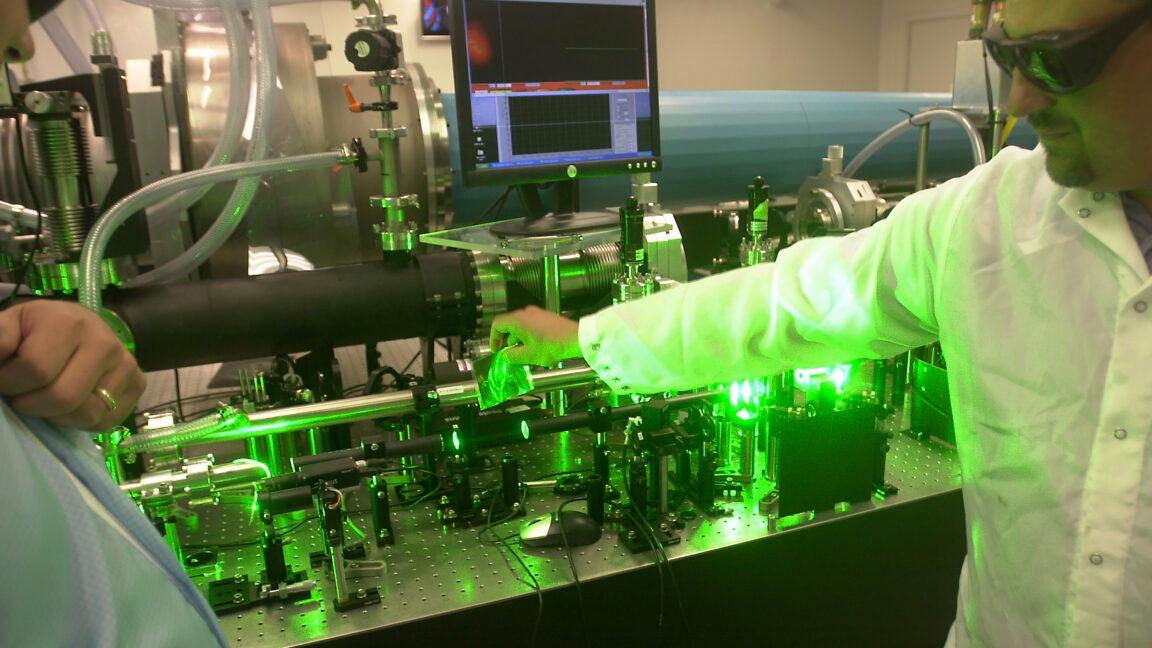
The facility is described as “currently closed due to funding cuts,” and it is characterized as “a government-funded research center where scientists from across the country applied for time to use specialized equipment.”
The laser is also placed within a broader U.S. research ecosystem: “It was part of LaserNetUS, a Department of Energy network of high-power laser labs.”
The piece explains how the system works at the level of timing and physics, saying the laser “takes a tiny pulse of light, stretches it out so it doesn’t blast optics to pieces, and amplifies it until, for a brief instant, it carries more power than the entire U.S. electrical grid.”
It then adds that the pulse is “compress[ed]… back to a trillionth of a second to create a star in a vacuum chamber.”
On a typical day, the target could be “a piece of metal foil thinner than a human hair, a jet of gas or a tiny plastic pellet,” and the work is framed as answering questions ranging “from the physics of stellar interiors and fusion energy to new approaches for cancer treatment.”
From 7 a.m. to Stabilize
The operational rhythm described for TPW is anchored to an early start, with the author stating, “7 a.m. I arrive two hours before the first scheduled shot.”
After arriving, they describe donning protective gear and entering controlled conditions: “I put on my gown, boots and hairnet and step into the cold clean room.”

The account emphasizes that “The laser doesn’t just turn on. You coax it awake,” beginning with “the oscillator, a small box that generates the first seed of light.”
Before any amplification, the scientist records a set of parameters that define the shot, including “energy, center frequency, vacuum pressure in the tubes, cooling water level and flow,” and the text stresses that “At this stage, they are fixed regardless of the experiment.”
The author says the system must “perform the same way every time before the science can begin,” linking repeatability to the ability to do experiments.
The next stage is described as pumping the pulse, where they “fire up the pump laser that will amplify this tiny pulse from nanojoules to about half a joule.”
Stabilization is treated as a hard requirement, with the line “The system needs at least 30 minutes to stabilize,” followed by a detailed alignment check “through every pinhole and every camera along the beam path.”
The piece warns that alignment errors can have immediate and expensive consequences, saying, “A slight misalignment at this stage isn’t just a problem; it can be catastrophic – a mispointed beam at full power can burn through optics that take months to source and replace, setting the entire laser back.”
Amplifiers and Flash Lamps
Once the system is warmed up, the author describes sending the beam into a sequence of amplifiers, starting with “the first amplifier: a glass rod surrounded by bright flash lamps that pump light into the glass – like charging a battery.”
“If you walk across the open yard in front of the Physics, Math and Astronomy building at the University of Texas at Austin, you’ll see a 17-story tower and a huge L-shaped building”
The beam is said to grow stronger “With each pass,” as it “absorbs energy from the glass and grows stronger,” and the process then moves into “a larger rod” where “it makes four passes, picking up more energy each time until it reaches about 12 joules, roughly the energy of a ball thrown hard across a room.”
The narrative frames the time cost of this stage as substantial, stating, “This process alone takes the better part of an hour, most of it spent checking and confirming alignment and energy at each stage.”
After that, the beam is expanded and sent “through the final stage: the disk amplifiers,” which are described with specific hardware details.
The author says “Two amplifiers, each consisting of two massive 30-centimeter glass disks, are pumped by a huge bank of flash lamps powered by capacitor banks – essentially giant batteries that store electrical energy and release it in a sudden burst.”
The capacitor banks are described as physically separate, with the line “They are so large that they have their own room on a separate floor.”
Between stages, the system uses “Fast optical shutters between each stage act as gates, controlling exactly when and where the beam travels.”
The account also returns to the idea that the laser’s behavior must be controlled and consistent, because the “laser must perform the same way every time before the science can begin,” and the amplifier chain is portrayed as a carefully gated pipeline rather than a single switch.
System Shot Mode
The final phase of the described procedure is triggered only after the experimental team confirms the target is ready, and the author says, “When the experimental team confirms that the target is in position, it asks me to prepare for a system shot.”
They then describe running “the long checklist,” followed by a switch in operating mode where “We test the shutters and switch to system shot mode.”
The facility’s monitors are described as changing in unison, with the line “Every monitor in the facility changes to display the same message – “System Shot Mode” – and flashes red.”
At that point, the author moves to the control desk microphone, describing it as “a vintage piece that looks like it belongs in a World War II radio room,” and they “announce that we’re going into a system shot.”
The narrative emphasizes that the moment is brief and tightly controlled, consistent with the earlier description that “On a typical shot day, the target might be” one of several materials and that the day includes “hours of quiet, repetitive work followed by about 10 seconds where nobody breathes.”
The text also ties the shot to the physical components of the beam path, describing “Then I open the compressor beam dump: a heavy glass plate that normally blocks” as the next step in the sequence.
While the excerpt ends mid-sentence, it still conveys that the shot is executed through a chain of mechanical and optical actions that are coordinated with the facility’s status displays and checklists.
Across the three versions of the piece, the same structure appears: early arrival, parameter setting, stabilization, alignment, amplification, and then a controlled transition into “System Shot Mode.”
Funding Cuts and Research Networks
The account situates the Texas Petawatt not only as a machine but as part of a national research network, and it links the facility’s status to policy and funding.
“If you walk across the open yard in front of the Physics, Math and Astronomy building at the University of Texas at Austin, you’ll see a 17-story tower and a huge L-shaped building”
The author says TPW “was a government-funded research center where scientists from across the country applied for time to use specialized equipment,” and it adds that it “was part of LaserNetUS, a Department of Energy network of high-power laser labs.”
Yet the piece also states that “Texas Petawatt, which is currently closed due to funding cuts,” meaning the described “shot day” routine is tied to a facility that is no longer operating under the same conditions.
The narrative also describes the kinds of experiments that were enabled by the system, including “the physics of stellar interiors and fusion energy” and “new approaches for cancer treatment,” with the targets ranging from “a jet of gas” to “a tiny plastic pellet.”
The author’s present role is also stated, saying, “I now work as a research scientist at the University of Texas-Austin, studying the interaction of lasers with different materials.”
That shift is presented alongside the closure of TPW, reinforcing that the work continues in a different form even as the petawatt facility is shut.
The piece’s operational details—like the requirement that “The system needs at least 30 minutes to stabilize” and the warning that misalignment can “burn through optics that take months to source and replace”—underscore why funding and continuity matter for high-power laser research.
Even the description that “Scientists from across the country applied for time on TPW” ties the facility’s closure to the broader community of researchers who depended on access to the specialized equipment.
More on Technology and Science

Blue Origin Reuses New Glenn Booster for First Time on NG-3 From Cape Canaveral
12 sources compared

Austria Police Find Rat Poison in HiPP Baby Food Jar, Triggering Recall at SPAR
12 sources compared

Trump Signs Executive Order To Fast-Track Psychedelic Drug Research, Including Ibogaine
52 sources compared

Sam Altman’s World Expands Proof-Of-Human Verification With Tinder, Zoom, and Docusign
15 sources compared