
Lebanese Government Prioritizes Ceasefire Stabilization With Israel as Hezbollah Rejects Ban
Key Takeaways
- Hezbollah remains Lebanon's dominant political force shaping policy toward Israel.
- Israeli attacks have killed over 100 people and prompted evacuations.
- Lebanese government prioritizes stabilizing the ceasefire with Israel through Beirut diplomacy.
Ceasefire talks amid strikes
Lebanese presidency sources told Al-Sharq on Tuesday that stabilizing the cease-fire agreement with Israel is a "top priority" for the Lebanese government as evacuation warnings, air raids, and shelling continued across southern Lebanon and Beirut.
“Hezbollah is the most prominent of Lebanon’s political movements, and has long been the most powerful in the country”
The same Al-Sharq report said the U.S. ambassador to Lebanon, Michel Aissa, met Lebanese officials including Parliament Speaker Nabih Berri, and after meeting Berri Aissa said: "There will be a cease-fire, and our decision was for it to be comprehensive, but there was something that needed clarification and we clarified it today."
In parallel, l'Opinion said Hezbollah’s secretary-general Naïm Qassem rejected the Lebanese government’s ban on Hezbollah’s "security activities" in a message released on Wednesday, March 4, and the article linked that stance to the militia’s continued rocket and drone fire against Israeli territory on Thursday, March 5.
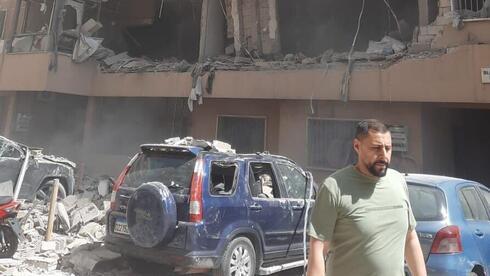
l'Opinion also reported that Israeli attacks against the Cedar country had killed 102 people since Sunday, and it described unprecedented evacuation orders for vast areas in southern Lebanon and Beirut.
The Al-Ghad report added that the Israeli army issued an immediate evacuation warning for the villages and towns Ghassanieh, Houmine al-Fouqa, and Ansariyeh ahead of military operations, while it said Israeli aircraft carried out strikes targeting Kfarraman and Nabatieh in the Tyre District.
Hezbollah’s justification and Lebanon’s split
l'Opinion said Hezbollah’s secretary-general Naïm Qassem released a message on Wednesday, March 4 justifying the militia’s entry into the war between Iran and the Israeli-American coalition, and it quoted his position that the militia responds "in an appropriate manner to the Israeli aggression."
In the same l'Opinion account, it said Naïm Qassem framed Hezbollah’s role as defending the Lebanese, the resistance to Israel, and the nation in an existential struggle, while the article described Israeli bombardments as killing at least 102 people, mainly in southern Lebanon, the southern suburbs of Beirut, and the Beqaa Valley.

TV5MONDE’s Jean-Paul Chagnollaud said the scale of displacement had reached "one million displaced people, which roughly means one Lebanese in five," and it described how Hezbollah continued to fire rockets and shells at northern Israel despite Israeli bombardments.
TV5MONDE also quoted Ali El Zein, a political activist in Beirut, saying: "We cannot condone what Israel did, but we cannot support Hezbollah either."
The Al Jazeera explainer on Lebanon’s political movements added that Hezbollah was led by Secretary-General Naim Qassem and was formed in 1982, and it said Hezbollah was widely considered weakened after an Israeli intensification in 2024 that killed much of Hezbollah’s military leadership, including Hassan Nasrallah.
Humanitarian and political stakes
The Al-Ghad report said the Israeli airstrikes have killed more than 3,600 people and displaced more than a million Lebanese, according to official estimates, while it added that fighting continued despite the ceasefire announced on April 16 and that Lebanese authorities reported about 3,500 airstrikes since the start of the truce.
“Back to top In the wake of the start of the war launched by the United States and Israel in the Middle East, Hezbollah, a highly influential pro-Iranian Shiite organization in Lebanon, has supported the Islamic Republic of Iran”
Al-Ghad further reported that UN data indicate about a quarter of Lebanon's population, roughly 1.24 million people, may face high levels of food insecurity through August, and it tied those risks to the ongoing escalation that began on March 2 when Hezbollah fired rockets toward Israel in support of Iran.
On the political front, Al-Sharq said Lebanese President Joseph Aoun would not meet Israeli Prime Minister Benjamin Netanyahu before a final agreement between Lebanon and Israel is reached, and it reported Aoun’s claim that negotiations with Israel were focused on reaching an agreement to prevent future attacks.
Al-Sharq also said Aoun described a major breakthrough as "a cease-fire in exchange for Hezbollah's withdrawal from the southern Litani," and it said the current work is on a "no-attack" or "security" agreement or other.
In parallel, the UN’s human rights chief Volker Türk told Al-Ghad that the commission would send a team of investigators to Lebanon next week to assess and document potential violations of international law by all parties to the conflict.
More on Lebanon

Netanyahu Urges Lebanese To Join Israel, Reject Hezbollah And Iran Amid Strikes
18 sources compared

Israeli Strikes On Tyre Kill Five, Wound Eight; Army Orders Evacuation Of Zakouk El-Mefdi
14 sources compared
Gunman In Military Uniform Killed After Firing On Israeli Troops At Lebanon Border
13 sources compared
Israel Strikes Beirut’s Dahieh After Hezbollah Fires Toward Israeli Territory, Netanyahu Says
13 sources compared