
Technology and Science · 18 August, 2026 · 3 min read
Milky Way Swallowed Dwarf Galaxy LKH About 11.8 Billion Years Ago, Hubble And Gaia Find
Dwarf galaxy Low-energy Kraken-Heracles merged with Milky Way about 11.8 billion years ago. Hubble data provide evidence of the merger, extending Milky Way history by 1.8 billion years.
15 outlets told this the same way.
10 of 12 outlets skipped it: collision was 'peaceful' for stars but 'explosive' for gas, triggering star formation.
15outlets compared
First merger pinned down
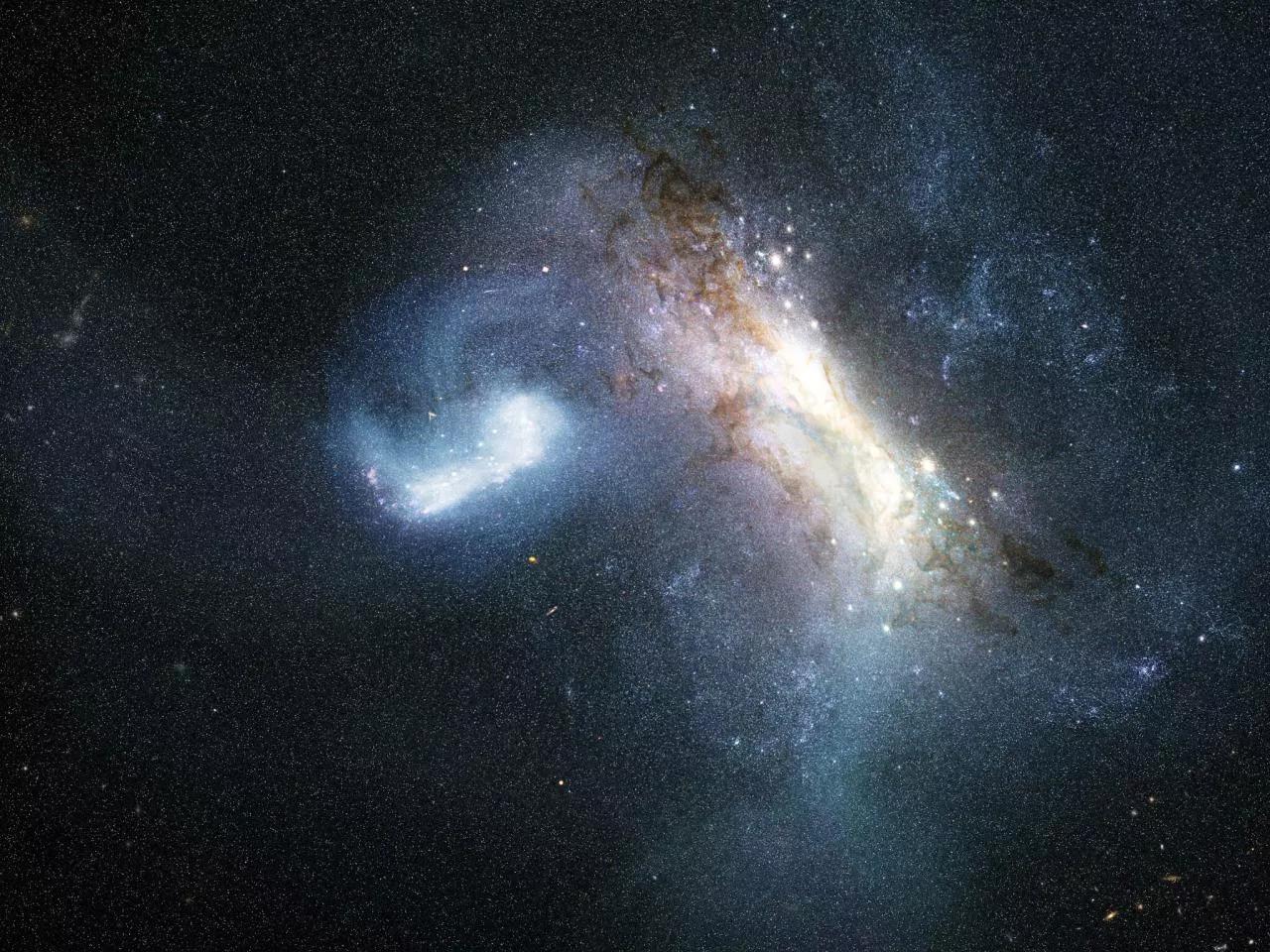
Astronomers say the Milky Way swallowed a dwarf galaxy called Low-energy-Kraken-Heracles, or LKH, about 11.8 billion years ago, roughly 2 billion years after the Big Bang. The research used Hubble and Gaia observations of stellar clusters spanning the Milky Way’s innermost 20,000 light-years to infer ages, chemical composition, and trajectories, with the LKH system estimated to have contained stars with a mass equivalent to 500 million times that of the sun at the time of the merger. NASA’s Hubble data, the sources say, extend the known Milky Way merger history 1.8 billion years farther back than before, adding a definitive earlier event to the galaxy’s timeline.
“This finding extends our knowledge of our galaxy’s history 1.8 billion years farther back in time than before.”
Lead author Davide Massari said, "In this paper we discover where the first significant batch of bricks came from: a dwarf galaxy that we call LKH." Chiara Zerbinati added, "Thanks to the high resolution and depth of Hubble imaging, we could measure the age and the metal content of these clusters with unprecedented precision."
How the evidence was read
The study’s core method, as described in the sources, compared globular clusters’ ages and metallicity—"the abundance of elements heavier than helium"—to separate star populations tied to different merger events. In the Reuters account, Massari said the merger was "rather peaceful, with no star-to-star crashes," but that from the point of view of gas it was more "explosive," with the collision between gas from LKH and that from the Milky Way triggering the formation of many stars. The Conversation’s framing emphasizes that globular clusters act as "cosmic clocks," allowing researchers to compare many stars sharing the same age even when dating individual ancient stars is difficult.
The sources also tie the new LKH event into a broader sequence, with the Milky Way later absorbing Gaia-Sausage-Enceladus about 1.8 billion years after the LKH merger and combining with the Sagittarius dwarf galaxy for roughly the past 6 billion years. Massari’s statement in the Space | Western Mainstream piece links the result to a larger question, saying, "Here, we have shown that stars born in external galaxies also need to be considered."
What it changes next
By pushing the earliest-known merger back to 11.8 billion years ago, the findings reshape how scientists reconstruct the Milky Way’s early growth, which the sources describe as driven by both star formation and mergers. The Reuters report places the LKH merger as the earliest-known galactic merger event experienced by the Milky Way in its infancy, while also noting that the Milky Way is currently merging with the Sagittarius Dwarf Spheroidal Galaxy, a process that started some 6 billion years ago. The sources say the team plans to continue scouring globular clusters to identify other ancient collisions, with NASA describing that the team now plans to examine more globular clusters to build a more complete record of the Milky Way’s growth.
“Every single one of these mergers had an influence on the events that have led to the formation of our own solar system, and ultimately of Earth.”
heise online frames the discovery as "unequivocal evidence" for the collision 11.8 billion years ago and says the research group aims to search for more and to better understand the existing ones. In the same NASA account, Massari’s team treats the merger as part of a chain of events that influenced later outcomes, with Massari saying, "Every single one of these mergers had an influence on the events that have led to the formation of our own solar system, and ultimately of Earth."