
Full story
Tunnel rescue after floods
Rescuers pulled two trapped workers alive from a hydropower tunnel at the Upper Trishuli 3A project in Nepal on Friday, nine days after flash floods ravaged the Himalayan nation.
“Rescuers were searching for dozens of others inside the tunnel at a hydropower plant damaged by last week’s deadly floods.”
The New York Times reported that cheers erupted as Nepali Army personnel in hard hats lifted one of the men to the surface, and it said the survivors were in stable condition at an Army hospital in Kathmandu, the capital.
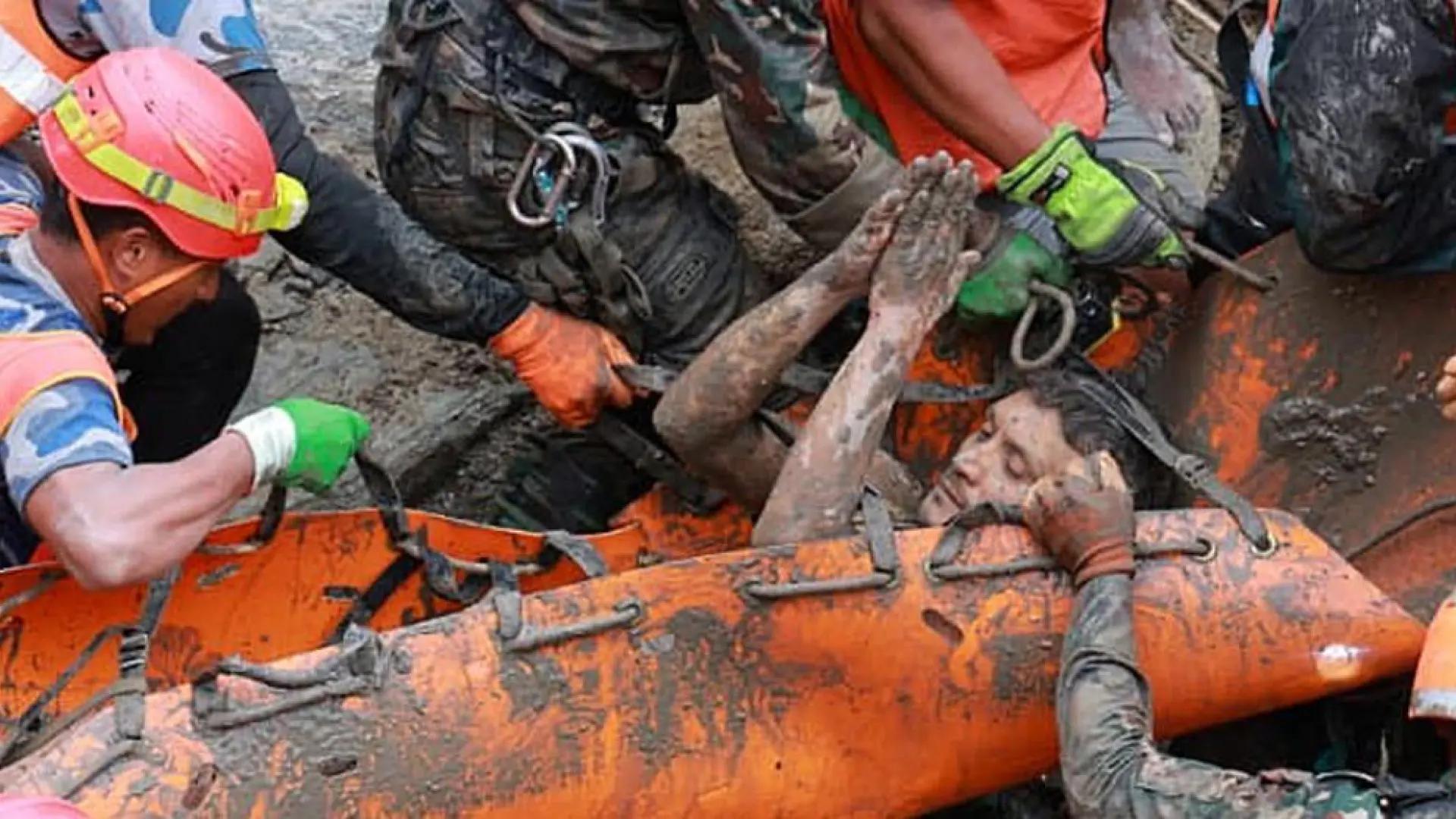
The New York Times also said the body of a third man, a mechanical engineer, was recovered on Friday, and it quoted Dirghayu Kumar Shrestha, the head of the Nepal Electricity Authority, describing the recovery at the hydropower plant on Friday.
Reuters said the rescue came as an engineer-led WhatsApp group guided search workers scouring the Trishuli valley after the wall of water, mud and rock crashed down the Trishuli valley on August 26.
Reuters added that the authorities hoped some of the about 900 people reported missing from six hydropower plants may have escaped by working in or fleeing into the tunnels.
Voices at the hospital
Dev Sah, the brother-in-law of Sanjay Sah, said, “It had been nine days and everybody’s sense of hope was waning,” after the two men were rescued and treated at an Army hospital in Kathmandu.
The New York Times quoted the head of the Nepal Electricity Authority, Dirghayu Kumar Shrestha, saying doctors told him that they “are both stable and have normal health parameters.”

NPR reported that Nepalese lawmaker Shri Ram Neupane posted about the second rescue on his Facebook page shortly after army spokesperson Brig. Gen. Raja Ram Basnet confirmed the first trapped worker’s rescue.
NPR also said officials identified the two men as a mechanical foreman and a mechanical supervisor, and it reported that both men were flown to a hospital in Kathmandu.
Al Jazeera said the rescued men were identified as Sanjay Shah, 30, a mechanical foreman, and Kabir Maharjan, 45, a mechanical supervisor, by the minister of home affairs of Nepal, Sudan Gurung.
What remains at risk
Even as the rescue raised hope, Reuters said the flood deposited 2.2 million tonnes of mud and debris down the valley, making it tough to find entrances to some tunnels and complicating the search for anyone still alive.
“2.2 million tonnes of mud and debris down the valley.”
Reuters reported that Nepal’s Independent Power Producers' Association said at least eight people could be trapped at Chilime, while an official at the Nepal Electricity Authority said 46 may be trapped at Rasuwagadhi hydropower plant.
AP said about 900 workers are missing from 12 hydropower projects in Nepal, with roughly 500 believed to be trapped in various tunnels, and it said about 115 are believed trapped in the tunnel at Trishuli 3A alone.
AP also quoted Nepal’s Communication Minister Bikram Timilsina writing on Facebook that officials “are waiting for the rescue of more and more people.”
The New York Times said the disaster killed more than 1,300 people in Nepal and Tibet and left thousands of others missing, while it reported that more than 4,000 people are missing in Nepal and neighboring Tibet.