Oil Prices Surge After Trump Says U.S. Seized Iranian Cargo Ship Near Strait of Hormuz
Key Takeaways
- Oil prices jump after Trump claims U.S. seized Iranian cargo ship near Hormuz.
- IEA approves record 400 million-barrel emergency oil release to ease price surge.
- IEA member countries coordinate largest-ever oil reserve release to stabilize markets.
Oil, Markets, and Hormuz
Oil prices surged and stocks moved unevenly as renewed U.S.-Iran tensions over the Strait of Hormuz rattled global markets, with multiple outlets tying the swings to the same flashpoints: a U.S. seizure of an Iranian cargo ship, shifting claims about whether the strait is open, and a ceasefire deadline approaching.
NBC News said U.S. crude jumped “more than 5%” to “about $87 per barrel,” while Brent rose “5%” to “around $95 per barrel,” as the S&P 500 “fell slightly by about 0.3%” and the Nasdaq Composite “fell 0.4%.”

BBC reported Brent rose “by more than 4% to $94.20 (£69.60) a barrel,” reversing a Friday drop after Iran said the Strait of Hormuz would be “completely open” for the remainder of the ceasefire.
CNBC put the move in futures terms, saying West Texas Intermediate futures for May delivery “rose nearly 7% to close at $89.61 per barrel” and Brent crude futures for June delivery “advanced more than 5% to settle at $95.48.”
Devdiscourse described a broader regional lift, saying “Asian markets climbed” and that “In Tokyo, the Nikkei 225 rose 1% while South Korea's Kospi increased by 1.1%,” while U.S. markets hit “record highs” with the S&P 500 “soared to an all-time high.”
Across the same reporting window, the strait’s status remained the central variable: NBC News said the transit point “typically sees more that 20% of the world's oil supply pass through it on a daily basis” but has been “effectively closed since the beginning of March,” while BBC said “usually about 20% of the world's oil and liquefied natural gas passes through it.”
Ceasefire, Blockade, and Ship Seizure
The market moves were anchored to a rapidly changing narrative about the ceasefire and the Strait of Hormuz, with outlets describing a pattern of opening and closure claims and then a U.S. action that shifted sentiment again.
NBC News said the day began with optimism after “a senior Iranian official told Reuters the nation was "positively" reviewing possible participation in peace talks with the U.S.,” but it also reported that Trump later told Bloomberg News it was “highly unlikely” he would extend the “two-week ceasefire” that would expire on “Wednesday evening, Washington time.”

NBC News further described how Iran declared the strait open for commercial vessels on Friday, sending “stock indexes soaring and oil prices plummeting 11%,” only for officials to walk that back over the weekend by accusing the U.S. of only “partially implementing the ceasefire” while maintaining its “own naval blockade of the strait.”
BBC similarly tied the reversal to Iran’s statements, saying Brent rose after Trump said the navy had intercepted and seized an Iran-flagged cargo ship, and that on Saturday Iran said it was closing the strait again and that any ship that approached it would be targeted.
CNBC added detail on the U.S. action, saying “The U.S. Navy on Sunday fired on an Iranian container ship in the Gulf of Oman, and the Marines later took custody of the ship, President Donald Trump said,” and that the ship had tried to get past the U.S. naval blockade of Iran’s ports.
BBC said Trump’s representatives would be in Pakistan on Monday for negotiations, and that a White House official said Vice-President JD Vance would lead the U.S. delegation, while Iran’s state media said Tehran had “no plans for now to participate” in the talks.
Prices at the Pump and Market Jitters
Beyond crude benchmarks, the reporting connected the geopolitical shock to consumer-facing costs and to a wider set of energy-linked futures, describing how investors tried to price the odds of renewed disruption.
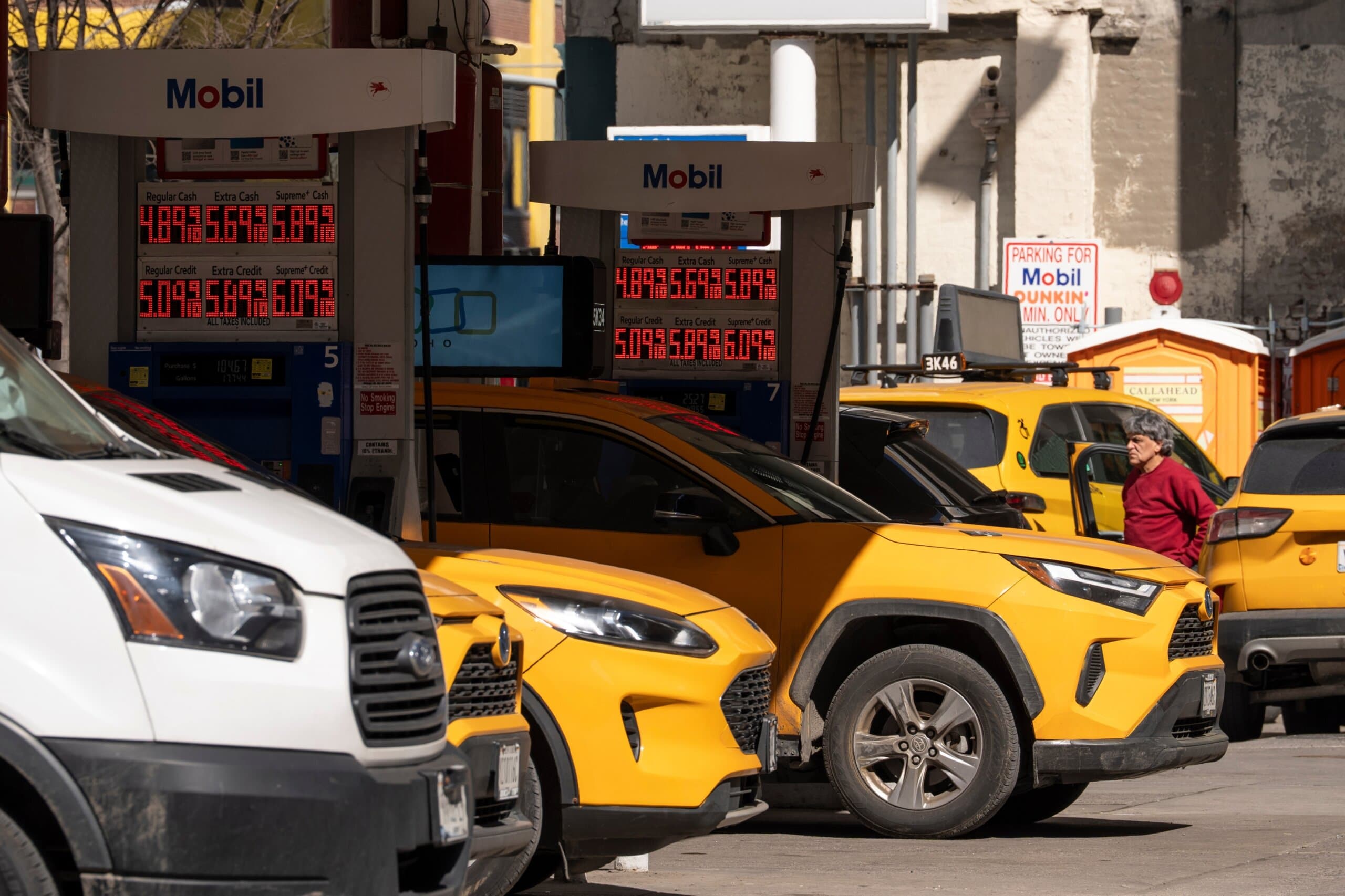
NBC News said “Wholesale gas prices also rose by 4% and heating oil futures, which are a proxy for jet fuel prices, spiked 5%,” while “Natural gas rose 1%,” and it linked the elevated oil price environment to inflation and pump prices by citing AAA’s figure that “The average price per gallon of unleaded gas was $4.04 per gallon Monday.”
BBC described the same volatility in market terms, saying “Oil markets continue to gyrate in response to oscillating social media posts by the US and Iran, rather than the realities on the ground which remain challenging for oil flows to resume in a rapid fashion,” quoting analyst Saul Kavonic from MST Marquee.
BBC also quoted Shanti Kelemen, co-chief investment officer at 7 Investment Management, saying there was “a bit of fatigue” and that “I think the market stopped believing the words, and will look more towards the actions,” reinforcing why the strait’s operational status mattered more than statements.
The Independent framed the same price action as a household-impact story, saying the uncertainty “is set to further impact households across the UK” and that “Consumers face immediate increases in petrol and diesel costs at the pumps.”
Devdiscourse, meanwhile, described a different angle on the same day’s trading, saying “Despite the geopolitical uncertainty, Asian markets were buoyant,” and it reported that “US stocks reached record highs due to optimistic economic sentiments,” including that the S&P 500 “soared to an all-time high.”
Negotiations, Threats, and Policy Stakes
The reporting also emphasized that the financial market reaction was tied to political bargaining and explicit threats, with multiple outlets quoting Trump’s language and describing the negotiation posture in Pakistan.
NBC News said Trump “told Bloomberg News it was "highly unlikely" he would extend the two-week ceasefire,” and it also reported that Trump said, “I’m not opening [the Strait of Hormuz] until a deal is signed.”

NBC News further described Trump’s direct threats, including his Truth Social statement that “Iran decided to fire bullets yesterday in the Strait of Hormuz — A Total Violation of our Ceasefire Agreement,” and it quoted another Trump line that the U.S. military had “blown a hole” in the engine room of an Iranian ship that “tried to get past our Naval Blockade.”
CNBC similarly said Trump threatened again to “blow up every power plant and bridge in Iran if its leaders do not accept a deal with the U.S.,” and it described the ceasefire agreement “will expire this week.”
BBC added that Trump said his representatives would be in Pakistan on Monday for negotiations and that Vice-President JD Vance would lead the U.S. delegation, while it reported that Iran’s state media said Tehran had “no plans for now to participate.”
The Independent connected the negotiation stakes to UK policy concerns, quoting Foreign Secretary Yvette Cooper on tolls and passage, including her statement that “there is no sustainable resolution to the closure of Hormuz that leaves the Iranian regime charging for access.”
Stranded Cargo and Inflation Risks
Several outlets quantified the potential scale of disruption and linked it to inflation and monetary policy concerns, underscoring why the market reaction was not just about day-to-day trading but also about longer-term risk pricing.
Crude Oil Prices Today said Brent “jumped over six per cent on Monday morning to over $96,” and it described how the weekend tensions left shipping “ground to a halt following a brief opening on Friday,” while also reporting that Tehran warned the closure would remain until the U.S. blockade is lifted.
It also cited a Truth Social post in which Trump wrote, “We’re offering a very fair and reasonable DEAL,” and it included his threat that “if they don’t, the United States is going to knock out every single Power Plant, and every single Bridge, in Iran,” while repeating his “NO MORE MR. NICE GUY!” language.
Crude Oil Prices Today added a specific stranded-volume estimate, saying “Over 600 million oil barrels stranded in the Strait,” and it quoted analyst Tamas Varga of TP ICAP Group that “over 600 million barrels of oil are now estimated to be stranded behind the strait.”
BBC, meanwhile, described how governments were responding to the energy crisis by ordering work-from-home, cutting the working week, declaring national holidays, and closing universities early, and it added that even China was making adjustments and limiting a fuel price hike as citizens faced with a “20% jump in price.”
Offshore Technology provided a shipping-data counterpoint, saying data from Kpler indicated “more than 20 vessels transporting oil, liquefied petroleum gas (LPG), metals and fertilisers transited the strait on Saturday,” and it called it “the busiest day for ship crossings through the passage since 1 March.”
More on Finance
Donald Trump Orders Halt To All Trade With NATO Ally Spain In Ankara
10 sources compared

easyJet Agrees in Principle to Castlelake’s £6.90-Per-Share Takeover Bid
14 sources compared

Spotify Removes 500,000 Streams From Malcolm Todd’s “Earrings” After Artificial Streaming Findings
20 sources compared

ESMA Warns Prediction Market Event Contracts May Be Banned From EU Retail Sales
12 sources compared