Technology and Science02 June, 20263 min read
OpenAI Updates Codex With Six Role-Specific Plugins for Office Work
This article is an automated aggregation of coverage from news outlets. Our editorials offer in-depth analysis curated by the NewsCord team.
OpenAI released six role-specific Codex plugins for office work, including data analysis. Enterprise features enable workspaces via Sites and Annotations to streamline business workflows.

Codex goes office-first
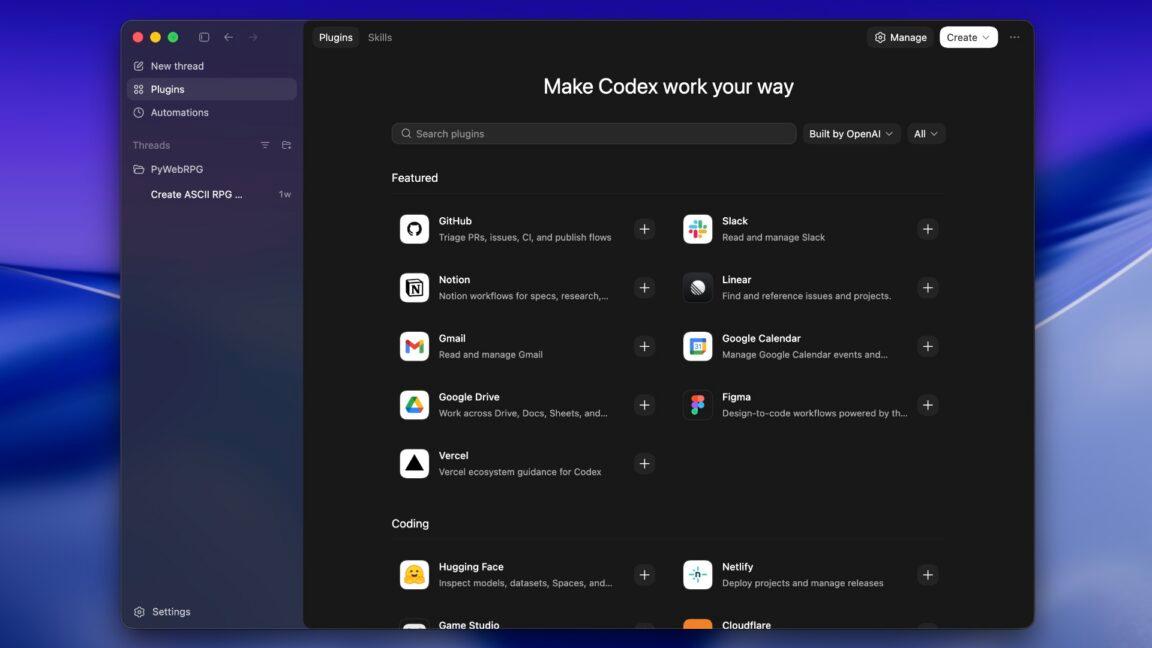
OpenAI updated Codex with six plugins designed for specific roles inside a company, aiming to move the tool beyond software development and into broader office work. The company said more than 5 million people use Codex each week, and that 20% of them are not developers, with analysts, designers, marketing teams and other professionals making up a fifth of active users. OpenAI’s update includes a data analytics plugin that lets users explore business metrics and create reports with tools like Snowflake, Databricks or Tableau, while a creative production plugin connects with Figma, Canva and Shutterstock to turn a briefing into review-ready materials.
For sales, OpenAI’s new plugin works with Salesforce, HubSpot and Slack, and two additional plugins target finance, including one focused on investment in public equities with access to Moody’s, FactSet and S&P. OpenAI also introduced Sites, a function that lets Codex generate interactive websites hosted in the cloud from work produced inside the platform, sharing them with any team member via a URL without exporting files.

Sites and annotations
Alongside the role-specific plugins, OpenAI added Sites and Annotations to Codex, with Sites meant to prevent outputs from ending as a local file that someone must open, interpret and distribute. OpenAI said Sites will be shared with any member of the team through a URL, and that the function is intended as a shared space where teams can review advances, add information and make decisions directly on the generated content. The update also includes Annotations, which let users point to a specific section of a document or file inside Codex to give more precise instructions, such as changing a font in a navigation bar or clarifying labels in graphics.
In a separate report on the rollout, OpenAI said Codex weekly active users have topped 5,000,000 and that knowledge workers account for about 20 percent of total users and are growing more than three times faster. OpenAI’s internal framing of the change emphasized that the new capabilities are designed to help businesses integrate AI into infrastructure and workflows, with Denise Dresser saying, "El desafío ahora es ayudar a las empresas a integrar estos sistemas en la infraestructura y los flujos de trabajo que impulsan sus negocios".
Enterprise rollout and partners
OpenAI said the plugins are available in all regions compatible with Codex, with installation handled through the plugins directory and Sites rolling out in a test phase for business and enterprise teams. The company also tied the Sites rollout to an ecosystem of partners, stating it has associated with Wix, Replit, Lovable, Figma and Base44 as partners for the function. A separate account of the same update described OpenAI collaborating with Wix, Base44, Replit, Lovable, Figma and Emergent for Sites, while also saying it plans to expand its partner ecosystem further.
The update’s enterprise push was framed as a response to competition, with one outlet noting that Anthropic had introduced its Enterprise Agents program in February and that OpenAI’s Codex support for enterprise complements arrived in March. OpenAI’s broader strategy was also described as moving Codex toward the ChatGPT app, with one report saying the company plans to put Codex into the ChatGPT app everywhere "in the next few weeks".