Gaza Genocide20 April, 20267 min read
Palestinian Prisoners Club Says Israel Holds 90 Female Detainees, Including Two Girls
This article is an automated aggregation of coverage from news outlets. Our editorials offer in-depth analysis curated by the NewsCord team.
Palestinian Prisoners Club says 90 female detainees are held. Detainees are women and minors, including teenagers.

Prisoners, numbers, and conditions
The Palestinian Prisoners Club said the number of Palestinian female detainees in Israeli prisons has reached 90 this month, describing them as being subjected to “starvation, mistreatment, and naked searches.” The Prisoners Club said “the majority of the detainees are held in Damon Prison (north),” and it added that among them are “two girls,” “a female prisoner in her third month of pregnancy,” “25 administrative detainees (without charges),” “3 female journalists,” and “two prisoners with cancer,” as well as “two prisoners detained since before the war in Gaza.” In a separate joint statement reported by Al-Jazeera Net, the Prisoners Club said that “there are more than 9,600 Palestinian prisoners in Israeli jails, including 86 women and about 350 children, as of early April.”
Al-Jazeera Net also reported that the Prisoners Club said “the female detainees face harsh detention conditions including starvation, deprivation, medical neglect, and mistreatment, along with isolation and abuses, including naked searches.” The same report said that “most arrests are carried out under the pretext of ‘incitement,’” and that “the number of women arrested since the start of the war has surpassed 700.”
It further stated that “this escalation comes during one of the bloodiest periods for Palestinian women,” while “ongoing grave violations” include “physical and sexual assaults and holding women hostage to pressure their families.” Al-Jazeera Net framed the broader war context by stating that on “October 8, 2023, Israel, with American support, began a genocidal war in the Gaza Strip,” leaving “more than 72,000 dead and more than 172,000 wounded,” “most of them children and women.”
Ceasefire releases and timelines
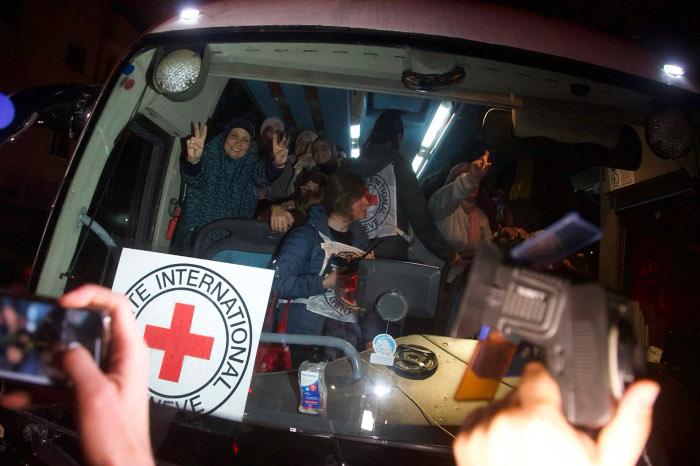
Israel’s release of Palestinian prisoners unfolded as part of a ceasefire and hostage-prisoner exchange described across multiple outlets, with the first phase centered on 90 Palestinian detainees. TV5MONDE reported that Israel released “90 Palestinian prisoners, mostly women and children,” “a few hours after three Israeli hostages were released by Hamas as part of the ceasefire,” and it placed the exchange on Monday, January 20, with times listed in Coordinated Universal Time. France 24 similarly said Israel released “90 Palestinian detainees” on Monday, “a few hours after three Israeli female hostages freed by Hamas returned to their homeland,” and it reported that “a senior Hamas official told AFP that the next prisoner exchange would take place in five days.”
Euronews said the detainees were “all women and minors” and that they were released “from the Ofer Military Prison in the occupied West Bank and from a detention center in Jerusalem shortly after midnight on Monday.” Euronews also reported that the ceasefire “came into effect Sunday morning at 11:15 a.m. local time,” nearly three hours late due to Hamas’s delay in publishing the names of hostages to be released that day.

L’Humanité described the release as occurring “in the night from Sunday, January 19 to Monday, January 20,” with the prisoners then “gathered in the city of Ramallah, north of Jerusalem.” RFI described the first phase of the hostage exchange as beginning on “Sunday, January 19,” when Hamas freed “three Israeli hostages,” after which “the Israeli state freed 90 Palestinian detainees: women and youths.”
Voices: ICRC, Hamas, and families
The exchange and its aftermath drew statements from humanitarian actors, Hamas, and released detainees, with each voice emphasizing different aspects of the process.
“I was in cell number 11. The warden called my name. I replied, 'I\'m here'.”
France 24 reported that the ICRC “facilitated their transfer” and welcomed the outcome of a “complex operation” to ensure their safety, quoting Mirjana Spoljaric Egger urging each party to “respect their commitments.”
France 24 also said the ICRC “urging each party to ‘respect their commitments.’”
In parallel, Anadolu Ajansı reported Hamas’s claim that “the health status of the released Palestinian prisoners reflected Israel's 'barbarity and fascism'.”
Anadolu Ajansı quoted Hamas saying, “Images of the three female prisoners showed they were in good physical and psychological health, unlike our prisoners whose appearance showed signs of neglect and exhaustion,” and it added Hamas’s assertion that “This starkly illustrates the large difference between the values and ethics of the resistance and the barbarity and fascism of the occupation.”
RFI provided a personal account from Bouchra al-Tawil, who said, “I was in cell number 11. The warden called my name. I replied, 'I\'m here'.”
RFI also captured her caution about the ceasefire, quoting her worry that “Until the last moment, one can fear that Israel will not respect the agreement and resume the war in Gaza.”
How outlets framed the same event
While the core fact of Israel releasing 90 Palestinian prisoners was shared, the outlets diverged in what they foregrounded—detention conditions, the exchange mechanics, and the political meaning of the moment.
TV5MONDE emphasized the sequencing of releases, saying Israel released “90 Palestinian prisoners, mostly women and children” “a few hours after three Israeli hostages were released by Hamas,” and it described the first day of the ceasefire as a period when “humanitarian aid flowed into the ruined Palestinian territory” with “630 trucks entering that day, according to the UN.”

France 24, by contrast, foregrounded the operational and diplomatic aspects, reporting that the ICRC welcomed the transfer as a “complex operation” and that “Our teams are ready to implement the agreements to ensure the release of more hostages and prisoners.”
Euronews focused on the legal and procedural framing of the released detainees, stating that “Most of them had been detained for several years for offenses related to national security” and that the ceasefire’s start was delayed “nearly three hours late due to Hamas's delay in publishing the names of the hostages.”
L’Humanité leaned into the human relief and political symbolism, describing “relief, joy, and anticipation” as the prisoners arrived in Ramallah and quoting Bouchra al-Tawil that “The wait was extremely difficult. But, thanks to God, we were sure that we would be released one day.”
Anadolu Ajansı highlighted Hamas’s critique of Israel’s detention practices, quoting Hamas’s claim that released prisoners showed “signs of neglect and exhaustion” and that this illustrated “the large difference between the values and ethics of the resistance and the barbarity and fascism of the occupation.”
Chronique de Palestine described the West Bank street scenes and the crowd’s impatience, including the moment when the process began at “4:00 p.m., local time,” and the later arrival of buses at “2 a.m.”
Stakes: next exchanges and risks
The stakes of the Gaza ceasefire and prisoner exchange were presented in the sources as both immediate humanitarian needs and the uncertainty of future compliance. France 24 said that “The next release of Israeli hostages is scheduled for Saturday,” and it reported that “a senior Hamas official told AFP that the next hostage release would take place on Saturday,” while also noting that the ICRC said its teams were ready “to implement the next steps of the agreement.” Euronews described a structured roadmap, saying “The second phase provides for a permanent halt to fighting, the release of the remaining hostages, and the complete withdrawal of the Israeli army from the Gaza Strip,” and it added that “Finally, a third phase envisions the reconstruction of the Palestinian enclave, completely destroyed after nearly a year and a half of bombardments.”
L’Humanité reported that the agreement aimed “ultimately, according to Doha, to lead to the 'definitive end' of the conflict,” and it stated that “Under its terms, 33 Israelis are to be released in an initial six-week phase,” with Israeli authorities announcing they would release “1,900 Palestinians in the same timeframe.” It also said the ceasefire agreement “specifies that 236 Palestinians sentenced to life imprisonment for having carried out or participated in attacks or bombings will, in turn, be exiled, mainly to Qatar or Turkey,” and it quoted Daniel Hagari saying “between three and four abducted women” would be “released each week.”
RFI captured the risk of breakdown through Bouchra al-Tawil’s warning that “Until the last moment, one can fear that Israel will not respect the agreement and resume the war in Gaza,” and L’Humanité added that “the fear of renewed attacks remains” as “Israeli Prime Minister Benjamin Netanyahu warned that Israel reserves the right to resume the war if needed.” In the background of these political stakes, tv5monde described the ceasefire’s first day as a time when “thousands of displaced Palestinians began their journey yesterday across the Gaza Strip,” and it quoted Hamas saying, “Gaza, with its great people and unshakable will, will rise again to rebuild.”