Praising Trump’s war, monarchist forces hijack Iranian diaspora
Key Takeaways
- Monarchist forces hijack Iranian diaspora, praising Trump's war.
- Iranian protests erupted over dire economic conditions worsened by U.S. sanctions.
- Sanctions-triggered inflation and currency devaluation fueled mass mobilizations nationwide.
Protests over economic crisis
Earlier this year, the Iranian people took to the streets to protest the country’s dire economic conditions.
“Earlier this year, the Iranian people took to the streets to protest the country’s dire economic conditions”
These hardships have intensified due to U.S. sanctions, which have contributed to a rapid surge in prices and the devaluation of the currency.
Soon, the protests grew into mass mobilizations against the severe economic difficulties millions of Iranians face, as well as against the country’s political system, which has long relied on brutal repression to silence those demanding change in hopes of building a more just society.
Various segments of society rose up—from merchants and workers to students—demanding economic justice, democratic rights and an end to state repression.
Economic backdrop & women’s mobilization
Background to the mass protests In previous years, Iranians had also mobilized for gender equality through the “Woman, Life, Freedom” movement, which led to some cultural changes within the country.
For instance, women in major cities such as Tehran, Mashhad, and Shiraz increasingly appear in public without headscarves.
This widespread grassroots movement also generated mass opposition to Iran’s morality police, making the compulsory hijab increasingly difficult to enforce in many areas.
The Iranian state scaled back efforts to enforce its “hijab and chastity” law in 2024 because it feared widespread social unrest, demonstrating the power of people’s movements to generate internal change within the country.
However, women are still seen as inferior to men by law, so there is a long way to go to advance women’s rights.
With that said, many believe that state repression and the violation of women’s rights are the primary reasons the Iranian people have resisted the government.
In reality, the Iranian working class also faces severe economic disparities and hardship due to capitalist exploitation by Iran’s ruling class.
Today, 41 million Iranians (nearly 45% of the population) are considered “economically inactive,” while over 20% are unemployed.
Notably, 40% of the unemployed are university graduates.
Additionally, 30-35% of the population (between 25 and 30 million people) lives in absolute poverty.
Hossein Raghfar, a state-affiliated economist, has stated that around 10% of Iran’s population currently suffers from malnutrition and hunger.
He warned that if current trends continue, “the poor population” could reach about 40% of the total population.
Furthermore, according to Iran’s Parliamentary Research Center, approximately 30% of Iranians live in absolute poverty, while 6%—around four million people—live in extreme poverty.
Raghfar also pointed out that, “on one side, poverty is growing, and on the other, a small but extremely wealthy class has emerged which is influential within the system and manipulates policymaking in its favor.”
Indeed, the richest 10% of the population holds more than 63% of the country’s wealth, while the richest 1% alone owns 29%.
Meanwhile, the bottom 50% of the population owns less than 4% of the wealth.
Inflation has drastically increased the cost of living while wages remain low, particularly affecting food and housing.
In 2022, The Tehran Times reported that rent had increased by 40.9% in Tehran.
Although the government later attempted to cap rent increases at 25%, Iran’s Statistical Center continued to report record-breaking increases, and the country’s rental crisis reportedly peaked in October 2025.
Over 65% of workers do not own their homes and are trapped in a rental market where even a small apartment can cost 10 million tomans per month, equivalent to the entire minimum wage.
In 2025, Iran’s Minister of Labor announced a minimum wage of 10,399,000 tomans, which is more than three times lower than the minimum cost of living.
Meanwhile, government figures acknowledge that 96% of Iranian workers are employed on temporary or short-term contracts, leaving them without job security, pensions, or protections.
Iran also ranks 102nd in the world for workplace safety, with an average of 40 workers dying on the job each week.
All the while, trade union activists and workers who have protested for better conditions have been attacked and jailed.
This underscores the urgency of demanding freedom for political prisoners as part of solidarity with the Iranian people’s struggles.
Monarchist co-optation & Shah legacy
Co-optation of the movement: Monarchist voices attempt a takeover However, these mobilizations were soon co-opted by pro-imperialist and pro-Zionist forces.
“Earlier this year, the Iranian people took to the streets to protest the country’s dire economic conditions”
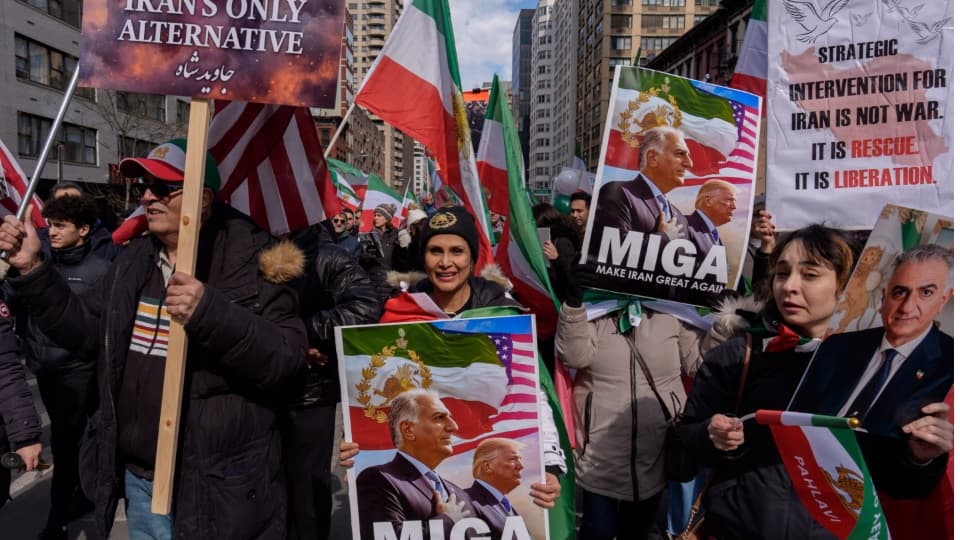
Outside Iran, the narrative began circulating that the Iranian people wanted to reinstall Reza Pahlavi as their “Shah,” and pro-monarchist voices within the Iranian diaspora quickly reframed the entire movement around Pahlavi.
Some even rejected widely used protest slogans such as “Woman, Life, Freedom” and “Free All Political Prisoners,” arguing that the only slogan that should be cried is “Long Live the Shah.”
Another slogan promoted by monarchist groups was “Make Iran Great Again,” a phrase clearly inspired by Donald Trump’s MAGA movement.
Monarchist forces portray Iran under the Pahlavi monarchy as an ideal society to which the country should return, rather than the repressive, undemocratic, and unequal society that it actually was.
The Pahlavi monarchy was installed by foreign powers in 1953 after the democratically elected Prime Minister Mohammad Mossadegh was overthrown in a U.S.-British orchestrated coup d’état.
This intervention was triggered by Mossadegh’s move to nationalize the British-owned Anglo-Iranian Oil Company (now BP).
As a result, Pahlavi was widely disliked because he was seen as a ruler who conceded to U.S. interests while heavily suppressing his own people.
With support from the United States, the Shah’s secret police, SAVAK, inflicted widespread political terror—surveilling, imprisoning, torturing, and executing political opponents, particularly members of leftist, communist, and working-class organizations.
At the same time, poverty and illiteracy were widespread.
A 1974 New York Times article noted that although oil revenues were flowing into the national treasury, 70% of the people are illiterate and 60% live at subsistence levels.
Despite widely circulated images of wealthier women wearing Western clothing and miniskirts, the female literacy rate under the Shah was only about 35.5%.
Many impoverished women in rural areas were deeply religious, and social inequality remained stark.
Child labor was common, trade union activity was banned, and the cost of living was high.
Although the Shah attempted to address some of these problems through his so-called White Revolution, the reforms failed to meet the needs of the population.
This failure led to mass mobilizations across Iranian society, religious and secular alike, which ultimately culminated in the 1979 Revolution.
After the revolution, there was a brief period during which various political organizations were able to mobilize openly and freely for the first time.
Economic reforms were also introduced to redistribute wealth, including the nationalization of key industries, the creation of welfare programs, and policies aimed at reducing poverty in rural communities.
These reforms contributed to rising literacy rates.
Today, around 90% of Iran’s adult population is literate, and women make up about 50% of university graduates, though many struggle to find jobs afterwards.
However, the Islamic Republic soon became violently repressive as well.
In 1988, the government carried out mass executions of political prisoners, including thousands of communists and leftists.
The country was further devastated by the eight-year war with Iraq, which resulted in around one million deaths and was prolonged by both countries’ controversial acceptance of weapons from the United States to support their war efforts.
By the 1990s, Iran was once again pushed into a severe economic crisis through privatization, the removal of energy subsidies, and the elimination of welfare programs.
Although Iran has been and continues to be a victim of imperialism, many Iranians have grown frustrated watching the Islamic Republic invest heavily in its military apparatus while neglecting the needs of its own people.
In the Iranian diaspora, the narrative that Iran was “great” under the Shah and that repression only began after the 1979 Revolution has convinced some that reinstating the monarchy is Iran’s only path forward.
Those who challenge this narrative are often silenced, shamed, or attacked.
Through these tactics, pro-monarchist forces outside Iran undermine the legitimate protests inside the country by reducing a broad mass movement to the ambitions of a single man who has lived outside Iran for more than 40 years and has little direct connection to the people currently struggling there.
Voices inside Iran have been largely ignored In January, Tehran’s Bus Workers’ Union issued a statement titled “Workers Must Lead the Fight for Liberation, Not Authoritarian Forms of Power or Foreign States.”
The union argues that true liberation cannot come from leaders imposed from above, foreign governments, or rival factions within the state.
Instead, it must come through solidarity, unity, and the creation of independent worker organizations.
At the same time, university students protesting inside Iran carried banners reading “Death to the oppressor, whether Shah or Supreme Leader” and “No monarchy, no supreme leadership—democracy and equality.”
Contrary to monarchist talking points, it is clear that the most decisive force remains the working class, not Reza Pahlavi.
Although labor’s participation in these protests was somewhat limited, it was nonetheless significant.
Strikes at the South Pars gas facilities, actions by maintenance workers in Zagros and Lorestan, and solidarity statements from teachers, truck drivers, and oil workers all demonstrate the crucial role that workers play in leading a people’s resistance movement in Iran.
If the Iranian working class organizes as an independent force, despite the challenges posed by the state’s repression of organized movements, a political general strike led by workers could potentially bring down the regime.
As the Tudeh Party of Iran said recently, “The political system ruling our homeland is irreformable. Solidarity among different social groups—from workers, laborers, and retirees to women, students, youth, and merchants—against the aggressive policies of this regime, and efforts to organize coordinated, nationwide protest movements, can lay the groundwork for seriously challenging the regime and opening the path toward fundamental and democratic transformations.”
The Islamic Republic responded to the protests with brutal repression, killing thousands of demonstrators.
Diaspora war propaganda & next steps
Manufacturing consent for war: Ideological warfare Rather than focusing on supporting the just struggles of the Iranian people, diaspora networks and outlets such as Iran International promoted narratives that began to manufacture consent for war.
Iranians were told that the only path to liberation would come through foreign intervention and, as a result, the Iranian diaspora’s response to the current war is very different from the one back in June 2025.
Today, thousands within the diaspora now openly celebrate figures like Trump and Netanyahu as they strike Iran—bombing schools and killing more than 150 schoolgirls, bombing civilian homes and destroying thousands of residences, bombing oil refineries and releasing toxic chemicals and acid rain over populated areas.
It is painful to see so many people believe that Western powers will somehow treat Iran differently than the other countries they have bombed and destabilized across the region.
History shows the opposite.
In Afghanistan, U.S. intervention ultimately strengthened the Taliban.
In fact, forces that would later form the Taliban were originally armed and funded by the CIA in the 1980s to combat socialist forces in the country that aligned themselves with the Soviet Union.
In Libya, U.S.-NATO intervention helped create conditions for the rise of ISIS-Libya, which has actively participated in the enslavement, trafficking, and sexual exploitation of migrants and refugees in the region.
In Syria, it contributed to the rise of extremist factions and eventually led to the presidency of Ahmed al-Sharaa, a man who was once closely affiliated with al-Qaeda.
And in Iraq, it resulted in half-a-million dead, economic devastation, sectarian conflict, and the emergence of ISIS.
Meanwhile, in Palestine, the United States continues to arm Israel while the International Criminal Court strongly condemns Israel’s genocide of the Palestinian people.
Today, Trump’s so-called “Board of Peace” seeks to reshape Gaza in its own image, constructing luxury hotels for the world’s wealthy while continuing the ethnic cleansing of Palestinians and displacing them from their homes.
All in all, these actions are just a few examples of U.S. imperialism in one region.
Across different regions and throughout history, a similar pattern of exploitation and oppression can be observed.
Imperialist wars do not liberate nations—they destroy them.
Even U.S. officials have openly suggested that regime change in Iran would benefit Western control over Iranian oil.
Similar arguments were made regarding Venezuela’s oil industry when Trump suggested that the kidnapping and removal of Nicolás Maduro would allow the United States to regain access to that country’s oil resources.
For this reason, Iran’s independent labor organizations have repeatedly rejected foreign intervention.
The Workers’ Union of Tehran and the Suburbs Bus Company stated clearly that they “strongly condemn any propaganda, justification, or support for military intervention by foreign governments, including the United States and Israel.”
Iranian teachers’ unions have issued similar statements, calling instead for international solidarity and diplomatic pressure against the Iranian government.
They warn that foreign military intervention would “destroy civil society, kill countless people, and provide the government with justification to intensify repression.”
Shortly after the attacks of Sept. 11, 2001, U.S. General Wesley Clark revealed that Washington had plans to target seven countries in the Middle East, one of which was Iran.
Under these constant threats and regional destabilization campaigns, Iran has dramatically expanded its military apparatus—in 2025, the Islamic Republic announced a 200% increase in its military budget.
Iran’s increasingly strong military apparatus is now also being used to heavily suppress resistance movements, and it is a military apparatus that the regime continuously justifies strengthening due to the constant and real threat of foreign invasion.
So, what happens next?
One thing is clear: A simple regime-change operation will very likely not happen.
Using arguments similar to those used to justify the 2003 invasion of Iraq, the United States and its proxy Israel went to war
More on Iran
Iranian missiles strike Dimona and Arad, injuring over 100.
47 sources compared
Israel and U.S. Strike Natanz Nuclear Facility Again; Iran Blames Attack
69 sources compared

Iran Attacks Diego Garcia with Long-Range Missiles, Targeting U.S.-UK Base
82 sources compared
Trump Defends Iran War by Citing Pearl Harbor
12 sources compared