Full story
Mecca pact signed
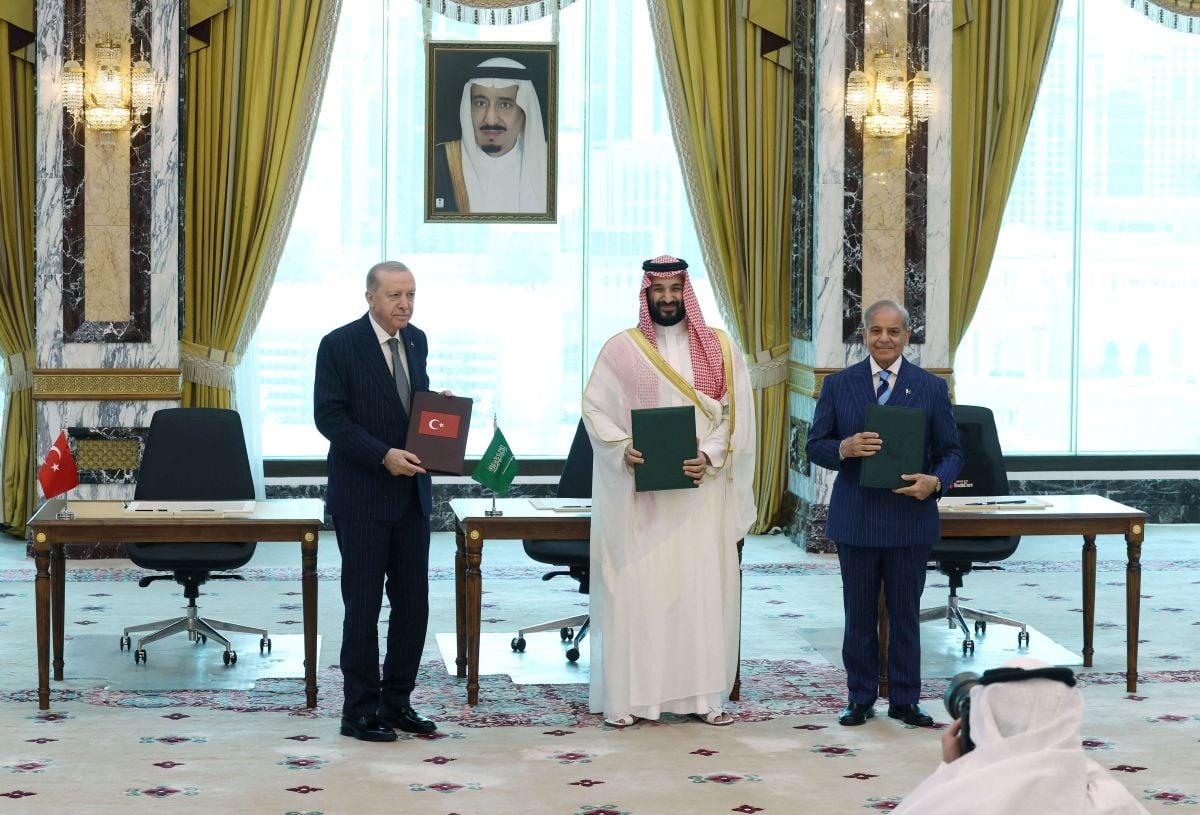
Saudi Arabia, Turkiye and Pakistan signed the “Mecca Joint Defence Agreement” in Mecca on Friday, pledging that an armed attack on any one of the three would be regarded as an attack on all three.
“stipulates that any armed attack against any one of the three states shall be regarded as an attack against them all”
The agreement is intended to strengthen collective deterrence, and a statement from the meeting says it “stipulates that any armed attack against any one of the three states shall be regarded as an attack against them all,” while also providing for “the enhancement of all aspects of defence cooperation among the three states.”

Reuters reported that the pact was signed as Iranian missile fire hit Gulf oil exporters and as Iran and its allies have been firing on Saudi Arabia and other Gulf states and blockading their energy shipments since the U.S. and Israel attacked it on February 28.
In Mecca, Turkish President Tayyip Erdogan and Pakistani Prime Minister Shehbaz Sharif joined Saudi Crown Prince Mohammed bin Salman for the signing, with Reuters describing the framework as intended to strengthen collective deterrence even as the statement did not give specifics on commitments.
Al Jazeera framed the pact as a response to shifting geopolitical calculations, quoting Kristian Coates Ulrichsen saying the decision to begin military operations against Iran and the subsequent conduct of the war “have only intensified those concerns and accelerated efforts to diversify security and defence relations.”
Debate over US role
Al Jazeera said analysts view the pact as pointing to “growing questions about the durability of US security guarantees,” with Kristian Coates Ulrichsen telling the outlet that doubts about the reliability of the US security partnership have intensified.
Sina Toossi, an analyst at the Center for International Policy, told Al Jazeera that the agreement is “one of the first major geopolitical signs that the regional order is being reshaped by the US-Israeli war on Iran,” adding that the significance is about how regional states are reassessing security.
Reuters quoted Abdulaziz Sager, chairman of the Gulf Research Center, saying the trilateral framework could strengthen the three countries’ collective diplomatic and defense weight while contributing to “the emergence of a more regionally driven security architecture.”
But Daily Sabah reported that Türkiye rejected claims the Mecca pact conflicts with NATO, citing the Presidential Communications Directorate’s statement that such assertions were “completely false,” and adding that “Türkiye's development of regional partnerships is not an alternative to its NATO membership.”
What comes next
Reuters said a key unanswered question is how the pact would function in practice, noting that the statement released by the three governments did not specify what military commitments members would be required to undertake if one were attacked.
“the statement released by the three governments did not specify what military commitments”
In the same Reuters account, Turkish Vice President Cevdet Yilmaz said the agreement was “not aimed at any specific country,” while a Turkish official added that it was purely defensive and did not abrogate any existing agreements the countries had with other states.
France 24 reported that Ankara later said the agreement was “not aimed at any particular country,” and that it was “not in contradiction with the commitments of Turkey's existing international alliances, including those at the heart of NATO,” according to a post on X by the government’s anti-disinformation service.
The Economic Times described the pact as intended to strengthen collective deterrence and to promote peace, security and stability in the region and beyond, while Reuters reported that Israeli Prime Minister Benjamin Netanyahu’s office declined to comment and Iran did not immediately comment.
For India, The Times of India said the development was “closely watched,” quoting MEA spokesperson Randhir Jaiswal saying: “The pact between the three countries is, again, a development that we are closely following, and we will keep you updated on that.”