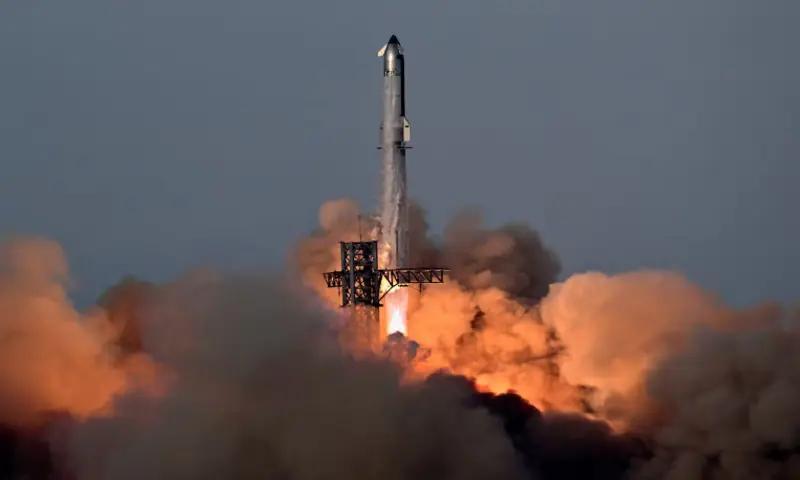
SpaceX Files for IPO With US SEC, Bets Starship and Starlink on AI Growth
Key Takeaways
- SpaceX files for IPO on Nasdaq under SPCX.
- Elon Musk remains the central figure in SpaceX's IPO.
- AI is the tentpole growth focus, with Starlink and Starship central assets.
IPO Ties Rockets to AI
SpaceX filed for an initial public offering with the US Securities and Exchange Commission on Wednesday, setting up a potential Nasdaq debut under the ticker symbol SPCX and betting that its rockets-to-AI vision can unlock funding and expansion.
“SpaceX took the wraps off its IPO filing on Wednesday, laying bare for investors just how much Elon Musk is losing on artificial intelligence while betting the company’s future on transforming the rocket maker into an AI powerhouse”
The Economic Times said SpaceX’s Starlink satellite business is expected to generate cash for its next-generation Starship rocket, with Starship then cutting launch costs to expand the market and ultimately support an AI business that it described as “a money guzzler.”
SpaceX’s S-1 filing also laid out how Starship is central to its growth strategy, warning that “Our ability to execute our growth strategy is highly dependent on Starship,” and noting that operational rockets Falcon 9 and Falcon Heavy were not capable of deploying its new satellites.
In the same disclosures, SpaceX reported $4.28 billion in losses in the three months ended March 31, an eightfold increase from a year earlier, and the Economic Times said those losses would force investors to rely less on traditional metrics and more on belief in execution.
The filing showed SpaceX’s accumulated deficit was $41.31 billion as of March 31, while Starlink generated $3.26 billion in revenue in the March quarter, up nearly a third year-on-year, even as SpaceX’s space revenue plunged 28.4% in the March quarter.
Musk Control, AI Losses
Multiple outlets framed the IPO filing as a window into how much Elon Musk is losing on artificial intelligence while keeping control tightly concentrated, with Devdiscourse saying the filing “cements Musk's tight control of SpaceX while giving shareholders little say over his decisions.”
Devdiscourse reported that in the first quarter only the connectivity segment powered by Starlink was profitable, with Starlink generating an operating profit of $1.19 billion, but it said the company booked a total operating loss of $1.94 billion on $4.69 billion in revenue.

Devdiscourse also said SpaceX’s AI division accounted for $2.47 billion in losses on $818 million in revenue, and it tied the spending surge to Musk’s purchase of xAI, saying it accounted for 76% of the company’s $10.1 billion in capital spending in the first quarter.
The Economic Times quoted Josh Gilbert, an analyst at eToro, saying, “The risk isn't whether SpaceX is a real business; it clearly is,” and it also quoted Rainmaker Securities cofounder Greg Martin on why traditional valuation methods may not fit.
Ars Technica added that SpaceX highlighted AI as the tentpole of its future, but said it must win customers who generally favor AI models from competitors such as OpenAI and Anthropic, while noting that SpaceX acquired Musk’s company xAI earlier this year and that the SpaceXAI division oversees the Grok AI models and the Grok chatbot.
Valuation Stakes and Next Steps
The IPO filing projected a massive market opportunity and tied it to future revenue streams, with New York Post saying SpaceX sees future revenue opportunities of $28.5 trillion, including $26.5 trillion from AI projects, $1.6 trillion from Starlink broadband, $740 billion in Starlink mobile and $370 billion from “space-enabled solutions.”
“- SpaceX publicly released its IPO paperwork”
TechCrunch reported that the filing includes “identified the largest actionable total addressable market in human history” of $28.5 trillion and said SpaceX attributes $22.7 trillion of that to “enterprise applications” of AI.
SpaceX’s next milestones were also embedded in the disclosures, with TechCrunch saying the company is expected to conduct the 12th launch of Starship as early as this week and that SpaceX expects Starship to begin payload delivery to orbit in the second half of 2026.
The Economic Times described the financial stakes behind those timelines, saying losses at the AI business ballooned to $2.47 billion and capital expenditures tripled to $7.72 billion, eclipsing the combined capex of the other two businesses.
In the same risk framing, SpaceX warned that “The complexity and interdependence of our engineering, manufacturing, assembly and terrestrial, space transportation, and infrastructure systems mean that a disruption in one component can have cascading effects throughout our operations,” underscoring what the filing says is at risk if execution falters.
More on Technology and Science
New Jersey Officials Attribute 19 Heat Wave Deaths, Power Outages Hit Nearly 1 Million
17 sources compared

Trump Delivers July Fourth Speech After Severe Weather Evacuates National Mall for America’s 250th
10 sources compared
Australian Space Agency Investigates Six Metallic Spheres Found on Forrest Beach, Queensland
16 sources compared

Midjourney Asks Federal Court To Compel Disney, Universal, Warner Bros. To Disclose AI Training
10 sources compared