Full story
Ceuta surge and deaths
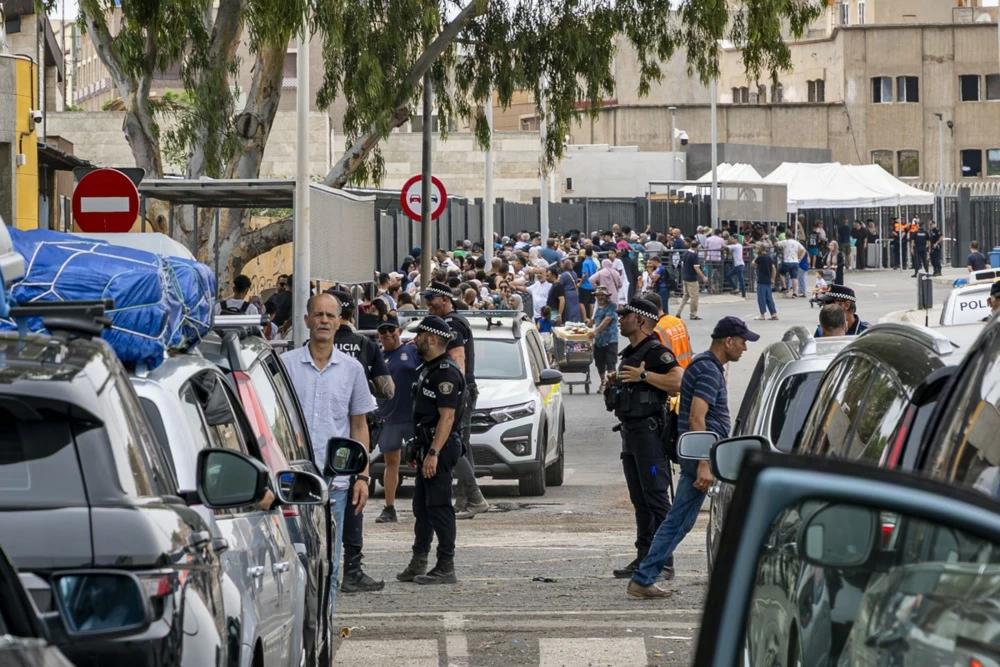
Spain condemned the "selfish, polarising and unlawful" reaction of some EU countries to an influx of about 60,000 migrants from Morocco into the Spanish enclave of Ceuta, as Spain’s interior minister said the death toll had risen to at least 67.
“the death toll from the surge in crossings had risen to at least 67”
Spanish authorities began installing a 500-metre floating barrier off the coast of Ceuta on Saturday, with the pneumatic barrier designed to stand 30 to 70 centimetres above water and extend up to one metre below the surface.

The crisis followed a surge in crossings that Italy temporarily suspended with Spain by closing its air and sea borders, after the entry of about 50,000 migrants into Ceuta since Thursday.
Spanish officials said almost all those who reached Ceuta on 30 July have returned, and Al Jazeera reported that "Virtually all those who entered Ceuta have now returned to Morocco".
In Ceuta, Spanish Interior Minister Fernando Grande-Marlaska said the situation had almost returned to normal, telling reporters "Almost all of [the migrants] have already left Ceuta" as businesses reopened.
EU fallout and rival claims
Pedro Sánchez called for an urgent meeting to "reaffirm that the security of our external borders is a shared responsibility of all Member States," while the BBC said 22 of the EU’s 27 countries also called for emergency talks in an open letter.
Italy’s Prime Minister Giorgia Meloni wrote on social media that such "uncontrolled immigration" was a threat to national security before suspending the Schengen zone agreement with Spain for a month, and Finland and Denmark backed Italy’s move.

Czech PM Andrej Babiš urged a temporary suspension of Spain's Schengen membership, while Danish Prime Minister Mette Frederiksen urged the EU to "consider all options, including a suspension of Schengen co-operation".
Spain responded by summoning the Italian ambassador to Madrid, and its foreign minister said he expected "European solidarity and not partisan demagoguery" as the dispute rippled through Madrid and other capitals.
The EU’s chief Ursula von der Leyen described the images from Ceuta as "unacceptable," and CNN said the causes of the surge remain disputed between Spanish officials blaming human trafficking networks and legal experts pointing to the narrow Supreme Court ruling.
Barriers, returns, and next steps
Spain said it would install buoys to “create a containment barrier, a physical barrier, if only a visual one,” and the Times of India described the floating barrier being laid on the Tarajal breakwater, one of the main entry points used by migrants attempting to reach Ceuta.
“create a containment barrier, a physical barrier, if only a visual one”
Spanish authorities said more than 48,000 had returned to Morocco within 48 hours, and the BBC reported that Spain had started to establish an inflatable maritime barrier to prevent further illegal migrant entry.
The Boston Globe reported that Ceuta’s President Juan Jesús Vivas said "The return of people has begun satisfactorily but the process must be completed," while the same report said security in the autonomous city of 84,000 remained bruised.
In legal terms, CNN said Spain’s Supreme Court ruling on June 29 stated that authorities cannot summarily deport migrants who arrive by sea without due process, and it quoted Gemma Pinyol-Jiménez saying "The idea is to facilitate the work of the police, but it doesn’t mean these people can stay in Ceuta."
As Spain moved to reinforce the border, the BBC said the government would launch an immediate investigation and Labour Minister Tahmina Akhter said "We will hold the owners fully accountable"—a parallel that underscored how quickly political and legal consequences followed the crisis.