Gaza Genocide21 April, 20269 min read
Spain, Ireland, and Slovenia Push to Suspend EU-Israel Deal as Germany and Italy Block
Spain, Slovenia and Ireland formally requested suspending the EU-Israel Association Agreement. Germany and Italy blocked the bid to suspend the pact.
The Jerusalem Post was read line by line by the Watchdog: 5.9. See the score →
EU debate over Israel pact
European foreign ministers met in Luxembourg on Tuesday to debate whether the European Union should suspend its Association Agreement with Israel, after Spain requested action and other countries pressed the issue despite Germany and Italy rejecting the idea. Spain, Ireland, and Slovenia arrived with a proposal to suspend the EU-Israel Association Agreement, but the meeting ended without support for either a total suspension or a partial one, with Kaja Kallas saying, “We did not see that today, but the discussions will continue.” El País reported that the High Representative for Foreign Policy acknowledged “there was no support in the room for a total suspension of the agreement,” and also “no support for a partial one, as proposed in September by the European Commission.”
“Kaja Kallas, the EU foreign policy chief, said proposals for a part suspension of the EU-Israel association agreement remained on the table but required states to shift their positions to come into force.”
The Guardian similarly described the bloc as split, quoting Kallas: “We didn’t see that today, but these discussions will continue.” Politico.eu reported that Spain, Ireland and Slovenia failed to win the unanimity needed to limit the country’s preferential access to the single market, and said Germany and Italy played a key role in blocking the proposal.

In parallel, the meeting also surfaced other policy items: Kallas told reporters the EU would add to wide-ranging restrictions on Iran by adopting new sanctions on Iranians involved in limiting free navigation through the strait of Hormuz, with an aim to adopt them in May. The dispute over Israel’s agreement is tied to the pact’s legal structure, because the association agreement requires unanimity to be revoked, while a partial suspension requires a weighted majority of 15 member states representing 65% of the EU population, according to The Guardian and Politico.eu.
How Gaza reshaped pressure
The push for EU action was framed by the Gaza war and by Israel’s conduct in other areas, with multiple outlets linking the debate to the aftermath of Hamas’s attack on October 7, 2023 and Israel’s subsequent military offensive. El País wrote that Spain, Ireland, and Slovenia revived their proposal after Israel continued “to violate international law inside and outside its borders,” and it recalled that the issue had been raised before, including in 2024 “months after the brutal Israeli military offensive against Gaza began following Hamas's no less violent attack on October 7, 2023.” The same article said the earlier proposal “did not even advance: the President of the European Commission, Ursula von der Leyen, kept it in a drawer,” and it described a later effort by Josep Borrell to suspend political dialogue that was “blocked by Germany and other EU partners.”
El País also described a September shift when Brussels proposed a partial suspension, noting that “freezing the commercial part only needs a qualified majority,” but it added that “Even so, it did not pass.” The Guardian tied the current pressure to “the plight of Gaza and violence against Palestinians by Israeli settlers in the West Bank,” and it reported that Ireland, Spain and Slovenia wrote to Kallas last week describing “unbearable” conditions in Gaza with “continuous violations of the ceasefire and insufficient entry of humanitarian aid.” Politico.eu added that the association agreement has underpinned political cooperation and trade relations since 2000 and that it includes a human rights clause, “Article 2,” making respect for democratic principles essential.

Al Jazeera’s explainer on the same debate said the agreement came into effect in 2000 and that its human rights clause, “based on respect for human rights and democratic principles,” is central to the argument over whether violations could justify suspending the agreement. Euronews reported that Spain’s call to suspend the agreement lacked support ahead of Tuesday’s meeting and said the total suspension requires a “unified position” among countries, while a partial suspension had been proposed by the European Commission last September.
Voices at the Luxembourg meeting
The Luxembourg meeting featured sharply contrasting statements from ministers, with Spain and Ireland pushing for a stronger EU response while Germany and Italy argued for a different approach.
“While Israel continues in that path of a permanent perpetual war, we will not be able to [run our relations] in the same way.”
José Manuel Albares, Spain’s foreign minister, said on Tuesday, “While Israel continues in that path of a permanent perpetual war, we will not be able to [run our relations] in the same way,” and he also told reporters, “I expect every European country to uphold what the International Court of Justice and the UN say on human rights and the defence of international law,” adding, “Anything different would be a defeat for the European Union.”
Ireland’s Helen McEntee called Israel’s conduct “completely unacceptable” and argued the EU needed to be “decisive” and show it was “upholding fundamental values,” while Politico.eu quoted Albares arriving at the meeting saying, “Today Europe is playing for its credibility,” and “We have to tell Israel clearly that it has to change course.”
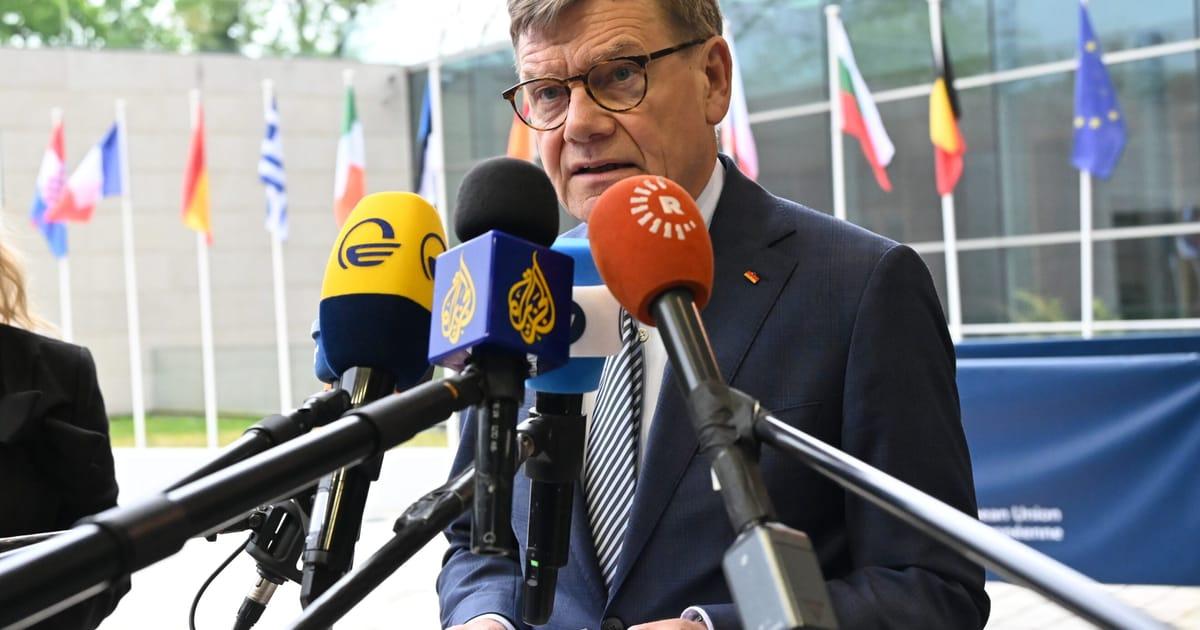
On the opposing side, Germany’s Johann Wadephul said the suspension was “inappropriate,” and he argued, “We have to talk with Israel about the critical issues. That has to be done in a critical, constructive dialogue with Israel.”
Italy’s Antonio Tajani said before the meeting, “There are neither the numerical nor the political conditions,” and Politico.eu reported that he underscored Rome’s alignment with Berlin, while also saying, “I believe it is better to sanction individually those responsible, I am thinking of violent settlers,” and expressing skepticism about broader trade measures.
Belgium’s Maxime Prévot argued that “We must be able to act in order to weigh on the debate,” and he said the bloc was calling for at least a partial suspension while noting that “a full suspension is probably out of reach given the positions of the various European countries.”
Kathleen Van Brempt, a Belgian vice-chair of the European parliament, said the EU was eroding its credibility as a human rights defender, arguing, “The failure by both the European Commission and the EU member states to act appropriately according to international law, human rights and its own values and beliefs is making Europe complicit in the war crimes and crimes against humanity perpetrated by Israel.”
Kaja Kallas, meanwhile, rejected criticism of double standards and said, “A suspension of the association agreement, will it stop the expansion [by Israeli settlers] on the West Bank? You know this is probably also not true,” while also emphasizing that any change would require unanimous support of all 27 member countries.
Where outlets diverge
While all the outlets describe the same Luxembourg meeting and the same core dispute, they diverge in emphasis—particularly on whether the debate is about a full suspension, a partial suspension, or the broader question of sanctions and leverage. El País framed the meeting as a test of whether Europe could “take a step further in future meetings,” describing that “this was not about making a decision this Tuesday, but about testing the waters,” and it stressed that Kallas said there was “no support in the room for a total suspension” and also “no support for a partial one.” The Guardian, by contrast, focused on the procedural reality that “proposals for a part suspension of the EU-Israel association agreement remained on the table” but required states to shift positions, and it highlighted Kallas’s skepticism about whether suspension would stop settlement expansion.
Politico.eu emphasized the unanimity hurdle and the role of Germany and Italy, saying Spain, Slovenia and Ireland “failed to win the unanimity needed to limit the country’s preferential access to the single market,” and it quoted Tajani saying, “There are neither the numerical nor the political conditions.” Euronews similarly reported that Spain’s call “lacks support ahead of ministerial meeting,” and it framed the situation as a lack of “broad consensus among the member states,” while adding that Italy’s official position was to adopt a “serious and balanced approach” to avoid “negative consequences for the Israeli civilian population.” The Times of Israel presented the same rejection from Germany and Italy but added a different lens by describing the context of “rising anger over the country’s conduct in Lebanon, Gaza and the West Bank,” and it reported that “no decision will be taken today” with Italy’s Tajani saying so.

Al Jazeera’s explainer treated the question as a wider political debate, describing the EU as divided and noting that Germany, Hungary and the Czech Republic were “reluctant to take any drastic steps,” making “any move towards full suspension of the agreement is unlikely in the near future.” Mehr News Agency, meanwhile, framed the request as formal agenda-setting, quoting Albares: “Spain, along with Slovenia and Ireland, has requested that the suspension of the Association Agreement between the European Union and Israel be discussed and debated today,” and it described the three governments’ letter as citing breaches of the 1995 agreement and “unbearable” Gaza conditions.
Economic and political stakes ahead
The reporting repeatedly ties the EU-Israel Association Agreement to both political leverage and economic exposure, and it lays out what could happen next if ministers revisit the issue. The Guardian and Politico.eu describe the legal mechanics: a full suspension requires unanimity among the EU’s 27 member states, while a partial suspension requires a weighted majority of 15 member states representing 65% of the EU population, meaning either Germany or Italy would have to change position. Euronews added that the Commission’s partial suspension proposal last September stalled because member states were deeply divided and because countries including Germany, Hungary, and the Czech Republic opposed the move, preventing a qualified majority.
“The association agreement needs unanimous approval by the EU’s 27 member states to be revoked, but a partial suspension requires only a weighted majority of 15 member states representing 65% of the EU population.”
The Guardian and Politico.eu also describe the human rights clause “Article 2” as the legal lever, and Politico.eu notes that Spain has been pulling on that clause for more than two years. In the background, the Guardian reported that Amnesty International accused the EU of “a moral failure” and said the NGO was among 70 groups that called for a suspension of the EU-Israel agreement last week, while it also reported that more than 1 million people and nearly 400 senior EU diplomats and officials demanded the same. Al Jazeera reported that on April 15, The Justice for Palestine European Citizens’ Initiative gathered one million signatures and said the European Commission is “required to react, and decide what, if any, action it will take in response to the initiative.”
The Times of Israel provided additional financial stakes, reporting that trade between Israel and the EU reached €42.6 billion in 2024, including €15.9 billion in Israeli imports, and that the EU accounted for nearly a third of Israel’s total international trade in goods last year. It also said that if the agreement is suspended, the EU’s €6 million in financial support to Israel and €14 million in annual support for projects supporting Israel in the context of the Abraham Accords would be put on pause. Euronews added that the EU has committed in the New York Declaration to “adopting restrictive measures against violent extremist settlers and entities and individuals supporting illegal settlements,” and it said that so far the EU has sanctioned nine individuals and five entities linked to violent extremism in the West Bank and East Jerusalem under the EU Global Human Rights Sanctions Regime.
Even where suspension is blocked, the reporting shows alternative pathways: The Guardian said France and Sweden urged the European Commission to “urgently consider” tariffs on products from illegal settlements and restrictions on exports, and Kallas said she would raise that with the trade commissioner. With Kallas telling reporters, “We did not see that today, but these discussions will continue,” the next step is framed as continued debate and possible targeted measures rather than immediate agreement on suspension.