Sudan24 May, 20263 min read
Study Says Sudan’s Rapid Support Forces Reshape Economy Through Gold Smuggling and Checkpoint Levies
This article is an automated aggregation of coverage from news outlets. Our editorials offer in-depth analysis curated by the NewsCord team.
RSF establishes parallel financial infrastructure, including a Future Bank and digital transfer app. Khartoum’s banking system is collapsing due to war, cutting access to services.

War economy and gold
A study by Dr. Abdelmoneim Mukhtar, Professor of Public Health and Executive Director of the Center for Evidence-Based Policy and Data, describes the Rapid Support Forces (RSF) in Sudan as a “complex model of transformation” into “hybrid economic-military entities” reshaping the state and economy in a war ongoing since April 2023.
The analysis links that transformation to a shift in Sudan’s resource base after the state “lose about 75% of its oil revenues,” pushing the economic center of gravity toward mineral resources led by gold.

Mukhtar’s report says gold production in Sudan ranged from 80 to 100 tons annually during 2018–2022, with smuggling estimated to exceed 60% of actual production through networks reaching borders of Chad, Libya, and Egypt and re-export markets in the United Arab Emirates and Turkey.
The study also describes informal levies at checkpoint posts that impose tolls on commercial trucks ranging from 5% to 20% of the value of goods, varying by commodity type and geography.
It further argues that violence became “a direct production mechanism for economic value rather than simply a tool of political conflict,” tying armed control of resources and crossing points to the war economy.
Banks stall in Khartoum
After a month of war in Khartoum, the banking system is described as nearly at a standstill in Sudan, with safes pillaged, customers left without service, and servers down. In Madani, 200 km south of the capital, AFP quoted Ibrahim Said saying, "I have been here since 7 a.m. hoping to withdraw the money I have on my account," as he waited in front of a Bank of Khartoum branch. The fighting is described as pounded since April 15 by the army's aviation led by General Abdel Fattah al-Burhan and the artillery of the paramilitaries of his rival General Mohamed Hamdan Daglo.
AFP also quoted Mohammed Abdelaziz, a banking sector expert, saying, "The servers that control bank operations are located at their headquarters in Khartoum," and that with the fighting no employee can reach them. The article says interbank trading is suspended until further notice, and that cash transfers have been halted because of deadly fighting, leaving people to buy flour—twice as expensive as before the war—or gasoline—twenty times more expensive.
Monetary fragmentation and risks
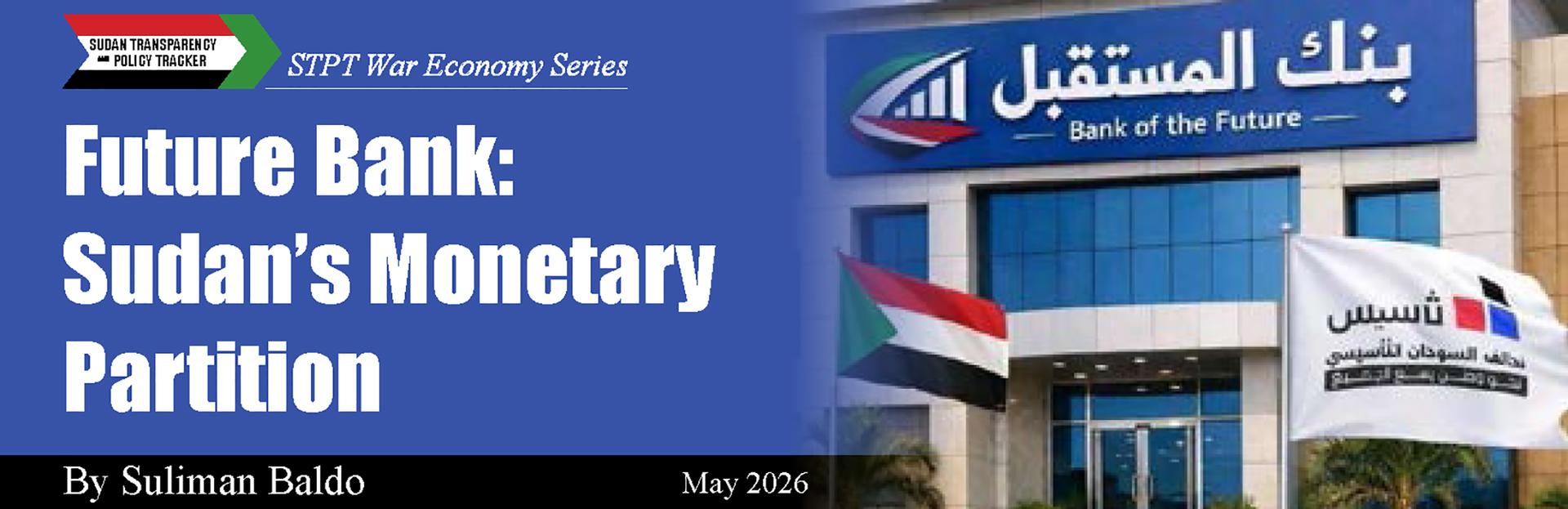
A report by Suliman Baldo for the Sudan Transparency and Policy Tracker (STPT), as carried by Dabanga Radio TV Online, says Sudan’s civil war is partitioning the country’s monetary system through the emergence of an RSF-aligned El Mustaqbal ‘Future’ Bank and its affiliated digital transfer application. The report frames this as an attempt by the Sudan Founding Alliance ‘Tasees’ government to establish parallel financial authority, describing how dwindling access to banknotes and the erosion of central banking authority have accelerated economic fragmentation. Baldo warns that “One cannot ignore the severe humanitarian and economic consequences of the non-availability of newly issued high denomination bills to the region,” linking it to “the closure or dysfunction of banks in RSF areas such as Darfur.”
The same report says the Central Bank of Sudan introduced new designs of the SDG 1,000 and 500 notes in November 2024 and limited their exchange to bank account holders, effectively excluding RSF-controlled areas from access to the new banknotes. It adds that the RSF responded by declaring the older banknotes legal tender in RSF territories, while residents continued to rely on national bank transfer applications such as ‘Bankak’—with the report describing funds disappearing or being frozen and cash transfers’ discount rate rising to 30 per cent.