Technology and Science24 August, 20263 min read
Tiangong Ultra Lowers 100-Meter Record to 8.86 Seconds at Beijing World Humanoid Robot Games
This article is an automated aggregation of coverage from news outlets. Our editorials offer in-depth analysis curated by the NewsCord team.
Tiangong Ultra ran 100m in 8.86 seconds at Beijing World Humanoid Robot Games. The time surpassed Usain Bolt’s 9.58s human world record by over seven-tenths.

11 outlets told this the same way.
Sub-9 Seconds in Beijing
A Chinese humanoid robot, Tiangong Ultra, ran 100 metres in 8.86 seconds at the World Humanoid Robot Games in Beijing on Tuesday, lowering the 9.39-second mark it set at the event’s opening. Reuters said the time was more than seven-tenths of a second faster than the 9.58-second men’s human world record set by Jamaican sprinter Usain Bolt in 2009. The race took place as the second edition of the Beijing event continued, where Reuters reported more than 2,000 robots from 666 teams were competing in 51 events including football, dancing and industrial-task contests.
AP described the same Beijing Games as an Olympic-style competition now in its second year, with the robot sprinting in 8.86 seconds and beating its robot competitors and the fastest recorded human time. AP added that the record-breaking robot fell after hitting the finish line, a padded barrier, with sparks flying from its waist, while Dennis Hong said the challenge is making a bipedal robot run at this speed.
Robots, Rules, and Rivalry
The World Humanoid Robot Games are being staged at Beijing’s National Speed Skating Oval, and CBN News said the five-day event is an Olympics-like spectacle with 51 events and more than 1,000 competitions taking place including running, table tennis and soccer.
CBN News reported that the U.S. Federal Communications Commission announced a ban on imports of new foreign-made humanoid robots, citing national security reasons and targeting China.
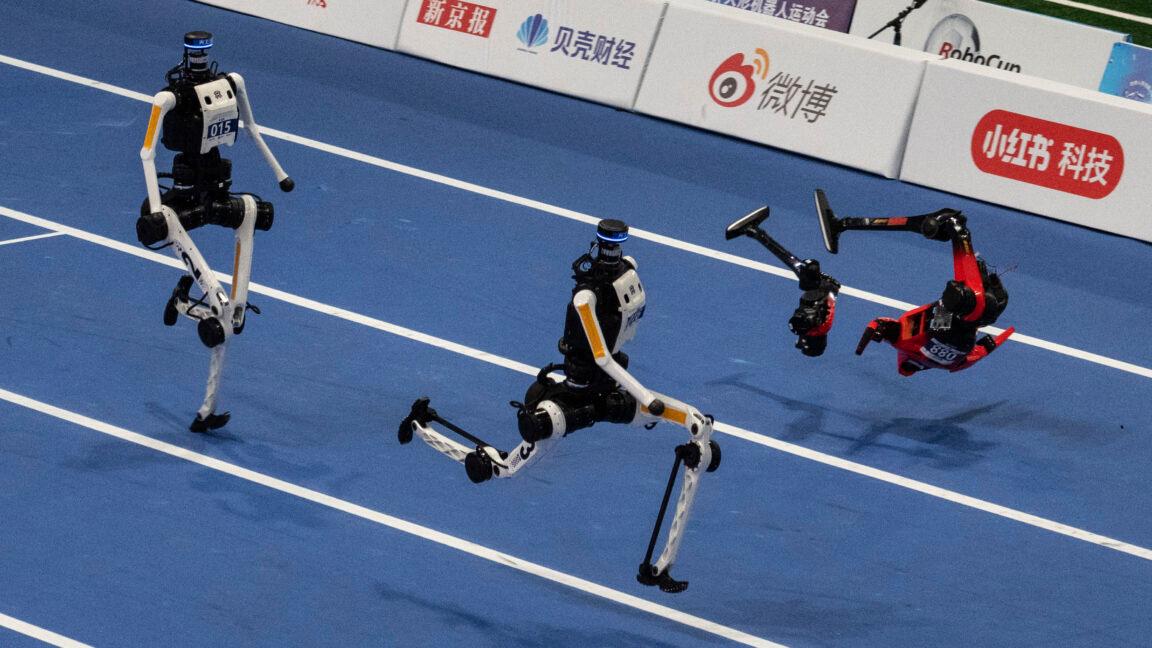
In parallel, Reuters reported that Tiangong Ultra’s sub-nine-second sprint came in the semifinal of the large-size robot division, and that Tiangong completed its sprint by striking a thick mat placed beyond the finish line to stop the sprinting machines.
AP quoted Dennis Hong, a professor of mechanical and aerospace engineering at the University of California, Los Angeles, saying, "As speed increases, balance, control, impacts, actuator performance, and mechanical robustness all become much more challenging," as the robot’s fall raised questions about safe movement and stopping.
AP also cited People’s Daily saying “‘Housekeeper’ and ‘caregiver’ robots are still in the pilot and validation phase,” while describing the focus of development as China’s robotics industry evolving toward higher quality and innovation.
From Records to Real Use
Beyond sprint times, Reuters said the Beijing Humanoid Robot Innovation Center said its Tiangong robots had already beaten four human world records, including a 400m time of 38.15 seconds and a 2.88-metre-high jump. AP framed the Games as a showcase for China’s rapid advances in robotics amid an intensifying technology rivalry with the U.S., and it described robot competitions in teams in real-world scenarios including household tasks, hotel services and emergency response. LaSexta said the competition is divided between sports events and challenges that try to reproduce real-life situations, including tests where robots must extinguish fires, fold clothes, work in factories, help in hotels, or perform tasks related to commerce and hospitality.
LaSexta also described a fire-extinguishing test in which 23 teams had to identify dangerous materials, close valves, and put out a fire in a maximum of 30 minutes, with only three teams completing all tasks within the allotted time. Ars Technica said viral videos of the World Humanoid Robot Games showed sprinting robots beating the human 100-meter record held by Usain Bolt, while other robots crashed into barriers, fell down, and even caught on fire, underscoring the gap between speed and reliable operation.