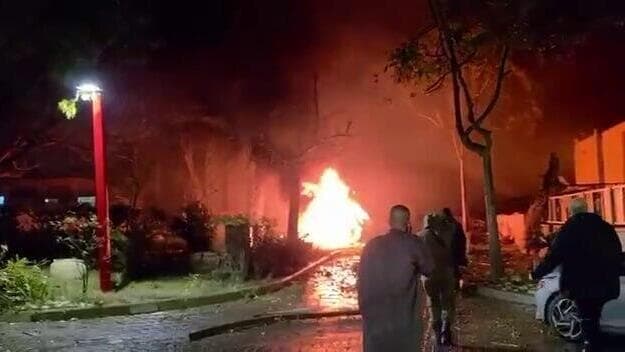
US and Israel Strike Iran's Natanz Enrichment Site; No Radioactive Leaks Reported.
Key Takeaways
- Natanz enrichment complex hit by US-Israeli strike; no radioactive leakage detected.
- Iran retaliatory missiles hit Dimona; dozens injured in southern Israel.
- IAEA monitoring Natanz; calls for restraint amid strikes.
Natanz Facility Strike
The United States and Israel jointly carried out an airstrike on Iran's Natanz uranium enrichment facility on Saturday, March 21, 2026, marking another escalation in the ongoing military conflict that began on February 28.
“Central Command, Adm”
Iranian authorities reported that the Shahid Ahmadi-Roshan Natanz Nuclear Facility, considered critical to Iran's uranium enrichment program, was struck in what Tehran described as a criminal attack by the US and Israel.

The facility, located approximately 135 miles southeast of Tehran in central Iran, has been repeatedly targeted throughout the conflict, including during the 12-day war between Iran and Israel in June 2025 and in earlier operations.
Despite the attack, Iranian officials emphasized that technical assessments conducted by the country's Nuclear Safety System Center found no radioactive material leakage and confirmed no danger to residents living near the facility.
Responsibility & Investigation
Israel distanced itself from direct responsibility for the Natanz strike, with the Israeli military stating that its warplanes had not conducted any strikes in the area and declining to comment on US activities.
However, Israeli state broadcaster KAN reported that the airstrikes were carried out by US warplanes using bunker-buster bombs, citing sources with knowledge of the matter.

The International Atomic Energy Agency confirmed that Iran had informed it about the attack and that no increase in off-site radiation levels had been reported, though the UN watchdog stated it was investigating the incident.
This attack follows previous strikes on the facility during the ongoing conflict, with satellite imagery showing damage to multiple buildings in earlier bombardment.
Iranian Retaliation
The attack on Natanz triggered immediate retaliation from Iran, which launched missile strikes targeting Israeli nuclear facilities in Dimona and Arad.
“The United States and Israel have struck Iran’s Natanz nuclear facility, according to its atomic energy organisation”
Iranian state television framed these strikes as a direct response to the Natanz attack, marking a new phase of tit-for-tat targeting in the conflict.
The Iranian missile attacks caused significant damage and injuries in southern Israel, with at least 70 people reported wounded, including a 10-year-old boy in serious condition.
Israeli Prime Minister Benjamin Netanyahu described it as 'a very difficult evening' but vowed that Israel would 'continue to strike our enemies on all fronts.'
The strikes represented a dangerous escalation as Iran specifically targeted facilities near Israel's main nuclear research center in what analysts described as establishing a 'nuclear deterrence equation' between the two adversaries.
International Reaction
The international community reacted strongly to the escalation, with Russia's Foreign Ministry condemning the Natanz attack as a 'blatant violation of international law' that posed a 'real risk of catastrophic disaster throughout the Middle East.'
UN nuclear watchdog Director General Rafael Grossi reiterated calls for 'military restraint to avoid any risk of a nuclear accident,' warning that the situation was 'very concerning.'

Meanwhile, President Donald Trump issued an ultimatum to Iran, giving it 48 hours to fully reopen the Strait of Hormuz or face the destruction of Iranian power plants, starting with the largest facility.
The Trump administration also sent mixed signals, with Trump announcing he was considering 'winding down' military operations while simultaneously deploying additional 2,500 Marines to the Middle East and requesting $200 billion in additional funding for the war effort.
Global Impact
The conflict continues to have severe global economic consequences, with Iran's effective closure of the Strait of Hormuz—a waterway responsible for approximately 20% of global oil trade—sending crude prices soaring over 50% in the past month.
North Sea Brent crude now trades comfortably above $105 per barrel, with analysts warning prices will likely continue rising while the strait remains closed.

The economic impact extends beyond energy markets, affecting food prices worldwide as transportation costs increase.
Meanwhile, the human toll continues to mount, with Iran reporting over 1,500 deaths since the conflict began, while Israeli strikes have killed more than 1,000 people in Lebanon and displaced over one million.
The war has entered its fourth week with no clear endgame in sight, even as international pressure mounts to secure shipping routes through the strategically vital waterway.
More on Iran

Trump Threatens to Obliterate Iran's Power Plants Over Strait of Hormuz
44 sources compared

Iran strikes Dimona and Arad near Israel's main nuclear facility
43 sources compared

Trump threatens to obliterate Iran's power plants over a 48-hour Hormuz ultimatum
13 sources compared

Iran Fires Ballistic Missiles at Diego Garcia Base, Fails to Hit Target
132 sources compared